Kirjojen hintavertailu – 12 903 725 kirjaa ja 27 kauppaa

Kirjailija

Thomas Grisso

Kirjat ja teokset yhdessä paikassa: 11 kirjaa, julkaisuja vuosilta 1998–2020, suosituimpiin kuuluu Juveniles’ Waiver of Rights. Vertaile teosten hintoja ja tarkista saatavuus suomalaisista kirjakaupoista.

11 kirjaa

Kirjojen julkaisuvuodet: 1998–2020.

Evaluations for Sentencing of Juveniles in Criminal Court

Evaluations for Sentencing of Juveniles in Criminal Court

Antoinette Kavanaugh; Thomas Grisso

Oxford University Press Inc
2020
nidottu
Forensic mental health assessment (FMHA) has grown into a specialization informed by research and professional guidelines. This series presents up-to-date information on the most important and frequently conducted forms of FMHA. The 21 topical volumes address best approaches to practice for particular types of evaluation in the criminal, civil and juvenile/family areas. Each volume contains a thorough discussion of the relevant legal and psychological concepts, followed by a step-by-step description of the assessment process from preparing for the evaluation to writing the report and testifying in court. Volumes include the following helpful features: - Boxes that zero in on important information for use in evaluations - Tips for best practice and cautions against common pitfalls - Highlighting of relevant case law and statutes - Separate list of assessment tools for easy reference - Helpful glossary of key terms for the particular topic In making recommendations for best practice, authors consider empirical support, legal relevance, and consistency with ethical and professional standards. These volumes offer invaluable guidance for anyone involved in conducting or using forensic evaluations.
Juveniles’ Waiver of Rights

Juveniles’ Waiver of Rights

Thomas Grisso

Springer-Verlag New York Inc.
2012
nidottu
The research studies reported in this book were completed between June, 1976 and November, 1979, with a USPHS research grant (MH- 27849) from the Center for Studies of Crime and Delinquency, National Institute of Mental Health. Every phase of the project was an exercise in combining the research methods of psychology with the concerns of law, legal systems, and legal process. Research psychologists will be especially interested in our efforts to apply psychological constructs and research methods to a difficult decision-making problem in law. This report describes in some detail the project's development of experimental measures of psychological condi­ tions related to legal standards and demonstrates the ways in which research design was influenced by concerns of law and the juvenile justice system. Lawyers, judges, and youth advocate groups have already ex­ pressed considerable interest in the implications of the project's results for the formation and modification of juvenile law and procedure. In each chapter, I have attempted to describe carefully the ways in which the empirical research results are applicable to these concerns, and I have tried to specify the limits which must be acknowledged in inter­ preting the results for application in the legal process.
Specialty Competencies in Forensic Psychology

Specialty Competencies in Forensic Psychology

Ira K. Packer; Thomas Grisso

Oxford University Press Inc
2011
nidottu
Although Forensic Psychology was formally recognized as a specialty by the American Board of Professional Psychology in 1985 and by the American Psychological Association's Commission for the Recognition of Specialties and Proficiencies in Professional Psychology in 2001, its origins can be traced back to early applications of psychology to law during the time psychology was being differentiated from the more general field of philosophy. As it is currently applied, the specialty took organizational shape from the 1960's to the 1990's, and today forensic psychology is one of the most popular areas of specialization among emerging psychologists. The demand for forensic training, continuing education, and research is growing in many graduate level professional programs and at events sponsored by the American Psychology-Law Division (41) of APA or the American Academy of Forensic Psychology. Therefore, the need for a comprehensive text focused on the competencies required in the specialty has never been greater. With Specialty Competencies in Forensic Psychology, Drs. Packer and Grisso provide a guide to understanding legal systems, evaluations, and consultations encountered in day-to-day forensic practice that is simultaneously sophisticated, scholarly, and user-friendly. This is a must-read for all those interested in pursuing the forensic specialty practice. Series in Specialty Competencies in Professional Psychology Series Editors Arthur M. Nezu and Christine Maguth Nezu As the field of psychology continues to grow and new specialty areas emerge and achieve recognition, it has become increasingly important to define the standards of professional specialty practice. Developed and conceived in response to this need for practical guidelines, this series presents methods, strategies, and techniques for conducting day-to-day practice in any given psychology specialty. The topical volumes address best practices across the functional and foundational competencies that characterize the various psychology specialties, including clinical psychology, cognitive and behavioral psychology, school psychology, geropsychology, forensic psychology, clinical neuropsychology, couples and family psychology, and more. Functional competencies include common practice activities like assessment and intervention, while foundational competencies represent core knowledge areas such as ethical and legal issues, cultural diversity, and professional identification. In addition to describing these competencies, each volume provides a definition, description, and development timeline of a particular specialty, including its essential and characteristic pattern of activities, as well as its distinctive and unique features. Written by recognized experts in their respective fields, volumes are comprehensive, up-to-date, and accessible. These volumes offer invaluable guidance to not only practicing mental health professionals, but those training for specialty practice as well.
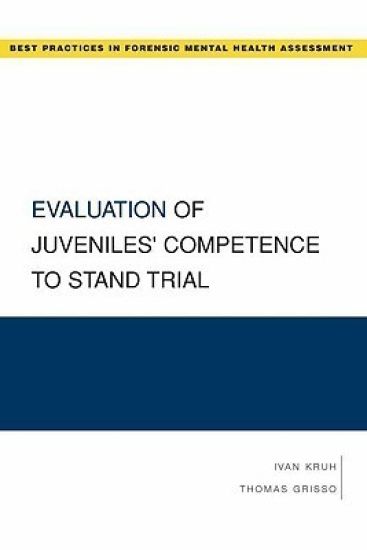
Evaluation of Juveniles' Competence to Stand Trial

Evaluation of Juveniles' Competence to Stand Trial

Ivan Kruh; Thomas Grisso

Oxford University Press Inc
2008
nidottu
Forensic mental health assessment (FMHA) has grown into a specialization informed by research and professional guidelines. This series presents up-to-date information on the most important and frequently conducted forms of FMHA. The 19 topical volumes address best approaches to practice for particular types of evaluation in the criminal, civil, and juvenile/family areas. Each volume contains a thorough discussion of the relevant legal and psychological concepts, followed by a step-by-step description of the assessment process from preparing for the evaluation to writing the report and testifying in court. Volumes include the following helpful features: - Boxes that zero in on important information for use in evaluations - Tips for best practice and cautions against common pitfalls - Highlighting of relevant case law and statutes - Separate list of assessment tools for easy reference - Helpful gloassary of key terms for the particular topic In making recommendations for best practice, authors consider empirical support, legal relevance, and consistency with ethical and professional standards. These volumes offer invaluable guidance for anyone involved in conducting or using forensic evaluations.
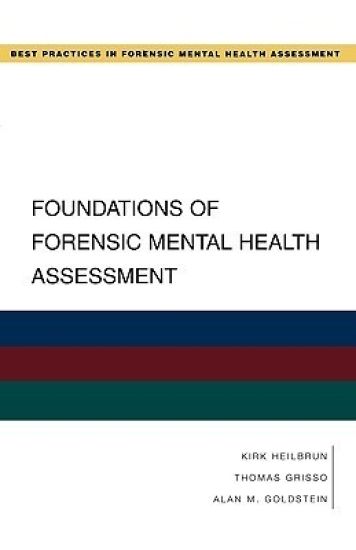
Foundations of Forensic Mental Health Assessment

Foundations of Forensic Mental Health Assessment

Kirk Heilbrun; Thomas Grisso; Alan M. Goldstein

Oxford University Press Inc
2008
nidottu
There appears to be nearly universal acknowledgement of a need to disseminate scientific research in forensic assessments to those 'in the trenches'. The Best Practices in Forensic Mental Health Assessment series was developed to directly address this need. This first book in the series will be the only volume to be written by the series editors as a 'road map'. As such, it will lay out the standards of best practices and how they plan to define and derive them throughout the rest of the titles in the series.
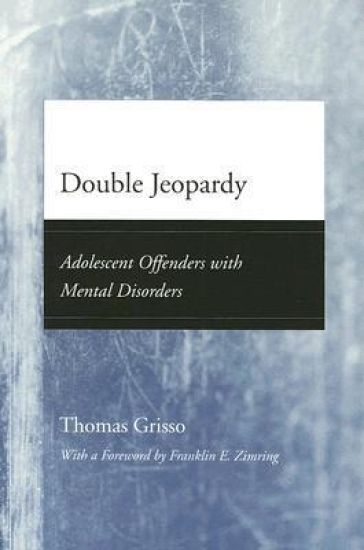
Double Jeopardy

Double Jeopardy

Thomas Grisso

University of Chicago Press
2006
nidottu
Nearly two-thirds of adolescent offenders currently held in juvenile justice facilities across the United States meet the criteria for one or more mental disorders - a fact that has many parents, healthcare providers, and legislatures wondering about our mental health systems for children. Have these systems failed so badly that we must arrest our children for crimes in order for them to receive help? In "Double Jeopardy", leading researcher, Thomas Grisso considers the newest data on the nature of mental disorders in youth - examining, for example, their relationship to delinquency, the values and limits of various treatment methods, and common, related patterns of adolescent offending - and then charts a course for practitioners working within today's juvenile justice system. Grisso carefully evaluates the threefold obligations of that system: as a custodian of children with health needs, a legal system promoting fairness in youth adjudication, and protector of public safety. "Double Jeopardy" provides a scientific and practical foundation for lawmakers, judges, attorneys, and mental health care professionals, as well as researchers in mental health and adolescent development.
Double Jeopardy

Double Jeopardy

Thomas Grisso

University of Chicago Press
2004
sidottu
Nearly two-thirds of adolescent offenders currently held in juvenile justice facilities across the United States meet the criteria for one or more mental disorders - a fact that has many parents, healthcare providers, and legislatures wondering about our mental health systems for children. Have these systems failed so badly that we must arrest our children for crimes in order for them to receive help? In "Double Jeopardy", leading researcher, Thomas Grisso considers the newest data on the nature of mental disorders in youth - examining, for example, their relationship to delinquency, the values and limits of various treatment methods, and common, related patterns of adolescent offending - and then charts a course for practitioners working within today's juvenile justice system. Grisso carefully evaluates the threefold obligations of that system: as a custodian of children with health needs, a legal system promoting fairness in youth adjudication, and protector of public safety. "Double Jeopardy" provides a scientific and practical foundation for lawmakers, judges, attorneys, and mental health care professionals, as well as researchers in mental health and adolescent development.
Evaluating Competencies

Evaluating Competencies

Thomas Grisso

Kluwer Academic/Plenum Publishers
2002
sidottu
As in its first edition, this book offers a conceptual model for understanding the nature of legal competencies. The model is interpreted to assist mental health professionals in designing and performing assessments for legal competencies defined in criminal and civil law, and to guide research that will improve the practice of evaluations for legal competencies. A special feature is the book's evaluative review of specialized forensic assessment instruments for each of several legal competencies. Three-fourths of the 37 instruments reviewed in the second edition are new and thus were not reviewed in the first edition. Application of the assessment model and reviews of instruments are provided for six areas of legal competence: -Competence to Stand Trial; -Waiver of Rights to Silence and Legal Counsel; -Not Guilty by Reason of Insanity; -Parenting Capacity - Determination of Child Custody; -Guardianship and Conservatorship; and -Competence to Consent to Treatment.
Evaluating Competencies

Evaluating Competencies

Thomas Grisso

Kluwer Academic/Plenum Publishers
2002
nidottu
As in its first edition, this book offers a conceptual model for understanding the nature of legal competencies. The model is interpreted to assist mental health professionals in designing and performing assessments for legal competencies defined in criminal and civil law, and to guide research that will improve the practice of evaluations for legal competencies. A special feature is the book's evaluative review of specialized forensic assessment instruments for each of several legal competencies. Three-fourths of the 37 instruments reviewed in the second edition are new and thus were not reviewed in the first edition. Application of the assessment model and reviews of instruments are provided for six areas of legal competence: -Competence to Stand Trial; -Waiver of Rights to Silence and Legal Counsel; -Not Guilty by Reason of Insanity; -Parenting Capacity - Determination of Child Custody; -Guardianship and Conservatorship; and -Competence to Consent to Treatment.
Rethinking Risk Assessment

Rethinking Risk Assessment

John Monahan; Henry J. Steadman; Eric Silver; Paul S. Appelbaum; Pamela Clark Robbins; Edward P. Mulvey; Loren H. Roth; Thomas Grisso; Steven Banks

Oxford University Press Inc
2001
sidottu
Rethinking Risk Assessment tells the story of a pioneering investigation that challenges preconceptions about the frequency and nature of violence among persons with mental disorders, and suggests an innovative approach to predicting its occurrence.
Assessing Competence to Consent to Treatment

Assessing Competence to Consent to Treatment

Thomas Grisso; Paul S. Appelbaum

Oxford University Press Inc
1998
sidottu
One of the most challenging tasks facing clinicians today is the assessment of patients' capacities to consent to treatment. The protection of a patient's right to decide, as well as the protection of incompetent patients from the potential harm of the decisions they might make, rests largely on clinicians' abilities to judge patients' capacities to decide what treatment they will receive. Confusing laws and complex ethical questions surrounding competence to consent to treatment have made the process of competence assessment intimidating for many clinicians. Health professionals - physicians, medical students nad residents, nurses, and mental health practitioners - have long needed a consice guidebook that translates the issue for practice. This is what this book accomplishes. The aurthors describe the place of competence in the doctrine of informed consent and show how assessments of competence to consent to treatment can be structured by using a specific set of general medical and psychiatric treatment settings, explain how the assessment should be conducted, and offer a structured interview method to assist the task. They also explore the often difficult process of making the judgement about competence and desire what to do when patients' capacities are limited.