Kirjojen hintavertailu – 12 859 829 kirjaa ja 27 kauppaa

Kirjailija

Thomas J. J. Altizer

Kirjat ja teokset yhdessä paikassa: 9 kirjaa, julkaisuja vuosilta 1991–2018, suosituimpiin kuuluu Resurrecting the Death of God. Vertaile teosten hintoja ja tarkista saatavuus suomalaisista kirjakaupoista.

9 kirjaa

Kirjojen julkaisuvuodet: 1991–2018.

Satan and Apocalypse

Satan and Apocalypse

Thomas J. J. Altizer

State University of New York Press
2018
pokkari
Offers a profound vision of the Christian epic as the site of the modern apocalyptic reenactment of the original apocalypse. Finalist for the 2017 Foreword INDIES Book of the Year Award in the Religion category In this series of essays, Thomas J. J. Altizer explores the Christian epic as the site of modern revolutionary apocalyptic reenactments and renewals of the original apocalypse enacted by Jesus Christ and primitive Christianity. Beginning with the pivotal seventeenth-century figures Milton and Spinoza, Altizer analyzes the apocalyptic visions of key figures of modernity, including Blake, Hegel, Kierkegaard, Nietzsche, and Joyce, often juxtaposing them to surprising and illuminating effect. These revolutionary moments stand in opposition to what Altizer calls the pathological modern counterrevolution that dominates the world today, which is an effect of a new postmodernity and of a progressive dissolution of historical consciousness. Through his analysis of modern apocalyptic moments and thinkers, this book becomes an elegant and accessible guide to Altizer's own apocalyptic vision and his ultimate project of the total and comprehensive reconstruction of theology.
Satan and Apocalypse

Satan and Apocalypse

Thomas J. J. Altizer

State University of New York Press
2017
sidottu
Offers a profound vision of the Christian epic as the site of the modern apocalyptic reenactment of the original apocalypse. Finalist for the 2017 Foreword INDIES Book of the Year Award in the Religion category In this series of essays, Thomas J. J. Altizer explores the Christian epic as the site of modern revolutionary apocalyptic reenactments and renewals of the original apocalypse enacted by Jesus Christ and primitive Christianity. Beginning with the pivotal seventeenth-century figures Milton and Spinoza, Altizer analyzes the apocalyptic visions of key figures of modernity, including Blake, Hegel, Kierkegaard, Nietzsche, and Joyce, often juxtaposing them to surprising and illuminating effect. These revolutionary moments stand in opposition to what Altizer calls the pathological modern counterrevolution that dominates the world today, which is an effect of a new postmodernity and of a progressive dissolution of historical consciousness. Through his analysis of modern apocalyptic moments and thinkers, this book becomes an elegant and accessible guide to Altizer's own apocalyptic vision and his ultimate project of the total and comprehensive reconstruction of theology.
Resurrecting the Death of God

Resurrecting the Death of God

Thomas J. J. Altizer

State University of New York Press
2015
pokkari
Considers the legacy and future of radical theology. In 1966, an infamous Time magazine cover asked "Is God Dead?" and brought the ideas of theologians William Hamilton and Thomas J. J. Altizer to the wider public. In the years that followed, both men suffered professionally and there was no notable increase to the small number of thinkers considered death of God theologians. Meanwhile, Christian fundamentalism staged a striking comeback in the United States. Yet, death of God, or radical, theology has had an ongoing influence on contemporary theology and philosophy. Contributors to this book explore the origins, influence, and legacy of radical theology and go on to take it in new directions. In a time when fundamentalism is the greatest religious temptation, this volume makes the case for the necessity of resurrecting the death of God.
Resurrecting the Death of God

Resurrecting the Death of God

Thomas J. J. Altizer

State University of New York Press
2014
sidottu
Considers the legacy and future of radical theology. In 1966, an infamous Time magazine cover asked "Is God Dead?" and brought the ideas of theologians William Hamilton and Thomas J. J. Altizer to the wider public. In the years that followed, both men suffered professionally and there was no notable increase to the small number of thinkers considered death of God theologians. Meanwhile, Christian fundamentalism staged a striking comeback in the United States. Yet, death of God, or radical, theology has had an ongoing influence on contemporary theology and philosophy. Contributors to this book explore the origins, influence, and legacy of radical theology and go on to take it in new directions. In a time when fundamentalism is the greatest religious temptation, this volume makes the case for the necessity of resurrecting the death of God.
Preaching Deconstruction

Preaching Deconstruction

Thomas J. J. Altizer; Robert M. Price

Mindvendor
2014
nidottu
Deconstruction is usually denigrated (or praised ) for being esoteric, abstruse, a method and a language restricted to a self-appointed academic elite. Its critics object that Deconstruction is a mind-game with no connection or relation to the real world. Perhaps the very opposite kind of speech is pulpit preaching, a dispensing of comforting bromides and pious clich s aimed at reinforcing the prejudices of the pew potatoes. What could Deconstruction and Postmodernism possibly have to do with preaching? They seem alien even to social activist liberal Protestant cheer-leading. In this book Robert M. Price applies the philosophy of Jacques Derrida and the radical theology of Thomas J. J. Altizer to real questions of spirituality and biblical interpretation. Price preaches from both Old and New Testaments, as well as the Koran and the Gospel of Thomas. Other influences on these sermons, delivered in a Baptist church, include Paul Tillich, Paul de Man, Rudolf Bultmann, Robert W. Chambers, Ingmar Bergman, Malcolm Boyd, and Thomas Ligotti. The book features a foreword by Thomas Altizer, an important new essay in its own right, as well as Price's introductory discussion of Deconstruction, then a set of innovative sermons. The sermons are not about Deconstruction. They are about spirituality and the Bible. But Deconstruction is everywhere present as an atmosphere and a medium. It quickly becomes clear, not only that no theological orthodoxy is any longer possible, but also that it is not necessary for Postmodern man (and woman) to blaze a path on the new spiritual frontier. The radical theology that erupted in the 1960s has long been relegated to a pop cultural time capsule along with lava lamps and Nehru jackets. But it is not unusual for the majority to (nervously)laugh off what makes them uncomfortable. In the 1990s, Deconstruction revived the theology of the Death of God, providing a much-needed theoretical reformulation. The significance of Deconstruction can be measured by the amount of controversy, even hysteria, that it provoked. The publication of these unique sermons is an attempt to keep that witness alive. And to demonstrate that Deconstruction provides a new way forward in religious exploration.
Living the Death of God

Living the Death of God

Thomas J. J. Altizer; Mark C. Taylor

State University of New York Press
2006
pokkari
The eminent death-of-God theologian traces his lifelong search for a theory that is contemporary yet biblical. Theologian Thomas J. J. Altizer became both famous and infamous as the chief spokesman for death-of-God theology in the 1960s. In the years that followed, he has created a theological tradition that has influenced all succeeding generations of theologians. Living the Death of God is Altizer's theological memoir. Taking us from his transformation as a theological student to his present life of solitude, Altizer recapitulates the voyage to create a truly new theology. The memoir recounts each stage of this voyage, from being overwhelmed by Satan to a conversion to the death of God and an extensive and even ecstatic preaching of the death of God. However, this is the death of that God who is the wholly alienated God, a death realizing anew the crucified God or the apocalyptic Christ. Written with Altizer's characteristic elegance, this book is fascinating on its own account, but can also serve the reader as a companion or introduction to Altizer's body of work.
Godhead and the Nothing

Godhead and the Nothing

Thomas J. J. Altizer

State University of New York Press
2003
pokkari
An eminent theologian argues that nothingness is necessary in order to fully actualize the Godhead. Eminent theologian Thomas J. J. Altizer breaks new ground by exploring the ultimate transfiguration of the Godhead as a question of the Nihil or nothingness and God. The Nihil is essential to the full actualization of the Godhead in that it fully occurs in both a primordial and an apocalyptic sacrifice of the Godhead. Virtually unexplored by philosophical and theological thinking, the Nihil is luminously enacted in the deepest expressions of the imagination, and most clearly and decisively so in the Christian epic tradition. Altizer looks at the works of philosophers and theologians such as Spinoza, Barth, Hegel, Nietzsche, and epic writers such as Dante, Milton, and Blake to ultimately posit a God that is necessarily a dichotomous God.
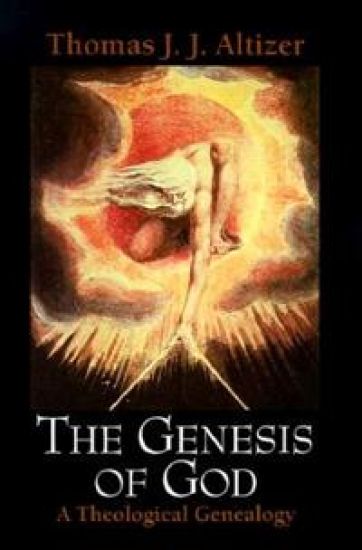
The Genesis of God

The Genesis of God

Thomas J. J. Altizer

Westminster/John Knox Press,U.S.
1993
nidottu
Thomas Altizer, one of America's premier theologians, searches for a proper understanding of the Christian God, which he believes can only be explicated when the question of origin is raised. He begins with an investigation of Hegelian thinking, develops his insights in dialogue with such thinkers as Augustine and Nietzsche, and then focuses on notions generated by the Christian epic poetry of Dante, Milton, and Blake. By explicating the absolute origin of God that only Christianity knows, Altizer discloses the origin of a uniquely Christian freedom while also touching upon such important themes as predestination, the fall, evil, and eternity.
Genesis and Apocalypse

Genesis and Apocalypse

Thomas J. J. Altizer

Westminster/John Knox Press,U.S.
1991
nidottu
Thomas Altizer's Genesis and Apocalypse engages a theological history of Western culture through the works of Augustine, Luther, Barth, and other important figures in theology, as well as critical theorists such as Hegel and Nietzsche, to ultimately offer a Christology for our modern times.