Kirjojen hintavertailu – 12 903 724 kirjaa ja 27 kauppaa

Kirjailija

Thomas Kemeny

Kirjat ja teokset yhdessä paikassa: 3 kirjaa, julkaisuja vuosilta 2015–2019, suosituimpiin kuuluu The Rise and Fall of Urban Economies. Vertaile teosten hintoja ja tarkista saatavuus suomalaisista kirjakaupoista.

3 kirjaa

Kirjojen julkaisuvuodet: 2015–2019.

Junior

Junior

Thomas Kemeny; Jeff Goodby

powerHouse Books,U.S.
2019
sidottu
There are a lot of great advertising books, but none that get down in the dirt with you quite like this one. Thomas Kemeny made a career at some of the best ad agencies in America. In this book he shows how he got in, how he's stayed in, and how you can do it too. He breaks apart how to write fun, smart, and effective copy-everything from headlines to scripts to experiential activations-giving readers a lesson on a language we all thought we already knew. This book is not a retrospective from some ad legend. It's a book that should be instantly useful for people starting out. A guide for the first few years at a place you'd actually want to work. Traditionally, advertising books have been written by people with established careers, big offices and letters like VP in their titles. They have stories from the old days when people could start in the mailroom. They are talented. That's been done. Who wants another book filled with seasoned wisdom? This is a book written by somebody still getting his bearings. Someone who has made an extraordinary number of errors in a still short career. Someone who has managed to hang onto his job despite these shortcomings.
The Rise and Fall of Urban Economies

The Rise and Fall of Urban Economies

Michael Storper; Thomas Kemeny; Naji Makarem; Taner Osman

Stanford Business Books,US
2016
pokkari
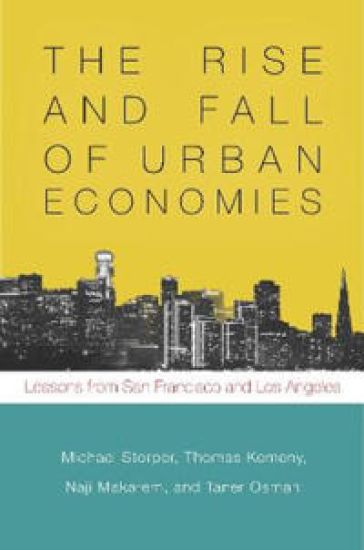
Today, the Bay Area is home to the most successful knowledge economy in America, while Los Angeles has fallen progressively further behind its neighbor to the north and a number of other American metropolises. Yet, in 1970, experts would have predicted that L. A. would outpace San Francisco in population, income, economic power, and influence. The usual factors used to explain urban growth—luck, immigration, local economic policies, and the pool of skilled labor—do not account for the contrast between the two cities and their fates. So what does? The Rise and Fall of Urban Economies challenges many of the conventional notions about economic development and sheds new light on its workings. The authors argue that it is essential to understand the interactions of three major components—economic specialization, human capital formation, and institutional factors—to determine how well a regional economy will cope with new opportunities and challenges. Drawing on economics, sociology, political science, and geography, they argue that the economic development of metropolitan regions hinges on previously underexplored capacities for organizational change in firms, networks of people, and networks of leaders. By studying San Francisco and Los Angeles in unprecedented levels of depth, this book extracts lessons for the field of economic development studies and urban regions around the world.
The Rise and Fall of Urban Economies

The Rise and Fall of Urban Economies

Michael Storper; Thomas Kemeny; Naji Makarem; Taner Osman

STANFORD UNIVERSITY PRESS
2015
sidottu
Today, the Bay Area is home to the most successful knowledge economy in America, while Los Angeles has fallen progressively further behind its neighbor to the north and a number of other American metropolises. Yet, in 1970, experts would have predicted that L. A. would outpace San Francisco in population, income, economic power, and influence. The usual factors used to explain urban growth—luck, immigration, local economic policies, and the pool of skilled labor—do not account for the contrast between the two cities and their fates. So what does? The Rise and Fall of Urban Economies challenges many of the conventional notions about economic development and sheds new light on its workings. The authors argue that it is essential to understand the interactions of three major components—economic specialization, human capital formation, and institutional factors—to determine how well a regional economy will cope with new opportunities and challenges. Drawing on economics, sociology, political science, and geography, they argue that the economic development of metropolitan regions hinges on previously underexplored capacities for organizational change in firms, networks of people, and networks of leaders. By studying San Francisco and Los Angeles in unprecedented levels of depth, this book extracts lessons for the field of economic development studies and urban regions around the world.