Kirjojen hintavertailu – 12 903 725 kirjaa ja 27 kauppaa

Kirjailija

Thomas Keymer

Kirjat ja teokset yhdessä paikassa: 4 kirjaa, julkaisuja vuosilta 2002–2019, suosituimpiin kuuluu Sterne, the Moderns, and the Novel. Vertaile teosten hintoja ja tarkista saatavuus suomalaisista kirjakaupoista.

4 kirjaa

Kirjojen julkaisuvuodet: 2002–2019.

Poetics of the Pillory

Poetics of the Pillory

Thomas Keymer

Oxford University Press
2019
sidottu
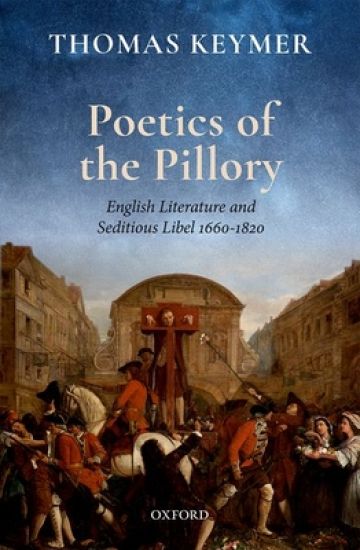
On the lapse of the Licensing Act in 1695, Thomas Macaulay wrote in his History of England, 'English literature was emancipated, and emancipated for ever, from the control of the government'. It's certainly true that the system of prior restraint enshrined in this Restoration measure was now at an end, at least for print. Yet the same cannot be said of government control, which came to operate instead by means of post-publication retribution, not pre-publication licensing, notably for the common-law offence of seditious libel. For many of the authors affected, from Defoe to Cobbett, this new regime was a greater constraint on expression than the old, not least for its alarming unpredictability, and for the spectacular punishment--the pillory--that was sometimes entailed. Yet we may also see the constraint as an energizing force. Throughout the eighteenth century and into the Romantic period, writers developed and refined ingenious techniques for communicating dissident or otherwise contentious meanings while rendering the meanings deniable. As a work of both history and criticism, this book traces the rise and fall of seditious libel prosecution, and with it the theatre of the pillory, while arguing that the period's characteristic forms of literary complexity--ambiguity, ellipsis, indirection, irony--may be traced to the persistence of censorship in the post-licensing world. The argument proceeds through case studies of major poets and prose writers including Dryden, Defoe, Pope, Fielding, Johnson, and Southey, and also calls attention to numerous little-known satires and libels across the extended period.
'Pamela' in the Marketplace

'Pamela' in the Marketplace

Thomas Keymer; Peter Sabor

Cambridge University Press
2009
pokkari
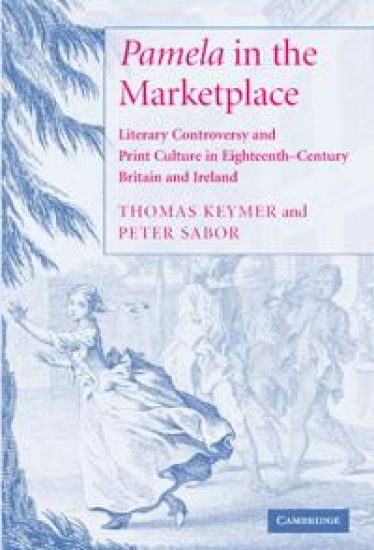
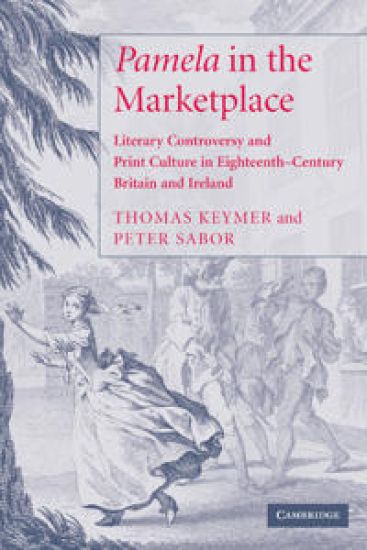
Samuel Richardson's Pamela (1740) is often regarded as the first true novel in English and a landmark in literary history. The best-selling novel of its time, it provoked a swarm of responses: panegyrics and critiques, parodies and burlesques, piracies and sequels, comedies and operas. The controversy it inspired has become a standard point of reference in studies of the rise of the novel, the history of the book and the emergence of consumer culture. In the first book-length study of the Pamela controversy since 1960, Thomas Keymer and Peter Sabor offer a definitive account of the novel's enormous cultural impact. Above all, they read the controversy as a market phenomenon, in which the writers and publishers involved were competing not only in struggles of interpretation and meaning but also in the larger and more pressing enterprise of selling print.
'Pamela' in the Marketplace

'Pamela' in the Marketplace

Thomas Keymer; Peter Sabor

Cambridge University Press
2005
sidottu
Samuel Richardson's Pamela (1740) is often regarded as the first true novel in English and a landmark in literary history. The best-selling novel of its time, it provoked a swarm of responses: panegyrics and critiques, parodies and burlesques, piracies and sequels, comedies and operas. The controversy it inspired has become a standard point of reference in studies of the rise of the novel, the history of the book and the emergence of consumer culture. In the first book-length study of the Pamela controversy since 1960, Thomas Keymer and Peter Sabor offer a definitive account of the novel's enormous cultural impact. Above all, they read the controversy as a market phenomenon, in which the writers and publishers involved were competing not only in struggles of interpretation and meaning but also in the larger and more pressing enterprise of selling print.
Sterne, the Moderns, and the Novel

Sterne, the Moderns, and the Novel

Thomas Keymer

Oxford University Press
2002
sidottu
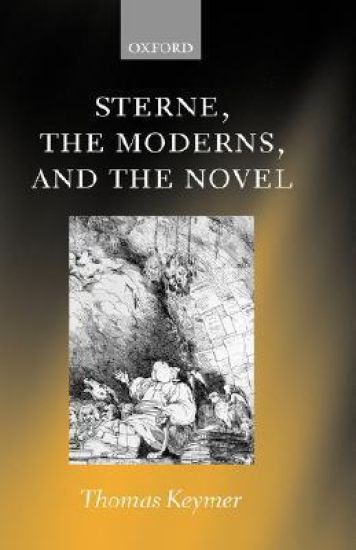
The author of Tristram Shandy (1759-67) is often seen as an anachronism - a belated exponent of learned-wit satire whose kinship is with Montaigne, or a proto-modernist whose narrative pyrotechnics anticipate Joyce. Yet to many contemporaries Sterne's writing was emphatically of its immediate time, a voguish compound of all things modern that seemed to typify, if not indeed constitute, a 'Shandy-Age'. In this historicizing study, Thomas Keymer demonstrates the self-conscious imbrication of Tristram Shandy in the diverse literary culture of its extended moment. Not only absorbing but also updating Swift's Tale of a Tub, Sterne's text turns the satirical resources of Scriblerian writing on the post-Scriblerian literary marketplace, and above all on that quintessentially modern genre, the novel itself. For all its anticipation of later trends, his play on narrative representation, linguistic indeterminacy, the unruliness of reading and the materiality of text turns out to be firmly grounded in the conventions and tropes of mid-eighteenth-century fiction. Through the mechanisms of improvisatory serialization, Sterne could also engage with other new texts and trends as they continued to emerge, including 'Nonsense Club' satire, the Ossianic vogue, and debates about the Seven Years War.