Kirjojen hintavertailu – 12 903 732 kirjaa ja 27 kauppaa

Kirjailija

Thomas Leonard

Kirjat ja teokset yhdessä paikassa: 4 kirjaa, julkaisuja vuosilta 1999–2020, suosituimpiin kuuluu A Course in Categorical Data Analysis. Vertaile teosten hintoja ja tarkista saatavuus suomalaisista kirjakaupoista.

4 kirjaa

Kirjojen julkaisuvuodet: 1999–2020.

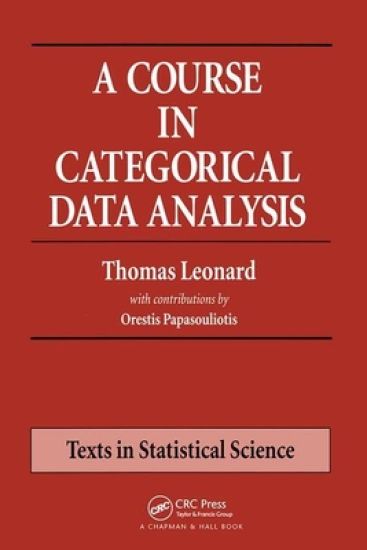
A Course in Categorical Data Analysis
Categorical data-comprising counts of individuals, objects, or entities in different categories-emerge frequently from many areas of study, including medicine, sociology, geology, and education. They provide important statistical information that can lead to real-life conclusions and the discovery of fresh knowledge. Therefore, the ability to manipulate, understand, and interpret categorical data becomes of interest-if not essential-to professionals and students in a broad range of disciplines. Although t-tests, linear regression, and analysis of variance are useful, valid methods for analysis of measurement data, categorical data requires a different methodology and techniques typically not encountered in introductory statistics courses. Developed from long experience in teaching categorical analysis to a multidisciplinary mix of undergraduate and graduate students, A Course in Categorical Data Analysis presents the easiest, most straightforward ways of extracting real-life conclusions from contingency tables. The author uses a Fisherian approach to categorical data analysis and incorporates numerous examples and real data sets. Although he offers S-PLUS routines through the Internet, readers do not need full knowledge of a statistical software package. In this unique text, the author chooses methods and an approach that nurtures intuitive thinking. He trains his readers to focus not on finding a model that fits the data, but on using different models that may lead to meaningful conclusions. The book offers some simple, innovative techniques not highighted in other texts that help make the book accessible to a broad, interdisciplinary audience. A Course in Categorical Data Analysis enables readers to quickly use its offering of tools for drawing scientific, medical, or real-life conclusions from categorical data sets.
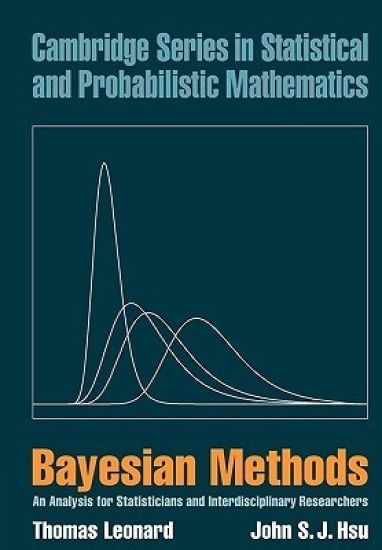
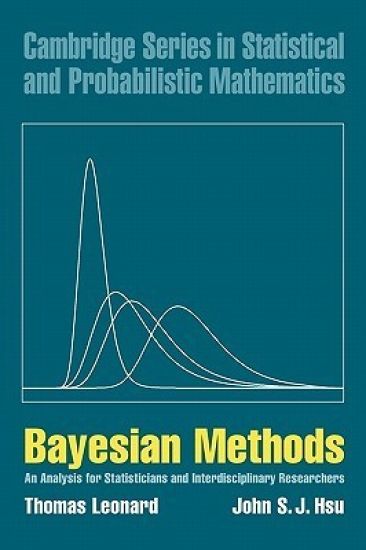
Bayesian Methods

Bayesian Methods

Thomas Leonard; John S. J. Hsu

Cambridge University Press
2001
pokkari
This book describes the Bayesian approach to statistics at a level suitable for final year undergraduate and Masters students. It is unique in presenting Bayesian statistics with a practical flavor and an emphasis on mainstream statistics, showing how to infer scientific, medical, and social conclusions from numerical data. The authors draw on many years of experience with practical and research programs and describe many new statistical methods, not available elsewhere. A first chapter on Fisherian methods, together with a strong overall emphasis on likelihood, makes the text suitable for mainstream statistics courses whose instructors wish to follow mixed or comparative philosophies. The other chapters contain important sections relating to many areas of statistics such as the linear model, categorical data analysis, time series and forecasting, mixture models, survival analysis, Bayesian smoothing, and non-linear random effects models. The text includes a large number of practical examples, worked examples, and exercises. It will be essential reading for all statisticians, statistics students, and related interdisciplinary researchers.
A Course in Categorical Data Analysis

A Course in Categorical Data Analysis

Thomas Leonard

Chapman Hall/CRC
1999
nidottu
Categorical data-comprising counts of individuals, objects, or entities in different categories-emerge frequently from many areas of study, including medicine, sociology, geology, and education. They provide important statistical information that can lead to real-life conclusions and the discovery of fresh knowledge. Therefore, the ability to manipulate, understand, and interpret categorical data becomes of interest-if not essential-to professionals and students in a broad range of disciplines. Although t-tests, linear regression, and analysis of variance are useful, valid methods for analysis of measurement data, categorical data requires a different methodology and techniques typically not encountered in introductory statistics courses. Developed from long experience in teaching categorical analysis to a multidisciplinary mix of undergraduate and graduate students, A Course in Categorical Data Analysis presents the easiest, most straightforward ways of extracting real-life conclusions from contingency tables. The author uses a Fisherian approach to categorical data analysis and incorporates numerous examples and real data sets. Although he offers S-PLUS routines through the Internet, readers do not need full knowledge of a statistical software package. In this unique text, the author chooses methods and an approach that nurtures intuitive thinking. He trains his readers to focus not on finding a model that fits the data, but on using different models that may lead to meaningful conclusions. The book offers some simple, innovative techniques not highighted in other texts that help make the book accessible to a broad, interdisciplinary audience. A Course in Categorical Data Analysis enables readers to quickly use its offering of tools for drawing scientific, medical, or real-life conclusions from categorical data sets.
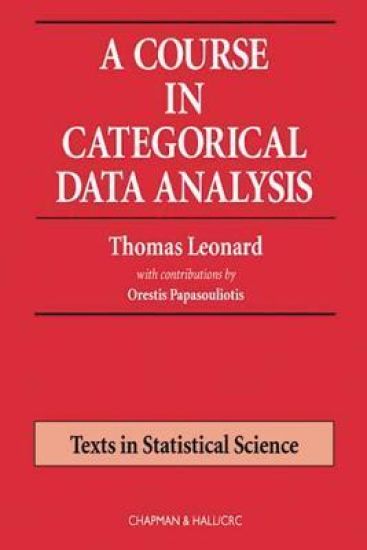
Bayesian Methods

Bayesian Methods

Thomas Leonard; John S. J. Hsu

Cambridge University Press
1999
sidottu
This book describes the Bayesian approach to statistics at a level suitable for final year undergraduate and Masters students. It is unique in presenting Bayesian statistics with a practical flavor and an emphasis on mainstream statistics, showing how to infer scientific, medical, and social conclusions from numerical data. The authors draw on many years of experience with practical and research programs and describe many new statistical methods, not available elsewhere. A first chapter on Fisherian methods, together with a strong overall emphasis on likelihood, makes the text suitable for mainstream statistics courses whose instructors wish to follow mixed or comparative philosophies. The other chapters contain important sections relating to many areas of statistics such as the linear model, categorical data analysis, time series and forecasting, mixture models, survival analysis, Bayesian smoothing, and non-linear random effects models. The text includes a large number of practical examples, worked examples, and exercises. It will be essential reading for all statisticians, statistics students, and related interdisciplinary researchers.