Kirjojen hintavertailu – 12 859 824 kirjaa ja 27 kauppaa

Kirjailija

Thomas M. Chen

Kirjat ja teokset yhdessä paikassa: 5 kirjaa, julkaisuja vuosilta 2014–2016, suosituimpiin kuuluu Forward Error Correction Based On Algebraic-Geometric Theory. Vertaile teosten hintoja ja tarkista saatavuus suomalaisista kirjakaupoista.

5 kirjaa

Kirjojen julkaisuvuodet: 2014–2016.

Terrorism Online

Terrorism Online

Lee Jarvis; Stuart MacDonald; Thomas M. Chen

Routledge
2016
nidottu
This book investigates the intersection of terrorism, digital technologies and cyberspace. The evolving field of cyber-terrorism research is dominated by single-perspective, technological, political, or sociological texts. In contrast, Terrorism Online uses a multi-disciplinary framework to provide a broader introduction to debates and developments that have largely been conducted in isolation. Drawing together key academics from a range of disciplinary fields, including Computer Science, Engineering, Social Psychology, International Relations, Law and Politics, the volume focuses on three broad themes: 1) how – and why – do terrorists engage with the Internet, digital technologies and cyberspace?; 2) what threat do these various activities pose, and to whom?; 3) how might these activities be prevented, deterred or addressed? Exploring these themes, the book engages with a range of contemporary case studies and different forms of terrorism: from lone-actor terrorists and protest activities associated with ‘hacktivist’ groups to state-based terrorism. Through the book’s engagement with questions of law, politics, technology and beyond, the volume offers a holistic approach to cyberterrorism which provides a unique and invaluable contribution to this subject matter. This book will be of great interest to students of cybersecurity, security studies, terrorism and International Relations.
Terrorism Online

Terrorism Online

Lee Jarvis; Stuart MacDonald; Thomas M. Chen

Routledge
2015
sidottu
This book investigates the intersection of terrorism, digital technologies and cyberspace. The evolving field of cyber-terrorism research is dominated by single-perspective, technological, political, or sociological texts. In contrast, Terrorism Online uses a multi-disciplinary framework to provide a broader introduction to debates and developments that have largely been conducted in isolation. Drawing together key academics from a range of disciplinary fields, including Computer Science, Engineering, Social Psychology, International Relations, Law and Politics, the volume focuses on three broad themes: 1) how – and why – do terrorists engage with the Internet, digital technologies and cyberspace?; 2) what threat do these various activities pose, and to whom?; 3) how might these activities be prevented, deterred or addressed? Exploring these themes, the book engages with a range of contemporary case studies and different forms of terrorism: from lone-actor terrorists and protest activities associated with ‘hacktivist’ groups to state-based terrorism. Through the book’s engagement with questions of law, politics, technology and beyond, the volume offers a holistic approach to cyberterrorism which provides a unique and invaluable contribution to this subject matter. This book will be of great interest to students of cybersecurity, security studies, terrorism and International Relations.

Cyberterrorism After Stuxnet

Cyberterrorism After Stuxnet

Strategic Studies Institute; Thomas M. Chen; U.S. Army War College

Lulu.com
2014
nidottu
Public government statements have cited cyberattacks by terrorists as a major concern for national security. To date, no large-scale cyber-terrorist attack has been observed, but terrorists are known to be using the Internet for various routine purposes. The discovery of Stuxnet in 2010 was a milestone in the arena of cybersecurity because, although a malware attack on industrial control systems was long believed to be theoretically possible, it was different to see malware used in reality to cause real physical damage. Stuxnet demonstrated that a sufficiently determined adversary with sufficient resources might be able to damage U. S. critical infrastructure physically through a cyber attack. Did Stuxnet change the threat of cyberterrorism?
Forward Error Correction Based On Algebraic-Geometric Theory

Forward Error Correction Based On Algebraic-Geometric Theory

Jafar A. Alzubi; Omar A. Alzubi; Thomas M. Chen

Springer International Publishing AG
2014
nidottu
This book covers the design, construction, and implementation of algebraic-geometric codes from Hermitian curves. Matlab simulations of algebraic-geometric codes and Reed-Solomon codes compare their bit error rate using different modulation schemes over additive white Gaussian noise channel model. Simulation results of Algebraic-geometric codes bit error rate performance using quadrature amplitude modulation (16QAM and 64QAM) are presented for the first time and shown to outperform Reed-Solomon codes at various code rates and channel models. The book proposes algebraic-geometric block turbo codes. It also presents simulation results that show an improved bit error rate performance at the cost of high system complexity due to using algebraic-geometric codes and Chase-Pyndiah’s algorithm simultaneously. The book proposes algebraic-geometric irregular block turbo codes (AG-IBTC) to reduce system complexity. Simulation results for AG-IBTCs are presented for the first time.
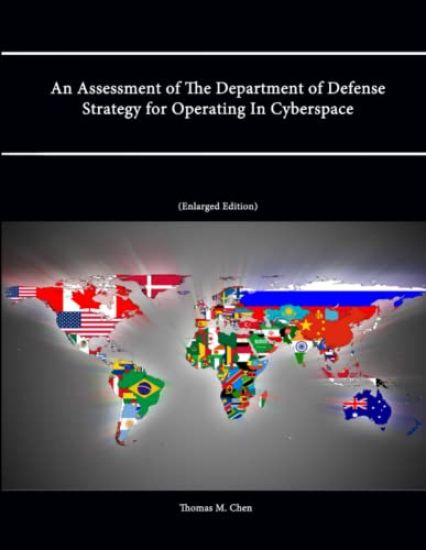
An Assessment of The Department of Defense Strategy for Operating In Cyberspace

An Assessment of The Department of Defense Strategy for Operating In Cyberspace

Thomas M. Chen; Strategic Studies Institute; U.S. Army War College

Lulu.com
2014
nidottu
In July 2011, the U. S. Department of Defense (DoD) issued the DoD Strategy for Operating in Cyberspace, which outlines five strategic initiatives: 1) Treat cyberspace as another operational domain; 2) Employ new defense operating concepts to pro--tect DoD networks; 3) Partner with other U. S. government agencies and the private sector; 4) Build relationships with U. S. allies and interna--tional partners to strengthen cyber security; and, 5). Leverage the national intellect and capabilities through cyber workforce training and rapid techno--logical innovation. First , the monograph explores the evolution of cyberspace strategy through a series of government publications leading up to the DoD Strategy for Operating in Cyber--space. It is seen that, although each strategy has differ--ent emphases on ideas, some major themes recur. Second, each strategic initiative is elaborated and critiqued in terms of significance, novelty, and practicality. Third, the monograph critiques the DoD Strategy as a whole.