Kirjojen hintavertailu – 12 859 819 kirjaa ja 27 kauppaa

Kirjailija

Thomas Poguntke

Kirjat ja teokset yhdessä paikassa: 6 kirjaa, julkaisuja vuosilta 2000–2013, suosituimpiin kuuluu Parteiorganisation im Wandel. Vertaile teosten hintoja ja tarkista saatavuus suomalaisista kirjakaupoista.

6 kirjaa

Kirjojen julkaisuvuodet: 2000–2013.

Measuring Intra-Party Democracy

Measuring Intra-Party Democracy

Benjamin von dem Berge; Thomas Poguntke; Peter Obert; Diana Tipei

Springer-Verlag Berlin and Heidelberg GmbH Co. K
2013
nidottu
This book presents an integrated approach to measuring the level of intra-party democracy through deductive and standardized content analysis of party statutes. Following the two main criteria of intra-party democracy – inclusiveness and decentralization – three main categories of intra-party democracy are theoretically derived: members’ rights, organizational structure and decision-making. On the basis of theoretical considerations further sub-categories and individual items are deduced from these main categories and put together into a comprehensive coding scheme. Furthermore, precise coding instructions are presented. Since it is the ultimate aim of this book to present an approach to measuring the level of intra-party democracy for any party statute and to express this in numerical terms, the final step is the quantification of the coded data and the calculation of a numeric measure of intra-party democracy. A numeric value of intra-party democracy can be calculated for any statute of any political party. Furthermore, empirical examples from Hungary, Slovakia and Romania are presented. ?

How Political Parties Respond

How Political Parties Respond

Kay Lawson; Thomas Poguntke

Routledge
2011
nidottu
How Political Parties Respond focuses specifically on the question of interest aggregation. Do parties today perform that function? If so, how? If not, in what different ways do they seek to show themselves responsive to the electorate? This fascinating book studies these questions with reference to Great Britain, France, Germany, Italy, Spain, Denmark, Norway, Sweden, and Canada. A chapter on Russia demonstrates how newly powerful private interest groups and modern techniques of persuasion can work together to prevent effective party response to popular interests in systems where the authoritarian tradition remains strong.
How Political Parties Respond

How Political Parties Respond

Kay Lawson; Thomas Poguntke

Routledge
2004
sidottu
How Political Parties Respond focuses specifically on the question of interest aggregation. Do parties today perform that function? If so, how? If not, in what different ways do they seek to show themselves responsive to the electorate? This fascinating book studies these questions with reference to Great Britain, France, Germany, Italy, Spain, Denmark, Norway, Sweden, and Canada. A chapter on Russia demonstrates how newly powerful private interest groups and modern techniques of persuasion can work together to prevent effective party response to popular interests in systems where the authoritarian tradition remains strong.
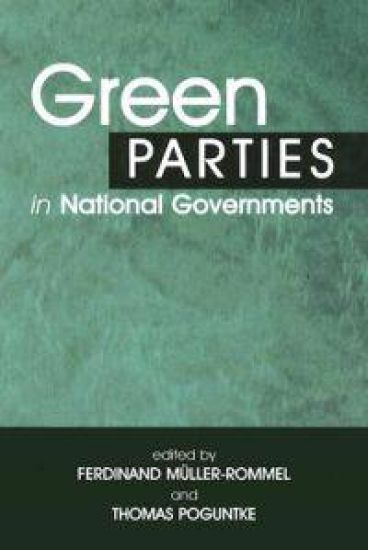
Green Parties in National Governments

Green Parties in National Governments

Ferdinand Muller-Rommel; Thomas Poguntke

Routledge
2002
nidottu
By the late 1990s Green parties had entered national governments in five Western European countries - Finland, Italy, Germany, France and Belgium. This book aims to provide an understanding of the differences and similarities of Green parties in coalition governments.
Green Parties in National Governments

Green Parties in National Governments

Ferdinand Muller-Rommel; Thomas Poguntke

Routledge
2002
sidottu
By the late 1990s Green parties had entered national governments in five Western European countries - Finland, Italy, Germany, France and Belgium. This book aims to provide an understanding of the differences and similarities of Green parties in coalition governments.
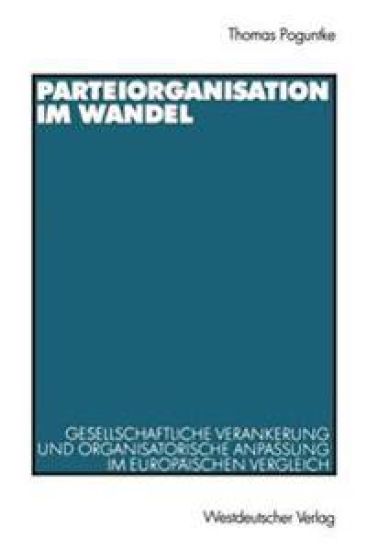
Parteiorganisation im Wandel

Parteiorganisation im Wandel

Thomas Poguntke

VS Verlag fur Sozialwissenschaften
2000
nidottu
Politische Parteien haben im wesentlichen zwei Wege, dauerhafte und zweiseitige Verbindungen zu den Bürgern herzustellen und zu unterhalten: über die eigene Mitgliederorganisation und durch eine Vernetzung mit intermediären Organisationen und Nebenorganisationen. Die eigene Mitgliederorganisation stellt einen wichtigen, direkten Transmissionskanal dar, da sie den Parteien erlaubt, durch ihre Mitglieder für ihre politischen Ziele in der Gesellschaft zu werben und andererseits politische Stimmungen und Präferenzen der Bevölkerung wahrzunehmen und in politisches Handeln umzusetzen. Die Vernetzung mit den verschiedenen Arten kollateraler Organisationen erfüllt prinzipiell die gleichen Funktionen, allerdings laufen diese Prozesse über externe, teilweise unabhängige Organisationen vermittelt ab. In der Studie wird der Frage nachgegangen, wie sich diese "Linkages" zwischen Parteien und Bürgern in Westeuropa seit 1960 verändert haben. Untersucht werden 78 Parteien in 11 westeuropäischen Ländern. Im Mittelpunkt stehen dabei die Entwicklung der Mitgliederzahlen und Veränderungen in der organisatorischen Verknüpfung zwischen den Entscheidungsgremien politischer Parteien und den verschiedenen Arten kollateraler Organisationen. Hierbei zeigt sich, daß Ausmaß und Intensität der gesellschaftlichen Verankerung politischer Parteien in Westeuropa deutlich schwächer geworden sind. Bemerkenswert ist außerdem, daß neue Parteien über fast keine gesellschaftlichen Bindungen verfügen.