
Kirjailija
Thomas Reid
Kirjat ja teokset yhdessä paikassa: 100 kirjaa, julkaisuja vuosilta 1983–2025, suosituimpiin kuuluu Thomas Reid and the University. Vertaile teosten hintoja ja tarkista saatavuus suomalaisista kirjakaupoista.
100 kirjaa
Kirjojen julkaisuvuodet: 1983–2025.
Travels In Ireland, In The Year 1822: Exhibiting Brief Sketches Of The Moral, Physical, And Political State Of The Country (1823)
Thomas Reid
KESSINGER PUBLISHING, LLC
2008
sidottu
Travels In Ireland, In The Year 1822: Exhibiting Brief Sketches Of The Moral, Physical, And Political State Of The Country (1823)
Thomas Reid
KESSINGER PUBLISHING, LLC
2008
nidottu
The pervasiveness of Protestant natural law in the early modern period and its significance in the Scottish Enlightenment have long been recognised. This book reveals that Thomas Reid (1710-1796) -- the great contemporary of David Hume and Adam Smith -- also worked in this tradition. When Reid succeeded Adam Smith as professor of moral philosophy in Glasgow in 1764, he taught a course covering pneumatology, practical ethics, and politics. This section on practical ethics took its starting point from the system of natural law and rights published by Francis Hutcheson. Knud Haakonssen has reconstructed it here for the first time from Reid's manuscript lectures and papers, and it provides a considerable addition to our understanding not only of Reid but of the thought of the Scottish Enlightenment and of the education system of the time. The present work is a revised version of a work first published by Princeton University Press in 1990 which has long been out of print.

Get an overview of the legal underpinnings of the contracting process. Learn why things are done in certain ways. And become familiar with the constitutional, statutory, and regulatory laws behind the rule or practice. This ActionPack book will equip you with a deeper understanding of government contracting practices to inform all your contracting activities. Ideal for all levels of professionals from novices to senior managers.
Essays on the Active Powers of the Human Mind an Inquiry into the Human Mind on the Principle of Common Sense
Thomas Reid
Kessinger Pub
2005
pokkari
Essays on The Active Powers of the Human Mind an Inquiry into the Human Mind on the Principle of Common Sense
Thomas Reid
KESSINGER PUBLISHING CO
2005
muu
Thomas Reid on Logic, Rhetoric and the Fine Arts
Thomas Reid
Edinburgh University Press
2004
sidottu
Thomas Reid saw the three subjects of logic, rhetoric and the fine arts as closely cohering aspects of one endeavour which he called the culture of the mind. This was a topic on which Reid lectured for many years in Glasgow and the volume is as near a reconstruction of these lectures as is now possible. The material is virtually unknown now but in fact it relates closely to Reid's published works and in particular to the two late ones, Essays on the Intellectual Powers of Man and Essays on the Active Powers of Man. When composing these volumes, Reid drew primarily on his lectures on 'pneumatology' which presented a theory of the mental powers, broadly conceived. These lectures were basic to the course on the culture of the mind which explained the cultivation of the mental powers. Although the Essays also included some elements from the material on the culture of the mind, the bulk of the latter was left in manuscript form and Professor Broadie's edition restores this important extension of Reid's overall work. In addition, this volume continues the Edinburgh Edition's attractive combination of manuscript material and published work, in this case Reid's important and well known essay on Aristotle's logic. This text was corrupted in older editions of Reid's works and is now restored to the state in which Reid left it. This volume underscores Reid's great and growing significance, viewed both as an historical figure and as a philosopher. At the same time, it is of great interdisciplinary importance. While the material emerges directly from the core of Reid's philosophy, as now understood, it will appeal widely to people in literary, cultural, historical and communications studies. In this regard, the present volume is a true fruit of the Scottish Enlightenment.
Thomas Reid (1710-96) is now recognized as one of the towering figures of the Enlightenment. Best known for his published writings on epistemology and moral theory, he was also an accomplished mathematician and natural philosopher, as an earlier volume of his manuscripts edited by Paul Wood for the Edinburgh Reid Edition, Thomas Reid on the Animate Creation, has shown. The Correspondence of Thomas Reid collects together all of the known letters to and from Reid in a fully annotated form. Letters already published by Sir William Hamilton and others have been reedited, and roughly half of the letters included appear in print for the first time. The letters illuminate virtually every aspect of Reid's life and career, and, in some instances, provide us with invaluable evidence about activities otherwise undocumented in his manuscripts or published works. Through his correspondence we can trace his relations with contemporaries like David Hume and his colleagues at both King's College, Aberdeen, and the University of Glasgow, as well as his engagement with the most controversial philosophical, scientific and political issues of his day. The letters assembled here serve as the starting point for understanding Reid and his place in the Enlightenment.
Thomas Reid - Essays on the Intellectual Powers of Man
Thomas Reid
Edinburgh University Press
2002
sidottu
This is Thomas Reid's greatest work. It covers far more philosophical ground than the earlier, more popular Inquiry. The Intellectual Powers and its companion volume, Essays on the Active Powers of Man, constitute the fullest, most original presentation of the philosophy of Common Sense. In the process, Reid provides acutely critical discussions of an impressive array of thinkers but especially of David Hume. In Reid's eyes, Hume had driven a deep tendency in modern philosophy to its ultimate conclusions by creating a phantom-world of so-called 'ideas' that sprang from objects of observation; the self was a conglomeration of perceived ideas; and the will as the source of action was nothing but the balance of passionate impulses. Reid's Common Sense philosophy answers these problems by suggesting that sceptics, such as Hume, unavoidably affirm what they purport to deny, namely the existence of a stable external world, of other minds, of the continuity of their own minds, and of their own and other people's ability to ascribe and accept responsibility for actions. We can understand all of this by proper empirical observation and philosophical analysis of the activity of the mind. Reid's major positive contribution to philosophy is a detailed account of the various innate powers of the mind. While particularly influential in the first half of the nineteenth century, Reid's work has retained a significant role in philosophy, not least in recent years. At the same time, his role in the Scottish Enlightenment is becoming much better understood. This is the only properly established text. It is accompanied by manuscript lectures on the nature and immortality of the soul, as well as helpful editorial annotation and introduction, making it useful to a wide variety of readers. Features * Accurate, reliable and critically established text * The Introduction explains the work's genesis and its place in Reid's system * Annotations provide an understanding of Reid's context * An Appendix contains manuscript material covering an important topic not represented in the hitherto published work
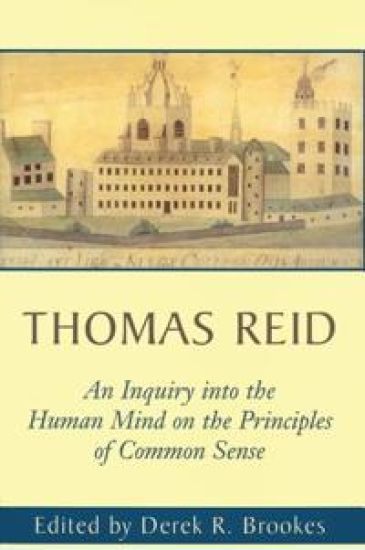
An Inquiry into the Human Mind on the Principles of Common Sense
Thomas Reid
Edinburgh University Press
2000
nidottu
Thomas Reid (1710-96) is increasingly being seen as a highly significant philosopher and a central figure in the Scottish Enlightenment. This edition of Reid's classic philosophical text in the philosophy of mind at long last gives scholars a complete critically edited text of the Inquiry. The critical text is based on the fourth life-time edition (1785). A selection of related documents showing the development of Reid's thought, textual notes, bibliographical details of previous editions, and a full introduction by the editor makes this an important contribution to the study of this increasingly respected philosopher. Key Features: *Complete, critically edited text of the Inquiry accompanied by a judicious selection of manuscript evidence relating to its composition. *Comprehensive Introduction providing an historical and philosophical account of the formation of the Inquiry. *Detailed textual notes which include bibliographical details and allusions, translations, references to secondary literature and selected passages from Reid's MSS.
An Inquiry into the Human Mind on the Principles of Common Sense
Thomas Reid
Edinburgh University Press
1997
sidottu
Thomas Reid's "Inquiry" is recognised as a classical philosophical text with over 40 editions since it first appeared in 1764. This volume provides a complete, critically edited text of the "Inquiry", together with a selection of related documents showing the development of Reid's thought. Textual notes, bibliographical details if previous editions, and a scholarly introduction are included in this contribution to the study of this philosopher.
This volume brings together for the first time a significant number of Reid's manuscript papers on natural history, physiology and materialist metaphysics. An important contribution not only to Reid studies but also to our understanding of eighteenth-century science and its context.
Inquiry and Essays
Thomas Reid; Keith Lehrer
Hackett Publishing Co, Inc
1983
pokkari
Halvin toimitettuna 29,80 €
Suitable for both students and scholars, this title covers topics such as Reid's views on the role of common sense, scepticism, the theory of ideas, perception, memory and identity, as well as his views on moral liberty, duties, and principles.