

Kirjailija
Thomas Robbins
Kirjat ja teokset yhdessä paikassa: 18 kirjaa, julkaisuja vuosilta 1990–2025, suosituimpiin kuuluu Magnalia Christi Americana; or, The Ecclesiastical History of New-England, From Its First Planting, in the Year 1620, Unto the Year of Our Lord 1698 ...; Volume 2. Vertaile teosten hintoja ja tarkista saatavuus suomalaisista kirjakaupoista.
18 kirjaa
Kirjojen julkaisuvuodet: 1990–2025.

Elements of General History, Ancient and Modern
Lord Alexander Fraser T Woodhouselee; Thomas Robbins
Hutson Street Press
2025
pokkari

Elements of General History, Ancient and Modern
Lord Alexander Fraser T Woodhouselee; Thomas Robbins
Hutson Street Press
2025
sidottu



This work has been selected by scholars as being culturally important, and is part of the knowledge base of civilization as we know it. This work was reproduced from the original artifact, and remains as true to the original work as possible. Therefore, you will see the original copyright references, library stamps (as most of these works have been housed in our most important libraries around the world), and other notations in the work. This work is in the public domain in the United States of America, and possibly other nations. Within the United States, you may freely copy and distribute this work, as no entity (individual or corporate) has a copyright on the body of the work. As a reproduction of a historical artifact, this work may contain missing or blurred pages, poor pictures, errant marks, etc. Scholars believe, and we concur, that this work is important enough to be preserved, reproduced, and made generally available to the public. We appreciate your support of the preservation process, and thank you for being an important part of keeping this knowledge alive and relevant.
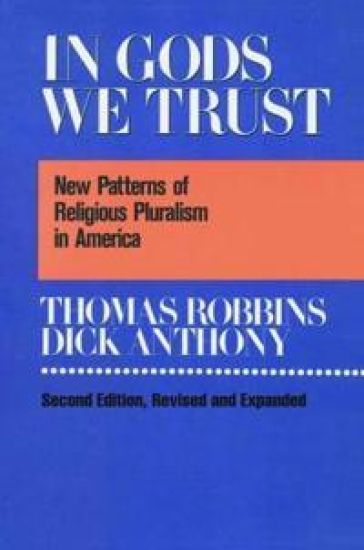
Much has changed since publication of the first edition of this established text in the sociology of religion. Revised and expanded, this edition emphasizes new patterns of religious change and conflict emerging in the United States in the latter part of the twentieth century. Leading scholars describe and analyze developments in five main areas: The fundamentalist and evangelical revival; challenge and renewal in mainline churches; spiritual innovation and the so-called New Age; women's movements and issues and their impact; and politics and civil religion. Chapters include an examination of religious movements' responses to AIDS; Christian schools; quasi-religions; healing rites and goddess worship; recruitment of women to charismatic and Hassidic groups,; televangelists and the Christian Right; racist rural populism; contemporary Mormonism and its growth; cults and brainwashing; Jonestown; dissidence in the Catholic church; and trance-channeling, among other topics. A new introductory chapter by the editors establishes an integrating framework in terms of three themes: increasing conflict and controversy associated with American religion; increasing focus on various forms of power in American religion; and challenges to models of secularization and modernization inherent in religious revival, innovation, and politicization. A concluding chapter by the editors looks at new trends and assesses their possible impact in coming years. Like its predecessor, this outstanding collection is a significant contribution to the literature as well as a valuable resource for the classroom.

By almost any measure, higher education is a vital part of the U. S. economy and society. Yet there is concern that the sector is inefficient or ill equipped to adapt to a changing environment. The information revolution, an aging population, demographic shifts, and a declining fiscal base all present it with major challenges. In Pursuit of Prestige describes the results of a two-year study of higher education in the United States designed to shed light on these issues. This volume examines higher education as an industry. It focuses on how institutions serve four identifiable markets that generate revenues (student enrollment, research funding, public fiscal support, and private giving). They analyze higher educational institutions' investment, pricing, and marketing behaviors, and the nature of competition among schools. They review the industry's basic conditions and market structure, then define the three key dimensions--degree level, scope, and resource allocation--by which institutions map out strategies for competing for markets. The heart of the book is an analysis showing how these strategies are carried out based on site-visit data from 26 highly diverse colleges and universities. This broad sampling covers all geographic regions of the country and every type of institution from elite research universities to community colleges. The authors then consider what strategies are possible in particular markets and how they affect students and competing institutions. Their conclusion draws out the implications of strategy and competition for the various customers of the U. S. higher education industry. Groundbreaking and genuinely exploratory in methodology.

Magnalia Christi Americana; or, The Ecclesiastical History of New-England, From Its First Planting, in the Year 1620, Unto the Year of Our Lord 1698 ...; Volume 2
Cotton Mather; Thomas Robbins
Creative Media Partners, LLC
2016
pokkari




The Cavalry Catechism: Or Instructions On Cavalry Exercise And Field Movements, Brigade Movements, Outpost Duty, Cavalry Supporting Artillery, Artille
Thomas Robbins
KESSINGER PUBLISHING, LLC
2008
nidottu

Magnalia Christi Americana or the Ecclesiastical History of New England
Cotton Mather; Thomas Robbins; Lucius F. (TRN) Robinson
Kessinger Pub
2006
pokkari

Magnalia Christi Americana or the Ecclesiastical History of New England
Cotton Mather; Thomas Robbins; Lucius F. (TRN) Robinson
Kessinger Pub
2006
pokkari

By almost any measure, higher education is a vital part of the U. S. economy and society. Yet there is concern that the sector is inefficient or ill equipped to adapt to a changing environment. The information revolution, an aging population, demographic shifts, and a declining fiscal base all present it with major challenges. In Pursuit of Prestige describes the results of a two-year study of higher education in the United States designed to shed light on these issues. This volume examines higher education as an industry. It focuses on how institutions serve four identifiable markets that generate revenues (student enrollment, research funding, public fiscal support, and private giving). They analyze higher educational institutions' investment, pricing, and marketing behaviors, and the nature of competition among schools. They review the industry's basic conditions and market structure, then define the three key dimensions--degree level, scope, and resource allocation--by which institutions map out strategies for competing for markets. The heart of the book is an analysis showing how these strategies are carried out based on site-visit data from 26 highly diverse colleges and universities. This broad sampling covers all geographic regions of the country and every type of institution from elite research universities to community colleges. The authors then consider what strategies are possible in particular markets and how they affect students and competing institutions. Their conclusion draws out the implications of strategy and competition for the various customers of the U. S. higher education industry. Groundbreaking and genuinely exploratory in methodology.
Much has changed since publication of the first edition of this established text in the sociology of religion. Revised and expanded, this edition emphasizes new patterns of religious change and conflict emerging in the United States in the latter part of the twentieth century. Leading scholars describe and analyze developments in five main areas: The fundamentalist and evangelical revival; challenge and renewal in mainline churches; spiritual innovation and the so-called New Age; women's movements and issues and their impact; and politics and civil religion. Chapters include an examination of religious movements' responses to AIDS; Christian schools; quasi-religions; healing rites and goddess worship; recruitment of women to charismatic and Hassidic groups,; televangelists and the Christian Right; racist rural populism; contemporary Mormonism and its growth; cults and brainwashing; Jonestown; dissidence in the Catholic church; and trance-channeling, among other topics. A new introductory chapter by the editors establishes an integrating framework in terms of three themes: increasing conflict and controversy associated with American religion; increasing focus on various forms of power in American religion; and challenges to models of secularization and modernization inherent in religious revival, innovation, and politicization. A concluding chapter by the editors looks at new trends and assesses their possible impact in coming years. Like its predecessor, this outstanding collection is a significant contribution to the literature as well as a valuable resource for the classroom.