Kirjojen hintavertailu – 12 859 828 kirjaa ja 27 kauppaa
Kirjailija
Thomas Robert Malthus
Kirjat ja teokset yhdessä paikassa: 52 kirjaa, julkaisuja vuosilta 1798–2025, suosituimpiin kuuluu Additions to the Fourth and Former Editions of An Essay on the Principle of Population, &c. &c. Vertaile teosten hintoja ja tarkista saatavuus suomalaisista kirjakaupoista.
Nimi esiintyy myös muodoissa: Thomas-Robert Malthus
Reprint of the Very Rare First EditionOne of the most influential works of political economy, this book had a profound effect on social policy during the nineteenth century. Malthus's central thesis is that population increases geometrically while food supplies increase arithmetically, a dynamic which will eventually lead to starvation and disease in the poorest sections of the community. To prevent this from happening, he posits, people, especially the poor, should have children later in life and limit the size of their families. The poor laws, which in his view tend "to create the poor which they maintain," must be reformed to incentivize this. First published anonymously and later under Malthus's own name, the work went through six editions between 1798 and 1826. It was the guiding spirit behind many of the reforms to social welfare in Great Britain during this time, including the Poor Law Amendment Act of 1834, which established the infamous workhouse system. Although Malthus failed to predict the Industrial Revolution and other advances in technology, his work had an indelible impact on socio-economic policy and influenced the development of evolutionary biology. An Essay on the Principles of Population remains an essential classic of history, political economy and social science.ix, 396 pp.
Resulting from discussions with his father on the works of Condorcet and William Godwin, Thomas Malthus (1766–1834) published anonymously in 1798 his first and most famous work. Written as a polite attack on French post-revolutionary speculations on social and human perfectibility, this remains one of the most powerful statements of the limits to human hopes set by the tension between population growth and natural resources. Central to his philosophy was the belief that 'The power of population is indefinitely greater than the power in the earth to produce subsistence for man'. The publication was extremely controversial, not only because of the discussions of prostitution, contraception and sex, but also because Malthus denied the right of the poor to be supported in the face of famine, poverty and disease. This 1798 first edition led to a riposte from Godwin, Of Population (1820), which is also reissued in this series.
Thomas Robert Malthus räknas som en av de mest inflytelserika klassiska ekonomerna. I sin berömda "En avhandling om befolkningslagen" (1798) – som hjälpte Charles Darwin att formulera teorin om det naturliga urvalet – tecknar han en dyster bild av framtiden. Befolkningen ökar med förbättrad levnadsstandard, men näringsutrymmet kan inte hålla jämn takt med befolkningstillväxten eftersom den odlingsbara arealen är begränsad och avkastningen avtagande när ytterligare – mindre lämpad – mark tas i bruk. Till slut nås en punkt då livsmedelsproduktionen inte länge räcker till för att livnära den växande befolkningen. Malthus befolkningsteori slog fel som prognos för utvecklingen i den industrialiserade världen, men den har haft stor betydelse för tolkningen av den förindustriella ekonomiska historien och även för diskussionen om vår tids globala befolkningsutveckling. Med dagens nymalthusianism har perspektivet vidgats till att inte bara gälla möjligheten att livnära en växande befolkning med livsmedel utan också frågan om vilka gränser naturen sätter för en ökande varuproduktion över huvud taget. Detta är första gången "En avhandling om befolkningslagen" har översatts till svenska i sin helhet.
The seminal essay on population growth by Thomas Robert Malthus is published here anew, complete and unabridged. Although wrong in its prediction of mass famine owing to population growth outpacing the growth in production of food, this essay became very influential among scientific and economic thinkers. Evolutionary science in particular appreciated the efforts of Malthus, with both Alfred Russel Wallace and Charles Darwin citing his paper as an influence on their own papers on natural selection. Malthus theorised that the fast rising numbers of people in the industrialising world would result in lowered wages, higher unemployment, and hence greater impoverishment and even famine. This idea, and others on the same theme, have acquired the term Malthusian over more than two centuries since this paper originally appeared - to this day commentators reference Malthus's themes when examining the world's rising population levels.
The seminal essay on population growth by Thomas Robert Malthus is published here anew, complete and unabridged. Although wrong in its prediction of mass famine owing to population growth outpacing the growth in production of food, this essay became very influential among scientific and economic thinkers. Evolutionary science in particular appreciated the efforts of Malthus, with both Alfred Russel Wallace and Charles Darwin citing his paper as an influence on their own papers on natural selection. Malthus theorised that the fast rising numbers of people in the industrialising world would result in lowered wages, higher unemployment, and hence greater impoverishment and even famine. This idea, and others on the same theme, have acquired the term Malthusian over more than two centuries since this paper originally appeared - to this day commentators reference Malthus's themes when examining the world's rising population levels.
This work has been selected by scholars as being culturally important, and is part of the knowledge base of civilization as we know it. This work was reproduced from the original artifact, and remains as true to the original work as possible. Therefore, you will see the original copyright references, library stamps (as most of these works have been housed in our most important libraries around the world), and other notations in the work. This work is in the public domain in the United States of America, and possibly other nations. Within the United States, you may freely copy and distribute this work, as no entity (individual or corporate) has a copyright on the body of the work. As a reproduction of a historical artifact, this work may contain missing or blurred pages, poor pictures, errant marks, etc. Scholars believe, and we concur, that this work is important enough to be preserved, reproduced, and made generally available to the public. We appreciate your support of the preservation process, and thank you for being an important part of keeping this knowledge alive and relevant.
With the first published version of Malthus’s Essay (1798) are selections from the expanded version (1803), which he considered definitive, as well as his Appendix (1806). Accompanying the text is an introduction and explanatory annotations by Joyce E. Chaplin and a rich selection of supporting materials. A chronology and a bibliography are also included.
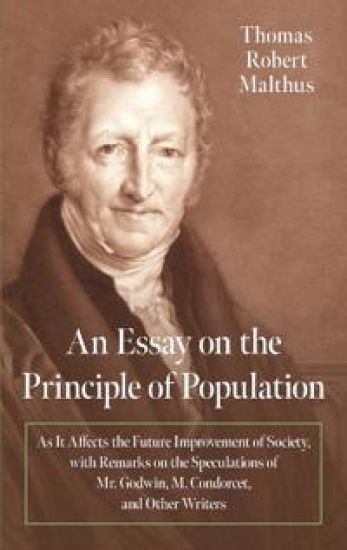
The Reverend Thomas Robert Malthus FRS (13 February 1766 - 29 December 1834) was an English cleric and scholar, influential in the fields of political economy and demography. Malthus himself used only his middle name, Robert. In his book An Essay on the Principle of Population, Malthus observed that an increase in a nation's food production improved the well-being of the populace, but the improvement was temporary because it led to population growth, which in turn restored the original per capita production level. In other words, mankind had a propensity to utilize abundance for population growth rather than for maintaining a high standard of living, a view that has become known as the "Malthusian trap" or the "Malthusian spectre". Populations had a tendency to grow until the lower class suffered hardship and want and greater susceptibility to famine and disease, a view that is sometimes referred to as a Malthusian catastrophe. Malthus wrote in opposition to the popular view in 18th-century Europe that saw society as improving and in principle as perfectible. He saw population growth as being inevitable whenever conditions improved, thereby precluding real progress towards a utopian society: "The power of population is indefinitely greater than the power in the earth to produce subsistence for man". As an Anglican cleric, Malthus saw this situation as divinely imposed to teach virtuous behaviour.