Kirjojen hintavertailu – 12 859 828 kirjaa ja 27 kauppaa

Kirjailija

Thomas Sommerer

Kirjat ja teokset yhdessä paikassa: 6 kirjaa, julkaisuja vuosilta 2010–2023, suosituimpiin kuuluu Der TrauerCoach. Vertaile teosten hintoja ja tarkista saatavuus suomalaisista kirjakaupoista.

6 kirjaa

Kirjojen julkaisuvuodet: 2010–2023.

SNS Democracy  Council 2023 Global Governance:  Fit for Purpose?

SNS Democracy Council 2023 Global Governance: Fit for Purpose?

Jonas Tallberg (ordförande); Karin Bäckstrand; Jan Aart Scholte; Thomas Sommerer

SNS Förlag
2023
nidottu
Global problems like climate change, health pandemics, financial crises, and military conflicts demand global solutions. This insight has spurred major growth of global governance over the past 75 years. Yet is this system of global governance fit for purpose in combating today s transboundary problems? The SNS Democracy Council 2023 examines this question with a focus on three preconditions for wellfunctioning global governance: power, effectiveness, and legitimacy. This report explores these themes in a comparative perspective, analyzing a broad range of international organizations in different policy areas, with an in-depth look at global climate governance as an illustrative case. The Council concludes that contemporary global governance is unable to deliver at its full potential and outlines strategies for making global governance more fit for purpose in the future. SNS Democracy Council 2023: Jonas Tallberg (Chairman), Professor of Political Science, Stockholm University, Karin Bäckstrand, Professor of Environmental Social Science, Stockholm University, Jan Aart Scholte, Professor of Global Transformations and Governance Challenges, Leiden University and Thomas Sommerer, Professor of International Organizations, University of Potsdam
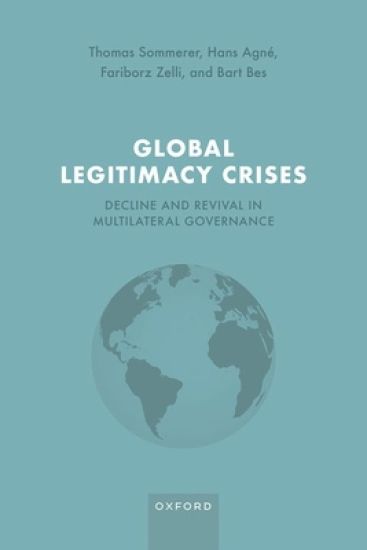
Global Legitimacy Crises

Global Legitimacy Crises

Thomas Sommerer; Hans Agné; Fariborz Zelli; Bart Bes

Oxford University Press
2022
sidottu
This is an open access title available under the terms of a CC BY-NC-ND 4.0 International licence. It is free to read at Oxford Scholarship Online and offered as a free PDF download from OUP and selected open access locations. Global Legitimacy Crises addresses the consequences of legitimacy in global governance, in particular asking: when and how do legitimacy crises affect international organizations and their capacity to rule. The book starts with a new conceptualization of legitimacy crisis that looks at public challenges from a variety of actors. Based on this conceptualization, it applies a mixed-methods approach to identify and examine legitimacy crises, starting with a quantitative analysis of mass media data on challenges of a sample of 32 IOs. It shows that some, but not all organizations have experienced legitimacy crises, spread over several decades from 1985 to 2020. Following this, the book presents a qualitative study to further examine legitimacy crises of two selected case studies: the WTO and the UNFCCC. Whereas earlier research assumed that legitimacy crises have negative consequences, the book introduces a theoretical framework that privileges the activation inherent in a legitimacy crisis. It holds that this activation may not only harm an IO, but could also strengthen it, in terms of its material, institutional, and decision-making capacity. The following statistical analysis shows that whether a crisis has predominantly negative or positive effects depends on a variety of factors. These include the specific audience whose challenges define a certain crisis, and several institutional properties of the targeted organization. The ensuing in-depth analysis of the WTO and the UNFCCC further reveals how legitimacy crises and both positive and negative consequences are interlinked, and that effects of crises are sometimes even visible beyond the organizational borders.
The Opening Up of International Organizations

The Opening Up of International Organizations

Jonas Tallberg; Thomas Sommerer; Theresa Squatrito; Christer Jönsson

Cambridge University Press
2013
pokkari
Once the exclusive preserve of member states, international organizations have become increasingly open in recent decades. Now virtually all international organizations at some level involve NGOs, business actors and scientific experts in policy-making. This book offers the first systematic and comprehensive analysis of this development. Combining statistical analysis and in-depth case studies, it maps and explains the openness of international organizations across issue areas, policy functions and world regions from 1950 to 2010. Addressing the question of where, how and why international organizations offer transnational actors access to global policy-making, this book has implications for critical issues in world politics. When do states share authority with private actors? What drives the design of international organizations? How do activists and businesses influence global politics? Is civil society involvement a solution to democratic deficits in global governance?
The Opening Up of International Organizations

The Opening Up of International Organizations

Jonas Tallberg; Thomas Sommerer; Theresa Squatrito; Christer Jönsson

Cambridge University Press
2013
sidottu
Once the exclusive preserve of member states, international organizations have become increasingly open in recent decades. Now virtually all international organizations at some level involve NGOs, business actors and scientific experts in policy-making. This book offers the first systematic and comprehensive analysis of this development. Combining statistical analysis and in-depth case studies, it maps and explains the openness of international organizations across issue areas, policy functions and world regions from 1950 to 2010. Addressing the question of where, how and why international organizations offer transnational actors access to global policy-making, this book has implications for critical issues in world politics. When do states share authority with private actors? What drives the design of international organizations? How do activists and businesses influence global politics? Is civil society involvement a solution to democratic deficits in global governance?