Kirjailija
Thomas Strässle
Kirjat ja teokset yhdessä paikassa: 7 kirjaa, julkaisuja vuosilta 2013–2024, suosituimpiin kuuluu Fake und Fiktion. Vertaile teosten hintoja ja tarkista saatavuus suomalaisista kirjakaupoista.
7 kirjaa
Kirjojen julkaisuvuodet: 2013–2024.

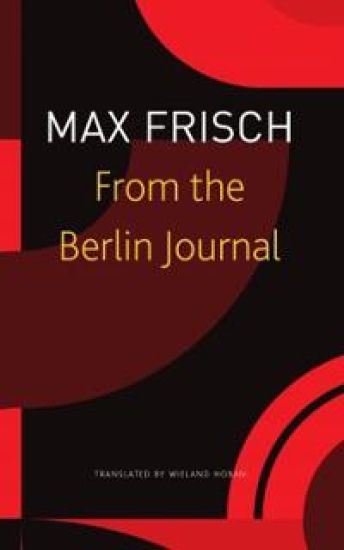
From the Berlin Journal
Max Frisch; Thomas Strässle; Margit Unser; Wieland Hoban
SEAGULL BOOKS LONDON LTD
2023
nidottu
Halvin toimitettuna 31,20 €
The daily journal of a giant of German literature, touching subjects ranging from everyday life to the political and social conditions in East Germany as viewed from West Berlin. Max Frisch (1911–91) was a giant of twentieth-century German literature. When Frisch moved into a new apartment in Berlin’s Sarrazinstrasse, he began keeping a journal, which he came to call the Berlin Journal. A few years later, he emphasized in an interview that this was by no means a “scribbling book,” but rather a book “fully composed.” The journal is one of the great treasures of Frisch’s literary estate, but the author imposed a retention period of twenty years from the date of his death because of the “private things” he noted in it. From the Berlin Journal now marks the first publication of excerpts from Frisch’s journal. Here, the unmistakable Frisch is back, full of doubt, with no illusions, and with a playfully sharp eye for the world. From the Berlin Journal pulls from the years 1946–49 and 1966–71. Observations about the writer’s everyday life stand alongside narrative and essayistic texts, as well as finely-drawn portraits of colleagues like Günter Grass, Uwe Johnson, Wolf Biermann, and Christa Wolf, among others. Its foremost quality, though, is the extraordinary acuity with which Frisch observed political and social conditions in East Germany while living in West Berlin.
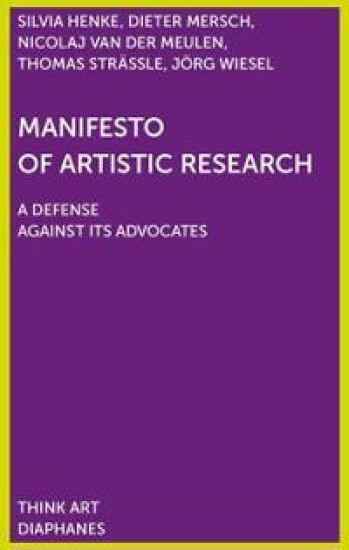
Manifesto of Artistic Research
Dieter Mersch; Silvia Henke; Thomas Strässle; Jörg Wiesel; Nicolaj Van Der Meulen
Diaphanes AG
2020
nidottu
Since its beginnings in the 1990s, artistic research has become established as a new format in the areas of educational and institutional policy, aesthetics, and art theory. It has now diffused into almost all artistic fields, from installation to experimental formats to contemporary music, literature, dance, or performance art. But from its beginnings—under labels like “art and science” or “scienceart” or “artscience” that mention both disciplines in one breath—it has been in competition with academic research, without its own concept of research having been adequately clarified. This manifesto attempts to resolve the problem and to defend the term. Further, this manifesto defends the radical potential of artistic research against those who toy all too carefully with university formats, wishing to ally their work with scientific principles. Its aim is to emphasize the autonomy and particular intellectuality of artistic research, without seeking to justify its legitimacy or adopt alien standards.