Kirjojen hintavertailu – 12 876 442 kirjaa ja 26 kauppaa

Kirjailija

Thomas Tanner

Kirjat ja teokset yhdessä paikassa: 8 kirjaa, julkaisuja vuosilta 2011–2021, suosituimpiin kuuluu Catalogi Codicum Manuscriptorum Bibliothecæ Bodleianæ ... Oxford, 1845-19, Volume 10.... Vertaile teosten hintoja ja tarkista saatavuus suomalaisista kirjakaupoista.

8 kirjaa

Kirjojen julkaisuvuodet: 2011–2021.

Resilience Reset

Resilience Reset

Aditya V. Bahadur; Thomas Tanner

Routledge
2021
sidottu
Drawing on evidence from urban resilience initiatives around the globe, the authors make a compelling argument for a "resilience reset", a pause and stocktake that critically examines the concepts, practices and challenges of building resilience, particularly in cities of the Global South. In turn, the book calls for the world’s cities to alter their course and "pivot" towards novel approaches to enhancing resilience. The book presents shifts in ways of acquiring and analysing data, building community resilience, approaching urban planning, engaging with informality, delivering financing, and building the skills of those running cities in a post-COVID world grappling with climate impacts. In Resilience Reset, the authors encourage researchers, policymakers, and practitioners to break out of existing modes of thinking and doing that may no longer be relevant for our rapidly urbanising and dynamic world. The book draws on the latest academic and practice-based evidence to provide actionable insights for cities that will enable them to deal with multiple interacting shocks and stresses. The book will be an indispensable resource to those studying urbanisation, development, climate change and risk management as well as for those designing and deploying operational initiatives to enhance urban resilience in businesses, international organisations, civil society organisations and governments. It is a must-read for anyone interested in managing the risks of climate impacts in urban centres in the Global South.
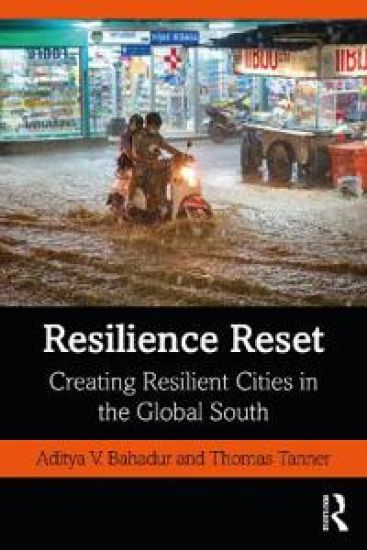
Resilience Reset

Resilience Reset

Aditya V. Bahadur; Thomas Tanner

Routledge
2021
nidottu
Drawing on evidence from urban resilience initiatives around the globe, the authors make a compelling argument for a "resilience reset", a pause and stocktake that critically examines the concepts, practices and challenges of building resilience, particularly in cities of the Global South. In turn, the book calls for the world’s cities to alter their course and "pivot" towards novel approaches to enhancing resilience. The book presents shifts in ways of acquiring and analysing data, building community resilience, approaching urban planning, engaging with informality, delivering financing, and building the skills of those running cities in a post-COVID world grappling with climate impacts. In Resilience Reset, the authors encourage researchers, policymakers, and practitioners to break out of existing modes of thinking and doing that may no longer be relevant for our rapidly urbanising and dynamic world. The book draws on the latest academic and practice-based evidence to provide actionable insights for cities that will enable them to deal with multiple interacting shocks and stresses. The book will be an indispensable resource to those studying urbanisation, development, climate change and risk management as well as for those designing and deploying operational initiatives to enhance urban resilience in businesses, international organisations, civil society organisations and governments. It is a must-read for anyone interested in managing the risks of climate impacts in urban centres in the Global South.

GNU Libtool Reference Manual

GNU Libtool Reference Manual

Alexandre Oliva; Thomas Tanner; Gary V. Vaughan

Samurai Media Limited
2015
nidottu
In the past, if you were a source code package developer and wanted to take advantage of the power of shared libraries, you needed to write custom support code for each platform on which your package ran. You also had to design a configuration interface so that the package installer could choose what sort of libraries were built. GNU Libtool simplifies your job by encapsulating both the platform-specific dependencies, and the user interface, in a single script. GNU Libtool is designed so that the complete functionality of each host type is available via a generic interface, but nasty quirks are hidden from the programmer. GNU Libtool's consistent interface is reassuring. . . users don't need to read obscure documentation to have their favorite source package build shared libraries. They just run your package configure script (or equivalent), and libtool does all the dirty work.
Climate Change and Development

Climate Change and Development

Thomas Tanner; Leo Horn-Phathanothai

Routledge
2014
sidottu
The evidence for human-induced climate change is now overwhelming, the brunt of its impacts is already being felt by poor people, and the case for urgent action is compelling. This book addresses the two greatest challenges of our time – averting catastrophic climate change and eradicating poverty – and the close interconnections between them. Climate Change and Development provides a comprehensive and multi-disciplinary foundation for understanding the complex and tangled relationship between development and climate change. It argues that transformational approaches are required in order to reconcile poverty reduction and climate protection and secure sustained prosperity in the twenty first century. Section One provides the building blocks for understanding climate science and the nexus between climate and development. Section Two outlines responses to climate change from the perspective of developing countries, with chapters on international agreements, climate change mitigation and adaptation, and climate finance. Each chapter offers analytical tools for evaluating responses, enabling readers to ask smart questions about the climate change and development nexus as policy and action evolve in the coming years. The last three chapters of the book, contained in Section Three, are forward looking and focus on why and how development must be re-framed to deliver more equitable and sustainable outcomes. This section sets out different critiques of ‘development-as-usual’ and explores alternative paradigms of development in a warming and resource-constrained world. This is an invaluable and clearly written text that uses real world examples to bring to life perspectives from across different disciplines. It also contains chapter learning outcomes, and end of chapter summaries, discussion questions, and suggestions for further reading and relevant websites. The text is suitable for both undergraduate and postgraduate students, as well as those working in international development contexts who wish to get to grips with this pressing global challenge.
Climate Change and Development

Climate Change and Development

Thomas Tanner; Leo Horn-Phathanothai

Routledge
2013
nidottu
The evidence for human-induced climate change is now overwhelming, the brunt of its impacts is already being felt by poor people, and the case for urgent action is compelling. This book addresses the two greatest challenges of our time – averting catastrophic climate change and eradicating poverty – and the close interconnections between them. Climate Change and Development provides a comprehensive and multi-disciplinary foundation for understanding the complex and tangled relationship between development and climate change. It argues that transformational approaches are required in order to reconcile poverty reduction and climate protection and secure sustained prosperity in the twenty first century. Section One provides the building blocks for understanding climate science and the nexus between climate and development. Section Two outlines responses to climate change from the perspective of developing countries, with chapters on international agreements, climate change mitigation and adaptation, and climate finance. Each chapter offers analytical tools for evaluating responses, enabling readers to ask smart questions about the climate change and development nexus as policy and action evolve in the coming years. The last three chapters of the book, contained in Section Three, are forward looking and focus on why and how development must be re-framed to deliver more equitable and sustainable outcomes. This section sets out different critiques of ‘development-as-usual’ and explores alternative paradigms of development in a warming and resource-constrained world. This is an invaluable and clearly written text that uses real world examples to bring to life perspectives from across different disciplines. It also contains chapter learning outcomes, and end of chapter summaries, discussion questions, and suggestions for further reading and relevant websites. The text is suitable for both undergraduate and postgraduate students, as well as those working in international development contexts who wish to get to grips with this pressing global challenge.