Kirjojen hintavertailu – 12 859 829 kirjaa ja 27 kauppaa
Kirjailija
Thomas Wilhelmsson
Kirjat ja teokset yhdessä paikassa: 13 kirjaa, julkaisuja vuosilta 1997–2026, suosituimpiin kuuluu EC Consumer Law. Vertaile teosten hintoja ja tarkista saatavuus suomalaisista kirjakaupoista.
This book will describe the development of European Community consumer law and seek to determine to what extent action by the European Community has promoted the interest of consumer protection. In doing so it will consider important areas relating to protection of the consumers economic interests and physical safety, as well as questions of access to justice. In addition to assessing the success of community consumer policy the authors will also put forward suggestions for ways in which consumer protection can be enhanced at the community level.
This seminal book develops a new perspective on the debate concerning the Europeanisation of private law. The theory is both realistic, building on existing experience, and normative as it focuses on the future. It outlines ‘good’ Europeanisation in which legal sources can be used across borders; hence the free movement of legal ideas. At its core, is the analysis of the legal consequences of growing societal uncertainty and increasing use of micro-politics, leading to a situation where the law develops through small narratives rather than according to a coherent master plan. The inevitable rule of law concerns around such a development, have to be addressed by transparent legal reasoning. The author masterfully illustrates how this can be achieved in decision-making across Europe, drawing on arguments which are both substantive and authoritative in nature. He shows how all legal actors, including decision-makers and scholars, are morally responsible for the choices made. This is a fascinating intervention in the field of European private law by one of its leading authorities.
This seminal book develops a new perspective on the debate concerning the Europeanisation of private law. The theory is both realistic, building on existing experience, and normative as it focuses on the future. It outlines ‘good’ Europeanisation in which legal sources can be used across borders; hence the free movement of legal ideas. At its core, is the analysis of the legal consequences of growing societal uncertainty and increasing use of micro-politics, leading to a situation where the law develops through small narratives rather than according to a coherent master plan. The inevitable rule of law concerns around such a development, have to be addressed by transparent legal reasoning. The author masterfully illustrates how this can be achieved in decision-making across Europe, drawing on arguments which are both substantive and authoritative in nature. He shows how all legal actors, including decision-makers and scholars, are morally responsible for the choices made. This is a fascinating intervention in the field of European private law by one of its leading authorities.
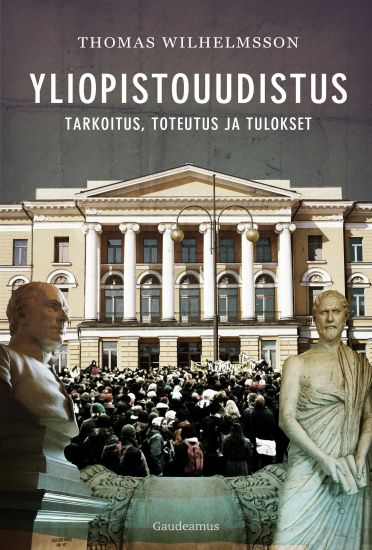
Uudenvuodenpäivänä vuonna 2010 astui voimaan kiistelty yliopistouudistus, jossa tarkoituksena oli lisätä yliopistojen autonomiaa. Peistä uudistuksesta taitettiin valtamedioissa asti, ja Helsingin yliopistossa vastustaminen oli johtanut hallintorakennuksen valtaamiseen. Mistä tässä kaikessa oli kysymys? Yliopistouudistus-kirjassa oman näkemyksensä uudistustyön etenemiseen ja taustoihin tuo Helsingin yliopiston entinen kansleri ja tuolloin rehtorina toiminut Thomas Wilhelmsson. Hän kertoo ajatuksista, keskusteluista ja tapahtumaketjuista, jotka vaikuttivat prosessin taustalla mutta joita ei käy ilmi virallisista asiakirjoista. Wilhelmsson avaa uudistuksen syitä ja tarvetta sääntelyn purkamiselle, kansainvälistymiselle sekä strategiselle johtamiselle mutta ei välttele tehtyjä virheitä. Ongelmia aiheuttivat myös kamppailut valtiovarainministeriön kanssa apteekkiprivilegiosta ja kiinteistöjen hallinnasta. Kymmenen vuoden jälkeen onkin aika kysyä: mitä uudistuksesta on seurannut?
First published in 1999, this book focuses on the new role of private law in late modernity. It analyses the pressures for changes in this area of law due to the present processes of privatisation and marketisation. The perspective is welfarist: in what ways and to what extent can the welfare state expectations of the citizens be defended through private law mechanisms when state-offered security is diminishing? Which alternatives are available when developing private law? The questions are discussed against the background of theories concerning important features of late modern society, for example consumerism, risk, information, globalisation and fragmentation. Several fields of private law are analysed, such as private law theory, tort and liability law, contract law and credit law as well as access to justice issues. The approach is comparative, including analyses of both common law and continental law.
First published in 1999, this book focuses on the new role of private law in late modernity. It analyses the pressures for changes in this area of law due to the present processes of privatisation and marketisation. The perspective is welfarist: in what ways and to what extent can the welfare state expectations of the citizens be defended through private law mechanisms when state-offered security is diminishing? Which alternatives are available when developing private law? The questions are discussed against the background of theories concerning important features of late modern society, for example consumerism, risk, information, globalisation and fragmentation. Several fields of private law are analysed, such as private law theory, tort and liability law, contract law and credit law as well as access to justice issues. The approach is comparative, including analyses of both common law and continental law.
In Rethinking EU Consumer Law, the authors analyse the development of EU consumer law on the basis of a number of clear themes, which are then traced through specific areas. Recurring themes include the artificiality of the EU’s consumer image, the problems created by the drive towards maximum harmonisation, and the unexpected effects EU Consumer Law has had on national law. The book argues that EU Consumer Law has the potential of enhancing the protecting of consumers throughout the EU and could offer a model for consumer law elsewhere in the world, but in order to unlock this potential, there needs to be a rethink with regard to the EU’s approach to consumer law and policy.
In Rethinking EU Consumer Law, the authors analyse the development of EU consumer law on the basis of a number of clear themes, which are then traced through specific areas. Recurring themes include the artificiality of the EU’s consumer image, the problems created by the drive towards maximum harmonisation, and the unexpected effects EU Consumer Law has had on national law. The book argues that EU Consumer Law has the potential of enhancing the protecting of consumers throughout the EU and could offer a model for consumer law elsewhere in the world, but in order to unlock this potential, there needs to be a rethink with regard to the EU’s approach to consumer law and policy.
The Unfair Commercial Practices Directive is the most important directive in the field of trade practices to have emerged from the EC but it builds upon European activity which has sought to regulate trade practices on both a sectoral and horizontal level. It is an umbrella provision, which uses general clauses to protect consumers. How effective this approach is and how it relates the existing acquis are fundamental issues for debate. This work provides a critical appraisal of the Unfair Commercial Practices Directive linking discussion of it to general debates about how fair trading should be regulated. It explains how the Directive fits into the existing acquis. It also examines national traditions where these are necessary to explain the European approach, as in the case of general clauses. The book will be a valuable tool for any student of consumer law seeking to understand the thinking behind the directive and how it will affect national laws. It will also influence policy makers by suggesting how the directive should be interpreted and what policy lies behind its formulation. Businesses and their advisers will use the book as a means of understanding the new regulatory climate post-the directive.
The Unfair Commercial Practices Directive is the most important directive in the field of trade practices to have emerged from the EC but it builds upon European activity which has sought to regulate trade practices on both a sectoral and horizontal level. It is an umbrella provision, which uses general clauses to protect consumers. How effective this approach is and how it relates the existing acquis are fundamental issues for debate. This work provides a critical appraisal of the Unfair Commercial Practices Directive linking discussion of it to general debates about how fair trading should be regulated. It explains how the Directive fits into the existing acquis. It also examines national traditions where these are necessary to explain the European approach, as in the case of general clauses. The book will be a valuable tool for any student of consumer law seeking to understand the thinking behind the directive and how it will affect national laws. It will also influence policy makers by suggesting how the directive should be interpreted and what policy lies behind its formulation. Businesses and their advisers will use the book as a means of understanding the new regulatory climate post-the directive.
Boken utgör en pedagogisk introduktion till köprätten, skriven av välkända jurister som deltog i beredningen av den nordiska köplagen. De många konkreta exemplen gör boken direkt användbar också för advokater, domare och affärsjurister.
Kauppalaki sisältää seikkaperäiset säännökset myyjän ja ostajan oikeuksista ja velvollisuuksista irtaimen omaisuuden kaupassa. Vaikka kauppalain säännökset voidaan sopimuksin syrjäyttää, lain sisällön tunteminen on tärkeää kaikille, jotka joutuvat laatimaan kauppaa koskevia sopimuksia tai ovat muuten tekemisissä tällaisten sopimusten kanssa. Kirjan käyttökelpoisuutta on tässä painoksessa parannettu lisäämällä uusia sekä laadittuja että pohjoismaisesta oikeuskäytännöstä tuotuja soveltamisesimerkkejä. Teoksessa selostetaan lain sisältö asiakokonaisuuksittain. Teos on tarkoitettu oppikirjaksi sekä palvelemaan käytännön liike-elämän ja lakimiesten tiedontarpeita. Kauppalain teksti on kirjan liitteenä ja kirjassa selostetaan myös KKO:n kauppalakia koskeva oikeuskäytäntö. Kauppalakia koskevan laajan pohjoismaisen oikeuskirjallisuuden pohjalta on tarvittaessa kehitelty aiemmissa painoksissa esitettyjä kannanottoja. Kirjoittajat ovat olleet Suomen edustajina kauppalakia valmistelleessa pohjoismaisessa työryhmässä sekä laatineet hallituksen esityksen kauppalaiksi.
This work looks at the consequences of the development of information technology and the information society for consumers and for consumer law. While the new technological environment has been greeted with enthusiasm by many, citing the improvement in consumer choice, convenience, and the accessibility of information, there have also been calls to focus on the needs of those consumers who cannot easily gain access to the benefits associated with the new technology. This collection of papers examines developments in consumer protection legislation around the world in response to the technological advances, and focuses on issues such as electronic marketing, electronic commerce, financial services, product liability, intellectual property and rights of access to information. Issues such as how and to what extent the new environment should be regulated, as well as the impact of changes in the globalized information market, are also discussed. This volume arose from the 7th International Consumer Law Conference, held in Helsinki in 1999 under the auspices of the International Association for Consumer Law.