Kirjojen hintavertailu – 12 859 819 kirjaa ja 27 kauppaa
Kirjailija
Tim Brady
Kirjat ja teokset yhdessä paikassa: 7 kirjaa, julkaisuja vuosilta 2012–2025, suosituimpiin kuuluu The N-Plan. Vertaile teosten hintoja ja tarkista saatavuus suomalaisista kirjakaupoista.
The astonishing true story of three fearless female resisters during WWII whose youth and innocence belied their extraordinary daring in the Nazi-occupied Netherlands... Truus Oversteegen, her younger sister Freddie, and their friend Hannie Schaft, were just teenagers when the commander of The Dutch Royal Army surrendered to the Nazis. Overnight, nine million Netherlanders were suddenly under the heel of the Nazi boot. As the German-controlled government slowly began to pen in the entire Jewish community and force them indoors, along with the requisite yellow star signifying Jood, so the girls were compelled to become involved in The Resistance. As Anne Frank and her family were just going into hiding only miles away in Amsterdam, the girls started with simple acts of covert illegality: lifting German ID cards to counterfeit them; distributing fliers announcing strikes, passing out anti-Nazi literature. With each initiative, the danger became more pronounced, the stakes higher. Soon they were called on for bigger, deadlier jobs: Ferrying Jewish children to safeguard locations. Stockpiling weapons. Detonating bombs. Intelligence-gathering. Spying. Sabotage. Murder. With each assignment, they became an integral part of the Dutch resistance. But it was not without peril, heartache, suffering, or loss. Award-winning historian Tim Brady paints a vivid portrait of Tuus, Freddie, and Hannie, three ordinary Dutch girls whose selfless acts of courage as they sought to undermine the Nazis and their Dutch collaborators were nothing short of extraordinary.
Told for the very first time, the astonishing true story of three fearless female resisters during WWII whose youth and innocence belied their extraordinary daring in the Nazi-occupied Netherlands. It also made them the underground's most invaluable commodity. Recruited as teenagers, Hannie Schaft, and Dutch sisters Truus and Freddie Oversteegen fulfilled their harrowing missions as spies, saboteurs, and Nazi assassins with remarkable courage, but their stories have remained largely unknown...until now. May 10, 1940. The Netherlands was swarming with Third Reich troops. In seven days it's entirely occupied by Nazi Germany. Joining a small resistance cell in the Dutch city of Haarlem were three teenage girls: Hannie Schaft, and sisters Truus and Freddie Oversteegen who would soon band together to form a singular female underground squad. Smart, fiercely political, devoted solely to the cause, and "with nothing to lose but their own lives," Hannie, Truus, and Freddie took terrifying direct action against Nazi targets. That included sheltering fleeing Jews, political dissidents, and Dutch resisters. They sabotaged bridges and railways, and donned disguises to lead children from probable internment in concentration camps to safehouses. They covertly transported weapons and set military facilities ablaze. And they carried out the assassinations of German soldiers and traitors--on public streets and in private traps--with the courage of veteran guerilla fighters and the cunning of seasoned spies. In telling this true story through the lens of a fearlessly unique trio of freedom fighters, Tim Brady offers a never-before-seen perspective of the Dutch resistance during the war. Of lives under threat; of how these courageous young women became involved in the underground; and of how their dedication evolved into dangerous, life-threatening missions on behalf of Dutch patriots--regardless of the consequences. Harrowing, emotional, and unforgettable, Three Ordinary Girls finally moves these three icons of resistance into the deserved forefront of world history.
In this book, leading authorities on project organizing explore the growing deployment of projects and other types of temporary organizations, with a focus on the challenges created by projectification. The way projects are coordinated and handled influences the success of innovation and change within organizations and is critical for strategic development in our societies, yet it is often at odds with the institutions of traditional industrial society. Drawing on both theoretical perspectives and real-world cases, this book sheds light on the transformation toward a project society and explores the effects, opportunities, and conflicts it has created. As change continues, the authors make a case for renewing institutions and mind-sets and provide a foundation from which to discuss societal changes for the future. This is an invaluable book for researchers and students in project management and organizational theory programs, as well as professionals involved in the management of projects.
By the time Mark Clark's Fifth Army reached the small village of San Pietro north of Naples in the first week of December 1943, a tough but rapid sweep through Sicily came to a muddy halt. On the slopes of a distant mountain, the death of a single platoon captain, Henry Waskow, epitomized the struggle. A Death in San Pietro chronicles the quietly heroic and beloved Captain Waskow and his company as they make their way into battle. Waskow's 36th (&ldquoTexas”) Division would ultimately succeed in driving the Germans off the mountains but not before eighty percent of Waskow's company is lost in action. For Americans back home, two of the war's most lasting artistic expression brought horrified focus to the battlefield, already dubbed"Purple Heart Valley” by the men of the 36th. Pulitzer Prize-winner Ernie Pyle's dispatch about Waskow's death and filmmaker John Huston's award-winning documentary of the battle rivets- and shocks- the nation, bringing, as if for the first time, the awful carnage of world war into living rooms across America.
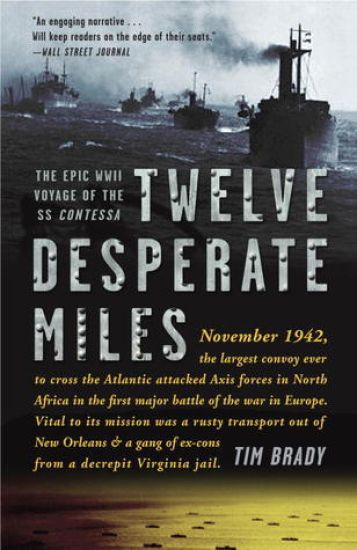
The true story of how a rusty New Orleans banana boat staffed with a most unlikely and diverse crew was drafted into service in WWII--and heroically succeeded in setting the stage for Patton's epic invasion of North Africa. The largest amphibious invasion force ever to cross the Atlantic Ocean set sail from Virginia in November 1942 with the aim of capturing Casablanca and a crucial airfield northeast of the city. Unfortunately, the airfield was located a dozen miles up a twisting Morrocan river, too shallow for any ship in the entire Allied fleet. As the invasion neared, the War Department turned up the Contessa, a salt-caked Honduran-registered civilian freighter that had spent most of her career hauling bananas and honeymooners. This unremarkable ship, crewed by seamen from twenty-six different nations, eighteen sailors pulled from the Norfolk County jail, and a French harbor pilot spirited out of Morroco by OSS agents, became the focus of the opening salvo of World War II. Too late to join the massive convoy sailing for Africa, the Contessa set out on her own through the U-boat-infested waters of the Atlantic to the shores of Morocco, where she faced her most daunting challenge: the twelve-mile voyage up the well-defended Sebou River, carrying an explosive cocktail of airplane fuel and nine hundred tons of bombs in her holds. Twelve Desperate Miles is a surprising and entertaining account of one of the great untold stories of the war.