Kirjojen hintavertailu – 12 903 725 kirjaa ja 27 kauppaa

Kirjailija

Tim Dyson

Kirjat ja teokset yhdessä paikassa: 7 kirjaa, julkaisuja vuosilta 1996–2024, suosituimpiin kuuluu Twenty-First Century India. Vertaile teosten hintoja ja tarkista saatavuus suomalaisista kirjakaupoista.

7 kirjaa

Kirjojen julkaisuvuodet: 1996–2024.

India's Historical Demography

India's Historical Demography

Tim Dyson

TAYLOR FRANCIS LTD
2024
nidottu
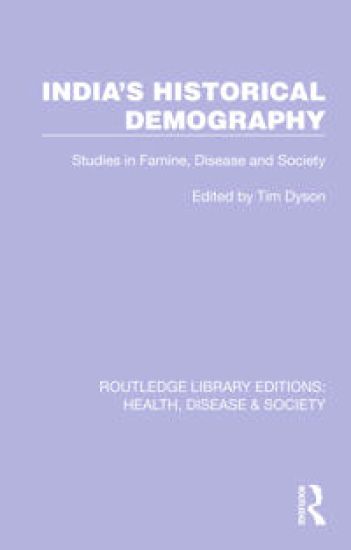
When this book was originally published in 1989 here had been virtually no studies of the country’s historical demography. This volume was significant for 3 reasons: it contributed greatly to the knowledge of India’s population history; it had major implications for the work of social and economic historians of India; and lastly the Indian context provides an excellent laboratory in which to investigate certain large-scale demographic phenomena – among others the experience of bubonic plague, influenza, cholera and famine.
India's Historical Demography

India's Historical Demography

Tim Dyson

TAYLOR FRANCIS LTD
2022
sidottu
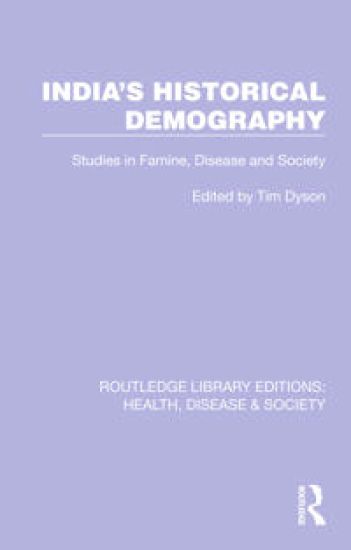
When this book was originally published in 1989 here had been virtually no studies of the country’s historical demography. This volume was significant for 3 reasons: it contributed greatly to the knowledge of India’s population history; it had major implications for the work of social and economic historians of India; and lastly the Indian context provides an excellent laboratory in which to investigate certain large-scale demographic phenomena – among others the experience of bubonic plague, influenza, cholera and famine.
A Population History of India

A Population History of India

Tim Dyson

Oxford University Press
2018
sidottu
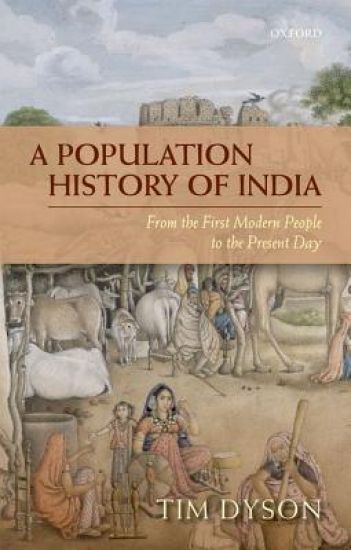
A Population History of India provides an account of the size and characteristics of India's population stretching from when hunter-gatherer homo sapiens first arrived in the country - very roughly seventy thousand years ago - until the modern day. It is a period during which the population grew from just a handful of people to reach almost 1.4 billion, and a time when the fact of death had a huge influence on the nature of life. This book considers the millennia that were characterized by hunting and gathering, the Indus valley civilization, the opening-up of the Ganges river basin, and the eras of the Delhi Sultanate, the Mughal Empire, British colonial rule, and India since independence. By observing India through a demographic lens, A Population History of India: From the First Modern People to the Present Day addresses mortality, fertility, the size of cities, patterns of migration, and the multitude of famines, epidemics, invasions, wars, and other events that affected the population. It draws together research from archaeology, cultural studies, economics, epidemiology, linguistics, history, and politics to understand the likely trajectory of India's population in comparison to the trends that applied to Europe and China, and to reveal a surprising and dramatic story.

Twenty-First Century India

Twenty-First Century India

Tim Dyson; Robert Cassen; Leela Visaria

Oxford University Press
2005
nidottu
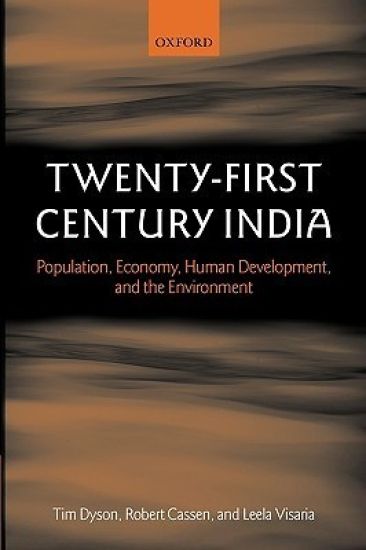
Twenty-First Century India is the first study of India's development giving a fully integrated account of population and development. It is built on new projections of the population for fifty years from the Census of 2001. India's population then had already passed 1 billion. Twenty-five years later it will exceed 1.4 billion, and will almost certainly pass 1.5 billion by mid-century. The projections incorporate for the first time both inter-state migration and the role of HIV/AIDS. They also show India's urban future, with close to half a billion urban inhabitants by the year 2026. The implications of this population growth are then traced out in a range of modelling and analytical work. Growing numbers are found to complicate the task of achieving widespread education in a number of India's states, while other states are already experiencing declines in their school-age population. Demographic growth also contributes to poverty, and increasing divergence in social conditions among the states. As population growth slows in the country overall, the labour force continues to grow relatively fast, with difficult consequences for employment. But national economic growth could be accelerated by the 'demographic bonus' of the declining proportion of dependents to workers in the population. The book is reasonably optimistic about India's food prospects: the country can continue to feed itself. It can also enjoy higher levels of energy use, manufacturing, and modern forms of transport, while experiencing less chemical pollution. India's cities can become cleaner and healthier places to live. Perhaps the most difficult environmental issue, and the one most strongly related to population growth, is water. Some states also face severe pressures on common property resources. A policy chapter concludes the book. India's future problems are large, but in principle manageable. However, whether the country will actually achieve sustainable development for all is another matter.
Twenty-First Century India

Twenty-First Century India

Tim Dyson; Robert Cassen; Leela Visaria

Oxford University Press
2004
sidottu
Twenty-First Century India is the first study of India's development giving a fully integrated account of population and development. It is built on new projections of the population for fifty years from the Census of 2001. India's population then had already passed 1 billion. Twenty-five years later it will exceed 1.4 billion, and will almost certainly pass 1.5 billion by mid-century. The projections incorporate for the first time both inter-state migration and the role of HIV/AIDS. They also show India's urban future, with close to half a billion urban inhabitants by the year 2026. The implications of this population growth are then traced out in a range of modelling and analytical work. Growing numbers are found to complicate the task of achieving widespread education in a number of India's states, while other states are already experiencing declines in their school-age population. Demographic growth also contributes to poverty, and increasing divergence in social conditions among the states. As population growth slows in the country overall, the labour force continues to grow relatively fast, with difficult consequences for employment. But national economic growth could be accelerated by the 'demographic bonus' of the declining proportion of dependents to workers in the population. The book is reasonably optimistic about India's food prospects: the country can continue to feed itself. It can also enjoy higher levels of energy use, manufacturing, and modern forms of transport, while experiencing less chemical pollution. India's cities can become cleaner and healthier places to live. Perhaps the most difficult environmental issue, and the one most strongly related to population growth, is water. Some states also face severe pressures on common property resources. A policy chapter concludes the book. India's future problems are large, but in principle manageable. However, whether the country will actually achieve sustainable development for all is another matter.
Population and Food

Population and Food

Tim Dyson

Routledge
1996
nidottu
Population and Food examines recent trends in food production and assesses the prospects for feeding humanity in the twenty-first century. With case studies from throughout the developed and developing world, the book suggests that food production in most world regions has kept ahead of population growth, that future food production prospects are encouraging, and that in all probability the people of the world will be better fed in the twenty-first than in the twentieth century.
Population and Food

Population and Food

Tim Dyson

Routledge
1996
sidottu
Population and Food examines recent trends in food production and assesses the prospects for feeding humanity in the twenty-first century. With case studies from throughout the developed and developing world, the book suggests that food production in most world regions has kept ahead of population growth, that future food production prospects are encouraging, and that in all probability the people of the world will be better fed in the twenty-first than in the twentieth century.