Kirjojen hintavertailu – 12 903 735 kirjaa ja 27 kauppaa

Kirjailija

Tim Lindsey

Kirjat ja teokset yhdessä paikassa: 10 kirjaa, julkaisuja vuosilta 2006–2025, suosituimpiin kuuluu Islam, Law and the State in Southeast Asia: Volume 3. Vertaile teosten hintoja ja tarkista saatavuus suomalaisista kirjakaupoista.

10 kirjaa

Kirjojen julkaisuvuodet: 2006–2025.

Islam, Law and the State in the Philippines

Islam, Law and the State in the Philippines

Tim Lindsey; Kerstin Steiner

TAYLOR FRANCIS LTD
2025
sidottu
This book investigates the development of Islam in the Philippines from a legal perspective, investigating Islam through the lens of the institutions of Islamic law. Drawing on original fieldwork, including in Mindanao, this comprehensive book covers a wide range of topics, including Islamic leadership and authority (mufti, darul ifta, and fatawa); Islamic judges and dispute resolution in Islamic courts, and alternative forms of dispute resolution; legislative codification of Islamic law especially in private law (marriage and divorce); Islamic banking and finance; and madrasahs and Islamic education. The book also offers a comprehensive, detailed, and timely socio-legal analysis of controversies relating to Islam and the long-running conflict in the Southern Philippines as Moro communities struggle with the challenges of transition to the long-awaited Bangsamoro Autonomous Region of Muslim Mindanao. This is contextualised against the wider history and politics of the southern Philippines, from pre-colonial times to 2024. The authors offer a detailed and nuanced analysis based on primary documents, as well as an account of the existing literature in the field. The book greatly enhances understandings of the social, political, and historical context of current developments in Islam in the Philippines. It will be of interest to researchers studying Islam and the administration of Islamic law, Malay Muslim communities in Southeast Asia, and the history and politics of the Philippines.
Indonesian Law

Indonesian Law

Tim Lindsey; Simon Butt

Oxford University Press
2018
sidottu
Indonesia has a growing population of almost 300 million people, it is increasingly involved in world affairs, and has a booming economy. The need to better understand its unique, complex, and often obscure legal system, has become pressing. This is true across a wide range of sectors including, but not limited to, trade and investment, crime and terrorism, and human rights. Indonesia's democratization after the fall of Soeharto in 1998 triggered massive social and political changes that opened up this diverse, and formerly tightly-controlled, society. Law reform was a key driver of Indonesia's transformation and its full effect remains to be seen. This book offers clear and detailed explanations of the foundations of Indonesia's legal system in the context of its legal reform and rapid development. It offers succinct commentaries on a wide range of issues, examining the judicial process, the constitution, corruption and the court system, contract law, administrative law, foreign investment, taxation, Islamic law, and family law. It examines current substantive law and judicial interpretation and presents case studies of how the system operates in practice. Written in an accessible and engaging style, this book is an essential guide for readers seeking quick and clear answers to questions regarding the law and its application in Indonesia.
Headwinds of Opportunity

Headwinds of Opportunity

Tim Lindsey

Greenleaf Publishing
2017
sidottu
Winner of the Silver Axiom Business Book Award in the category of Sustainability. Headwinds of Opportunity goes beyond philosophical and academic discussion of business sustainability to offer strategic guidance regarding how to make all types of organizations function more sustainably while simultaneously improving their competitiveness. It differs from other books in that it approaches sustainability as an innovation – an innovative way of conducting business. The book is informed by time-tested principles of innovation diffusion that can be effectively applied to drive change. It places considerable emphasis on the "how-to" aspects of sustainability improvement and how they can be used to increase effectiveness.
Headwinds of Opportunity

Headwinds of Opportunity

Tim Lindsey

Greenleaf Publishing
2017
nidottu
Winner of the Silver Axiom Business Book Award in the category of Sustainability. Headwinds of Opportunity goes beyond philosophical and academic discussion of business sustainability to offer strategic guidance regarding how to make all types of organizations function more sustainably while simultaneously improving their competitiveness. It differs from other books in that it approaches sustainability as an innovation – an innovative way of conducting business. The book is informed by time-tested principles of innovation diffusion that can be effectively applied to drive change. It places considerable emphasis on the "how-to" aspects of sustainability improvement and how they can be used to increase effectiveness.
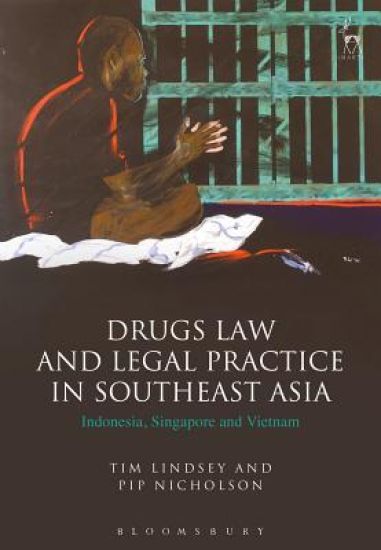
Drugs Law and Legal Practice in Southeast Asia

Drugs Law and Legal Practice in Southeast Asia

Tim Lindsey; Pip Nicholson

Hart Publishing
2016
sidottu
Drugs Law and Legal Practice in Southeast Asia investigates criminal law and practice relevant to drugs regulation in three Southeast Asian jurisdictions: Indonesia, Singapore and Vietnam. These jurisdictions represent a spectrum of approaches to drug regulation in Southeast Asia, highlighting differences in practice between civil and common law countries, and between liberal and authoritarian states. This book offers the first major English language empirical investigation and comparative analysis of regulation, jurisprudence, court procedure, and practices relating to drugs law enforcement in these three states.
Law Reform in Developing and Transitional States
Law reform in developing countries has become an increasingly topical subject in recent years. A critical issue is why so many law reform projects in developing economies are regarded by their sponsors and recipients as unsuccessful. This informative book:examines examples of law reform projects in post-socialist and post-authoritarian states in Asiaidentifies common problemsproposes analytical frameworks for understanding the problems identified. Though parallels between Asian models and those in developing states elsewhere in the world are strong, the book has been developed to avoid suggestion that the issues covered are somehow peculiarly ‘Asian’- indeed, it is shown that cultural relativist approaches to Asia are unsustainable. This is an invaluable reference for those involved in the areas of development economics, Asian studies and comparative politics.
Islam, Law and the State in Southeast Asia: Volume 3

Islam, Law and the State in Southeast Asia: Volume 3

Tim Lindsey; Kerstin Steiner

I.B. Tauris
2012
sidottu
Malaysia and Brunei both apply a complex hybrid body of positive law to their Malay Muslim majorities. This volume traces the development of a unique 'Anglo-Malay madhhab' in these states, initially by colonial and latterly by successor states. In Malaysia and Brunei, shari'ah has been filtered through Anglo-common law state institutions, creating a hybrid 'Anglo-Muslim' mixture of legal doctrines. This system of jurisprudence makes only very limited reference to the classical shari'ah but draws heavily on the secular English common law and its legal traditions, procedures and principles. In post-colonial times, this system has not been accepted without resistance and this volume considers the impact of colonial and successor states on the development of legal institutions and systems of Malaysia and Brunei.
Islam, Law and the State in Southeast Asia: Volume 1
A thorough and detailed survey of Islam and the law in Indonesia today is long overdue. This volume offers an expert and systematic update of the interaction of Islam and positive law (substantive regulations and institutions) in contemporary Indonesia, where Islamic law has developed within a state-approved and secularising bureaucratic structure that valorized local traditions over the scriptures of Islam. Successive governments have sought to integrate Islam into the framework of a secular national ideology, albeit in contested form, with constant ideological debates over relevance and content. The result is an increasingly complex mixture of local traditions and norms and state secularism, with growing social and political pressure for an orthodoxy modeled more closely on Arab cultures. Based on extensive fieldwork, this volume gives a detailed account of current debates, legal institutions and substantive laws, explicitly asking whether a uniquely Indonesian approach to Shari'ah can be identified, as many local Muslim leaders have long argued is the case.
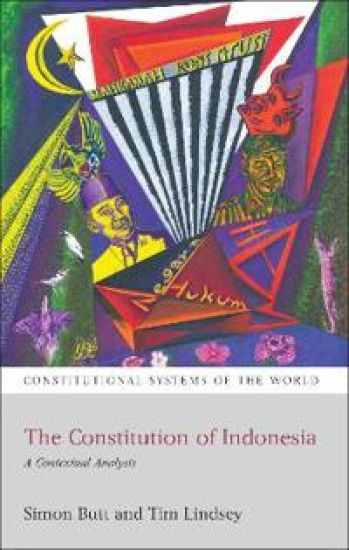
The Constitution of Indonesia

The Constitution of Indonesia

Simon Butt; Tim Lindsey

Hart Publishing
2012
nidottu
For decades, Indonesia's 1945 Constitution, the second shortest in the modern world, was used as an apologia by successive authoritarian regimes. A bare-bones text originally intended as a temporary measure, it did little beyond establish basic state organs, including a powerful presidency. It did not offer citizens real guarantees or protections. These weaknesses were ruthlessly exploited by the military-backed regime that President Soeharto headed from 1966 until his fall in 1998. The (first ever) amendments to the Constitution, which began the following year and were completed in 2002, changed all this. Enlarging and rethinking the Constitution, they ushered in a liberal democratic system based around human rights, an open society and separation of powers. These reforms also created a Constitutional Court that has provided Indonesia's first judicial forum for serious debate on the interpretation and application of the Constitution, as well as its first significant and easily-accessible body of detailed and reasoned judgments. Today, Indonesian constitutional law is rich, sophisticated and complex. This book surveys this remarkable constitutional transition, assessing the implementation of Indonesia's new constitutional model and identifying its weaknesses. After covering key institutions exercising executive, legislative and judicial powers, the book focuses on current constitutional debates, ranging from human rights to decentralisation, religious freedom and control of the economy.
Law Reform in Developing and Transitional States
Law reform in developing countries has become an increasingly topical subject in recent years. A critical issue is why so many law reform projects in developing economies are regarded by their sponsors and recipients as unsuccessful. This informative book:examines examples of law reform projects in post-socialist and post-authoritarian states in Asiaidentifies common problemsproposes analytical frameworks for understanding the problems identified. Though parallels between Asian models and those in developing states elsewhere in the world are strong, the book has been developed to avoid suggestion that the issues covered are somehow peculiarly ‘Asian’- indeed, it is shown that cultural relativist approaches to Asia are unsustainable. This is an invaluable reference for those involved in the areas of development economics, Asian studies and comparative politics.