

Kirjailija
Titus Lucretius Carus
Kirjat ja teokset yhdessä paikassa: 105 kirjaa, julkaisuja vuosilta 1821–2029, suosituimpiin kuuluu Titi Lucreti Cari De Rerum Natura Libri sex. With a Translation and Notes by H.A.J. Munro. Vertaile teosten hintoja ja tarkista saatavuus suomalaisista kirjakaupoista.
105 kirjaa
Kirjojen julkaisuvuodet: 1821–2029.
Dieses klassische Buch wurde urspr nglich vor Jahrzehnten ver ffentlicht als "On the Nature of Things " . Es wurde jetzt von Writat f r seine deutschsprachigen Leser ins Deutsche bersetzt. Bei Writat liegt uns die Bewahrung des literarischen Erbes der Vergangenheit sehr am Herzen. Wir haben dieses Buch ins Deutsche bersetzt, damit es heutige und zuk nftige Generationen lesen und bewahren k nnen.
Reproduction of the original. The publishing house Megali specialises in reproducing historical works in large print to make reading easier for people with impaired vision.
Reproduction of the original. The publishing house Megali specialises in reproducing historical works in large print to make reading easier for people with impaired vision.

The lengthy poem, On the Nature of Things, by Lucretius, published as De Rerum Natura in Latin, presents the Greek philosopher Epicurus's scientific theory. The title of Lucretius's work, Peri physes, is a translation of the title of Epicurus' principal treatise (On Nature). Lucretius structured his discussion into six books, each of which had a very well-crafted introduction. Books I and II lay forth the fundamental ideas of the atomic universe, disprove the competing views of Heracleitus, Empedocles, and Anaxagoras, pre-Socratic cosmic thinkers, and subtly criticize the Stoics, a rival school of moralists to Epicurus. The final sermon in Book III, "Death is nothing to us," illustrates the atomic structure of the soul and its mortality. Book IV criticizes sexual passion while describing the mechanisms of the mind, some physical functions, and sense perception. Book V explains how the world and heavenly bodies were created, how they function, how life evolved, and how human society developed. Book VI covers amazing astronomical and terrestrial events, especially lightning and thunder. The poem concludes with a description of the Athens epidemic, a sombre representation of mortality in contrast to the image of spring and life presented in the poem's opening appeal to Venus.
Ny genomgången utgåva av Ingvar Björkesons översättning av Lucretius Om tingens natur. Nu med latinsk parallelltext och ett nyskrivet förord av professor Anders Cullhed. Detta är andra korrigerade upplagan.
On The Nature Of Things; A Philosophical Poem In Six Books. Literally Translated Into English Prose By John Selby Watson; To Which Is Adjoined The Poetical Version Of John Mason Good
Titus Lucretius Carus; J S Watson
Alpha Edition
2020
pokkari
This book has been considered by academicians and scholars of great significance and value to literature. This forms a part of the knowledge base for future generations. So that the book is never forgotten we have represented this book in a print format as the same form as it was originally first published. Hence any marks or annotations seen are left intentionally to preserve its true nature.
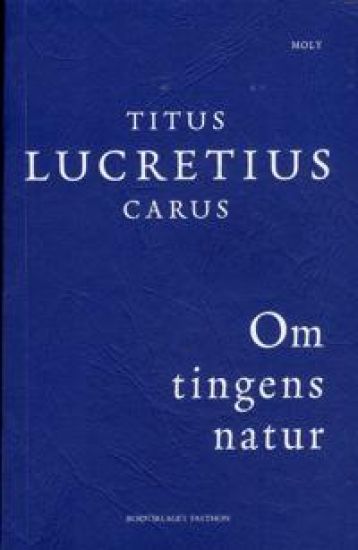
Ny genomgången utgåva av Ingvar Björkesons översättning av Lucretius "Om tingens natur". Nu med latinsk parallelltext och ett nyskrivet förord av professor Anders Cullhed.

Of the Nature of Things: De Rerum Natura
Titus Lucretius Carus
Createspace Independent Publishing Platform
2018
nidottu
Of the Nature of Things: De Rerum Natura by Titus Lucretius Carus. A metrical translation by William Ellery Leonard. De rerum natura; On the Nature of Things, is a first-century BC didactic poem by the Roman poet and philosopher Lucretius (c. 99 BC - c. 55 BC) with the goal of explaining Epicurean philosophy to a Roman audience. The poem, written in some 7,400 dactylic hexameters, is divided into six untitled books, and explores Epicurean physics through poetic language and metaphors. Namely, Lucretius explores the principles of atomism; the nature of the mind and soul; explanations of sensation and thought; the development of the world and its phenomena; and explains a variety of celestial and terrestrial phenomena. The universe described in the poem operates according to these physical principles, guided by fortuna ("chance"), and not the divine intervention of the traditional Roman deities.
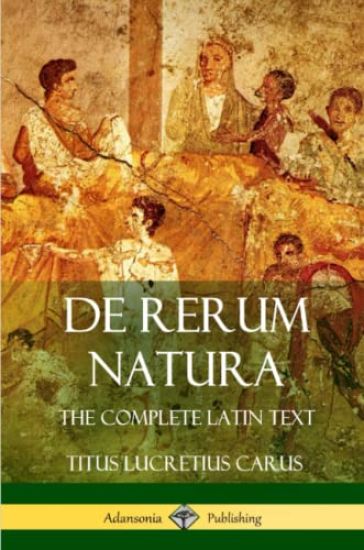
De Rerum Natura, the great didactic poem by philosopher and poet Lucretius, is presented here complete in the author's original Latin. Drawing on the atomism theory of Democritus, dating over 400 years prior to his masterwork, Lucretius main aim with his poem is to explain the various theories on why the world is as it is. Designed to be read publicly and by solitary readers, the wide ranging and lengthy poem examines the nature of the world, of sensation, of human consciousness, and of celestial bodies such as the moon and stars. A great admirer of Epicurus as a thinker, Lucretius bases much of his explanations off of Epicurean thought. Among the first thinkers to posit comprehensive philosophy of the world that was not rooted in religious belief, Epicurus - and therefore De Rerum Natura - stood in direct opposition to the idea that the classical pantheon of Roman Gods controlled the Earth. For this the work was controversial from the moment it appeared in 56 B. C.
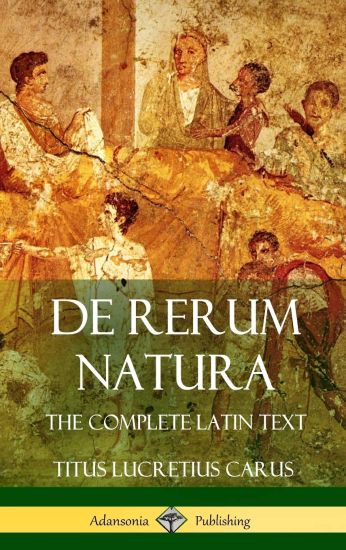
De Rerum Natura, the great didactic poem by philosopher and poet Lucretius, is presented here complete in the author's original Latin. Drawing on the atomism theory of Democritus, dating over 400 years prior to his masterwork, Lucretius main aim with his poem is to explain the various theories on why the world is as it is. Designed to be read publicly and by solitary readers, the wide ranging and lengthy poem examines the nature of the world, of sensation, of human consciousness, and of celestial bodies such as the moon and stars. A great admirer of Epicurus as a thinker, Lucretius bases much of his explanations off of Epicurean thought. Among the first thinkers to posit comprehensive philosophy of the world that was not rooted in religious belief, Epicurus - and therefore De Rerum Natura - stood in direct opposition to the idea that the classical pantheon of Roman Gods controlled the Earth. For this the work was controversial from the moment it appeared in 56 B. C.
On The Nature Of Things: De rerum natura
Titus Lucretius Carus
Createspace Independent Publishing Platform
2018
nidottu
On the Nature of Things: by Titus Lucretius Carus. A Metrical Translation by William Ellery Leonard. De rerum natura is a first-century BC didactic poem by the Roman poet and philosopher Lucretius (c. 99 BC - c. 55 BC) with the goal of explaining Epicurean philosophy to a Roman audience. To the Greek philosopher Epicurus, the unhappiness and degradation of humans arose largely from the dread which they entertained of the power of the deities, from terror of their wrath. This wrath was supposed to be displayed by the misfortunes inflicted in this life and by the everlasting tortures that were the lot of the guilty in a future state (or, where these feelings were not strongly developed, from a vague dread of gloom and misery after death). Epicurus thus made it his mission to remove these fears, and thus to establish tranquility in the minds of his readers. To do this, Epicurus invoked the atomism of Democritus to demonstrate that the material universe was formed not by a Supreme Being, but by the mixing of elemental particles that had existed from all eternity governed by certain simple laws. He argued that the deities (whose existence he did not deny) lived forevermore in the enjoyment of absolute peace-strangers to all the passions, desires, and fears, which affect humans- and totally indifferent to the world and its inhabitants, unmoved alike by their virtues and their crimes. This meant that humans had nothing to fear from them.