Kirjojen hintavertailu – 12 903 725 kirjaa ja 27 kauppaa

Kirjailija

Todd Dufresne

Kirjat ja teokset yhdessä paikassa: 10 kirjaa, julkaisuja vuosilta 2000–2026, suosituimpiin kuuluu The Future Belongs to Those Who Fight. Vertaile teosten hintoja ja tarkista saatavuus suomalaisista kirjakaupoista.

10 kirjaa

Kirjojen julkaisuvuodet: 2000–2026.

The Future Belongs to Those Who Fight

The Future Belongs to Those Who Fight

Todd Dufresne

MCGILL-QUEEN'S UNIVERSITY PRESS
2026
nidottu
We are living through the sixth mass extinction. Capitalism, the essential driver of carbon emissions, is reaching its inevitably brutal endgame: techno-feudalism. Not only are we facing a climate emergency – we need to prepare for climate revolution. In a series of reports from the front lines, philosopher-journalist Todd Dufresne provides an urgent analysis of the knowledge and morals that are fuelling this revolution. His manifesto outlines the links between Western values, capitalism, and climate change, rejecting the "pathology of politeness" afflicting mainstream climate activism and warning that the systemic violence of post-capitalist society will be met with violence. Dufresne champions the radical critics of capitalism whose ideas, courage, and exuberant energy have the power to forestall the social murder of humanity in service of short-term profits for a tiny, irredeemable elite. A fearless – and fearsome – account of the world-historical social and material conditions confronting us, The Future Belongs to Those Who Fight is a call to support utopic realism: a vision that embraces empathy, freedom, community, and universal human rights. It lays out what may be the only path to a world worth living in: left populism.
The Democracy of Suffering

The Democracy of Suffering

Todd Dufresne

McGill-Queen's University Press
2019
nidottu
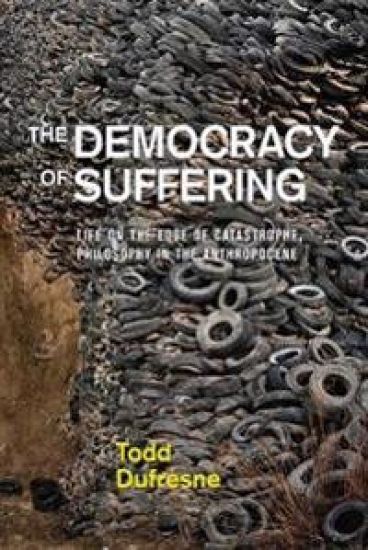
In The Democracy of Suffering philosopher Todd Dufresne provides a strikingly original exploration of the past, present, and future of this epoch, the Anthropocene, demonstrating how the twin crises of reason and capital have dramatically remade the essential conditions for life itself. Images, cartoons, artworks, and quotes pulled from literary and popular culture supplement this engaging and unorthodox look into where we stand amidst the ravages of climate change and capitalist economics. With humour, passion, and erudition, Dufresne diagnoses a frightening new reality and proposes a way forward, arguing that our serial experiences of catastrophic climate change herald an intellectual and moral awakening - one that lays the groundwork, albeit at the last possible moment, for a future beyond individualism, hate, and greed. That future is unapologetically collective. It begins with a shift in human consciousness, with philosophy in its broadest sense, and extends to a reengagement with our greatest ideals of economic, social, and political justice for all. But this collective future, Dufresne argues, is either now or never. Uncovering how we got into this mess and how, if at all, we get out of it, The Democracy of Suffering is a flicker of light, or perhaps a scream, in the face of human extinction and the end of civilization.
The Democracy of Suffering

The Democracy of Suffering

Todd Dufresne

McGill-Queen's University Press
2019
sidottu
In The Democracy of Suffering philosopher Todd Dufresne provides a strikingly original exploration of the past, present, and future of this epoch, the Anthropocene, demonstrating how the twin crises of reason and capital have dramatically remade the essential conditions for life itself. Images, cartoons, artworks, and quotes pulled from literary and popular culture supplement this engaging and unorthodox look into where we stand amidst the ravages of climate change and capitalist economics. With humour, passion, and erudition, Dufresne diagnoses a frightening new reality and proposes a way forward, arguing that our serial experiences of catastrophic climate change herald an intellectual and moral awakening - one that lays the groundwork, albeit at the last possible moment, for a future beyond individualism, hate, and greed. That future is unapologetically collective. It begins with a shift in human consciousness, with philosophy in its broadest sense, and extends to a reengagement with our greatest ideals of economic, social, and political justice for all. But this collective future, Dufresne argues, is either now or never. Uncovering how we got into this mess and how, if at all, we get out of it, The Democracy of Suffering is a flicker of light, or perhaps a scream, in the face of human extinction and the end of civilization.
The Late Sigmund Freud

The Late Sigmund Freud

Todd Dufresne

Cambridge University Press
2017
pokkari
Freud is best remembered for two applied works on society, The Future of an Illusion and Civilization and its Discontents. Yet the works of the final period are routinely denigrated as merely supplemental to the earlier, more fundamental 'discoveries' of the unconscious and dream interpretation. In fact, the 'cultural Freud' is sometimes considered an embarrassment to psychoanalysis. Dufresne argues that the late Freud, as brilliant as ever, was actually revealing the true meaning of his life's work. And so while The Future of an Illusion, Civilization and its Discontents, and his final work Moses and Monotheism may be embarrassing to some, they validate beliefs that Freud always held - including the psychobiology that provides the missing link between the individual psychology of the early period and the psychoanalysis of culture of the final period. The result is a lively, balanced, and scholarly defense of the late Freud that doubles as a major reassessment of psychoanalysis of interest to all readers of Freud.
The Late Sigmund Freud

The Late Sigmund Freud

Todd Dufresne

Cambridge University Press
2017
sidottu
Freud is best remembered for two applied works on society, The Future of an Illusion and Civilization and its Discontents. Yet the works of the final period are routinely denigrated as merely supplemental to the earlier, more fundamental 'discoveries' of the unconscious and dream interpretation. In fact, the 'cultural Freud' is sometimes considered an embarrassment to psychoanalysis. Dufresne argues that the late Freud, as brilliant as ever, was actually revealing the true meaning of his life's work. And so while The Future of an Illusion, Civilization and its Discontents, and his final work Moses and Monotheism may be embarrassing to some, they validate beliefs that Freud always held - including the psychobiology that provides the missing link between the individual psychology of the early period and the psychoanalysis of culture of the final period. The result is a lively, balanced, and scholarly defense of the late Freud that doubles as a major reassessment of psychoanalysis of interest to all readers of Freud.
Against Freud

Against Freud

Todd Dufresne

Stanford University Press
2007
pokkari
Everyone agrees that Sigmund Freud has had a profound impact on Western society and intellectual life. But even today few people know much about his life and work beyond the legends that Freud and his adherents created, fostered, and repeated. The result is an enormous cross-disciplinary field characterized by contradiction and confusion. Only the experts could possibly make sense of it all—but not always, since no field is as thoroughly undercut by ideology, acrimony, and bad faith as psychoanalysis. Against Freud collects the frank musings of some of the world's best critics of Freud, providing a convincing and coherent "case against Freud" that is as amusing as it is rigorously presented. Hailing from diverse academic backgrounds—history, philosophy, literary criticism, sociology, psychotherapy, and psychiatry—this diverse group includes renowned international figures such as Edward Shorter, Frank Sulloway, Frederick Crews, and Mikkel Borch-Jacobsen, as well as those who knew Freud and his family. Listen in on the critics and then decide for yourself whether or not "Freud is dead."
Against Freud

Against Freud

Todd Dufresne

Stanford University Press
2007
sidottu
Everyone agrees that Sigmund Freud has had a profound impact on Western society and intellectual life. But even today few people know much about his life and work beyond the legends that Freud and his adherents created, fostered, and repeated. The result is an enormous cross-disciplinary field characterized by contradiction and confusion. Only the experts could possibly make sense of it all—but not always, since no field is as thoroughly undercut by ideology, acrimony, and bad faith as psychoanalysis. Against Freud collects the frank musings of some of the world's best critics of Freud, providing a convincing and coherent "case against Freud" that is as amusing as it is rigorously presented. Hailing from diverse academic backgrounds—history, philosophy, literary criticism, sociology, psychotherapy, and psychiatry—this diverse group includes renowned international figures such as Edward Shorter, Frank Sulloway, Frederick Crews, and Mikkel Borch-Jacobsen, as well as those who knew Freud and his family. Listen in on the critics and then decide for yourself whether or not "Freud is dead."
Killing Freud

Killing Freud

Todd Dufresne

Continuum Publishing Corporation
2006
nidottu
Killing Freud takes the reader on a journey through the 20th century, tracing the work and influence of one of its greatest icons, Sigmund Freud. A devastating critique, Killing Freud ranges across the strange case of Anna O, the hysteria of Josef Breuer, the love of dogs, the Freud industry, the role of gossip and fiction, bad manners, pop psychology and French philosophy, figure skating on thin ice, and contemporary therapy culture. A map to the Freudian minefield and a masterful negotiation of high theory and low culture, Killing Freud is a witty and fearless revaluation of psychoanalysis and its real place in 20th century history. It will appeal to anyone curious about the life of the mind after the death of Freud.
Killing Freud

Killing Freud

Todd Dufresne

Continuum International Publishing Group Ltd.
2005
nidottu
"Killing Freud" takes the reader on a journey through the 20th century, tracing the work and influence of one of its greatest icons, Sigmund Freud. A devastating critique, "Killing Freud" ranges across the strange case of Anna O, the hysteria of Josef Breuer, the love of dogs, the Freud industry, the role of gossip and fiction, bad manners, pop psychology and French philosophy, figure skating on thin ice, and contemporary therapy culture. A map to the Freudian minefield and a masterful negotiation of high theory and low culture, Killing Freud is a witty and fearless revaluation of psychoanalysis and its real place in 20th century history. It will appeal to anyone curious about the life of the mind after the death of Freud.
Tales from the Freudian Crypt

Tales from the Freudian Crypt

Todd Dufresne; Mikkel Borch-Jacobsen

Stanford University Press
2000
sidottu
Tales from the Freudian Crypt is a fundamental reassessment of the Freud legend that aims to shake the very foundations of Freud studies. Writing from the perspective of intellectual history, the author traces the impact that Freud's essay Beyond the Pleasure Principle has had, and continues to have, on twentieth-century thought. Designed as both an introduction and a corrective to the vast literature on Freud, the book explores the trail left by Freud's late theory of the death drive, paying special attention to its ramifications in the fields of biography, biology, psychotherapy, philosophy, and literary theory. The author ironically concludes that if there were such a thing as a death drive, it would look like this seemingly endless and in many ways arbitrary proliferation of the literature on Freud. After first undertaking to demystify the pretensions of this literature, from the works of Sandor Ferenczi to those of Jacques Lacan, the author proposes a theory that sheds new light on the so-called cultural works of Freud's final years. He argues that the death drive theory was an elaborate ruse that Freud adopted to insulate his "findings" against criticism directed from outside the field of psychoanalysis—that Freud's troubling recourse to metapsychology was closely tied to his lifelong fear of suggestion. The author delivers a carefully reasoned, sustained blow to the culture of psychoanalysis—theoretical, therapeutic, institutional—which is driven by what it desires and fears most: death. In sum, Tales from the Freudian Crypt is offered as a kind of bankbook, audit, and investment plan for future work in Freud studies.