

Kirjojen hintavertailu – 12 903 725 kirjaa ja 27 kauppaa

Kirjailija

Todd Swanson

Kirjat ja teokset yhdessä paikassa: 2 kirjaa, julkaisuja vuosilta 2005–2018, suosituimpiin kuuluu Understanding Our Quantitative World. Vertaile teosten hintoja ja tarkista saatavuus suomalaisista kirjakaupoista.

2 kirjaa

Kirjojen julkaisuvuodet: 2005–2018.

A Spiral Approach to Financial Mathematics

A Spiral Approach to Financial Mathematics

Nathan Tintle; Nathan Schelhaas; Todd Swanson

Academic Press Inc
2018
nidottu
A Spiral Approach to Financial Mathematics lays a foundation of intuitive analysis of financial concepts early in the course, followed by a more detailed and nuanced treatment in later chapters. It introduces major financial concepts through real situations, integrates active learning, student focused explorations and examples with Excel spreadsheets and straightforward financial calculations. It is organized so sections can be read independently or through in-class guided-discovery activities and/or interactive lectures. Focusing on conceptual understanding to maximize comprehension and retention, using modern financial analysis tools and utilizing active learning, the book offers a modern approach that eliminates tedious and time-consuming calculations initially without underestimating the ability of readers.
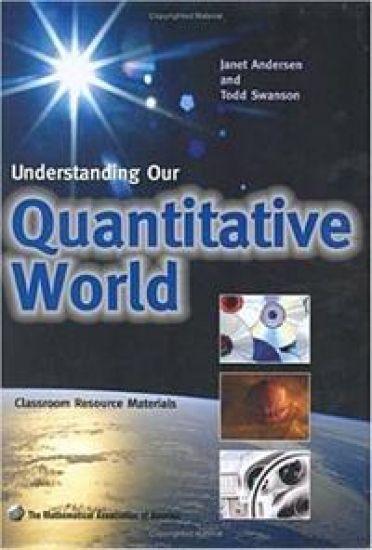
Understanding Our Quantitative World

Understanding Our Quantitative World

Janet Andersen; Todd Swanson

Mathematical Association of America
2005
sidottu
This book is intended for a general education mathematics course. The authors focus on the topics that they believe students will likely encounter after college. These topics fall into the two main themes of functions and statistics. After the concept of a function is introduced and various representations are explored, specific types of functions (linear, exponential, logarithmic, periodic, power, and multi-variable) are investigated. These functions are explored symbolically, graphically, and numerically and are used to describe real world phenomena. On the theme of statistics, the authors focus on different types of statistical graphs and simple descriptive statistics. Linear regression, as well as exponential and power regression, is also introduced. Simple types of probability problems as well as the idea of sampling and confidence intervals are the last topics covered in the text. The book is written in a conversational tone. Each section begins by setting the mathematics within a context and ends with an application. The questions at the end of each section are called ""Reading Questions"" because students are expected to be able to answer most of these after carefully reading the text. ""Activities and Class Exercises"" are also found at the end of each section. These activities are taken from public sources such as newspapers, magazines, and the Internet. Doing these activities demonstrates that mathematics can be used as a tool in interpreting quantitative information encountered in everyday life. The text assumes that students will have access to some type of technology such as a graphing calculator.