Kirjojen hintavertailu – 12 859 829 kirjaa ja 27 kauppaa

Kirjailija

Tom A. Rüsen

Kirjat ja teokset yhdessä paikassa: 8 kirjaa, julkaisuja vuosilta 2016–2024, suosituimpiin kuuluu Management der dynastischen Unternehmerfamilie. Vertaile teosten hintoja ja tarkista saatavuus suomalaisista kirjakaupoista.

8 kirjaa

Kirjojen julkaisuvuodet: 2016–2024.

Conflicts and Conflict Dynamics in Business Families

Conflicts and Conflict Dynamics in Business Families

Arist von Schlippe; Tom A. Rüsen

Springer International Publishing AG
2024
sidottu
Conflicts within the owner circle - or rather, within the "family of the family business" - are often the main cause of existential crises for family businesses. The damaging effects of unchecked family conflicts affect two social systems: the family business and the business family itself. The impairment of the survival capability of the family business goes hand in hand with the reduced chance of constructive follow-up communication between family members. Once caught up in conflict communication, it is extremely difficult for business families to get out of it without the help of external knowledge. It is therefore surprising that the topic of conflict prevention in business families has so far been given relatively little attention. Against this background, this book takes a closer look at the topic of "Conflicts in the Business Family" and deals with a number of topics that are essential to understanding the subject: the specific challenges and conflicts that business families typically face, as well as practically proven methods of conflict resolution at different levels. The content is based on the experiences that the two authors have gained in a variety of research projects, conflict moderation, and family strategic consulting projects over the past 18 years. The key findings from this wealth of experience are now made available to the general public.
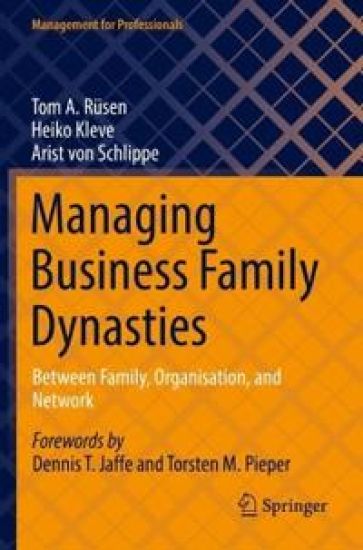
Managing Business Family Dynasties

Managing Business Family Dynasties

Tom A. Rüsen; Heiko Kleve; Arist von Schlippe

Springer Nature Switzerland AG
2022
nidottu
This book deals with dynastic business families. Such families are characterized by a circle of owners comprising more than 50 family members, which typically face specific issues and challenges for which there has been little research knowledge and practical approaches until now. The book presents results and findings from a special research project on “big family management” where 7 representatives of dynastic families from Germany were studied over a 3-year period. The result was the identification of six topic areas that management in these business families has to deal with. At the same time, the study observes that dynastic business families hardly follow the logic of classic families anymore, but can rather be understood as networks with common family backgrounds. The study also reveals that a large number of business families are heading for large shareholder groups due to changed inheritance practices. The contents outlined here provide an orientation framework for the growing business family.
The Two Sides of the Business Family

The Two Sides of the Business Family

Arist Von Schlippe; Tom A. Rüsen; Torsten Groth

Springer Nature Switzerland AG
2022
nidottu
This book focuses on a central success factor for family businesses: maintaining the decision-making ability over generations while not jeopardizing the business due to family conflict, inefficient governance structures, or lack of identification. The authors identify that this is not as easy as the endeavor to bring two social systems together with contradicting logic (family and business) leads to many dangerous pitfalls. This book presents outcomes of a unique research project in which family managers of eleven of the oldest and largest German family businesses, at least the fourth generation, met for more than three years on a regular basis and presented the essence of their family governance structures to each other and to the authors. It was a joint “learning journey” that admits identifying twelve core questions that these families had been answering to keep up the relationship between family and business successfully over generations. Obviously, there is no “right” answer to these questions. The key to success is rather engaging the families in a process to find out their own answers and make them aware of the “two sides”: being a family is different from being a business family.
Managing Business Family Dynasties

Managing Business Family Dynasties

Tom A. Rüsen; Heiko Kleve; Arist Von Schlippe

Springer Nature Switzerland AG
2021
sidottu
This book deals with dynastic business families. Such families are characterized by a circle of owners comprising more than 50 family members, which typically face specific issues and challenges for which there has been little research knowledge and practical approaches until now. The book presents results and findings from a special research project on “big family management” where 7 representatives of dynastic families from Germany were studied over a 3-year period. The result was the identification of six topic areas that management in these business families has to deal with. At the same time, the study observes that dynastic business families hardly follow the logic of classic families anymore, but can rather be understood as networks with common family backgrounds. The study also reveals that a large number of business families are heading for large shareholder groups due to changed inheritance practices. The contents outlined here provide an orientation framework for the growing business family.
Management der dynastischen Unternehmerfamilie

Management der dynastischen Unternehmerfamilie

Tom A. Rüsen; Heiko Kleve; Arist Von Schlippe

Springer-Verlag Berlin and Heidelberg GmbH Co. KG
2021
sidottu
Dieses Buch beschäftigt sich mit einem besonderen Typus von Eigentümerfamilien: der dynastischen Unternehmerfamilie. Diese Unternehmerfamilien zeichnen sich durch einen Eigentümerkreis aus, der mehr als 50 Familienmitglieder umfasst. Unternehmerfamilien dieses Typus stehen vor spezifischen Fragestellungen und Herausforderungen, für die es bisher kaum Forschungserkenntnisse und praktische Lösungsansätze gab. Das Autorenteam hat über drei Jahre mit Vertretern dieses Familientypus intensiv zusammengearbeitet. Herausgekommen sind sechs Themenfelder, die ein Management in diesen Unternehmerfamilien zu bearbeiten hat. Eine Vielzahl von Unternehmerfamilien steuert aufgrund geänderter Vererbungspraktiken auf große Gesellschafterkreise zu. Die hier skizzierten Inhalte eines "Big Family Managements" können als Orientierungsrahmen für die wachsende Unternehmerfamilie verwendet werden.
The Two Sides of the Business Family

The Two Sides of the Business Family

Arist Von Schlippe; Tom A. Rüsen; Torsten Groth

Springer
2021
sidottu
This book focuses on a central success factor for family businesses: maintaining the decision-making ability over generations while not jeopardizing the business due to family conflict, inefficient governance structures, or lack of identification. The authors identify that this is not as easy as the endeavor to bring two social systems together with contradicting logic (family and business) leads to many dangerous pitfalls. This book presents outcomes of a unique research project in which family managers of eleven of the oldest and largest German family businesses, at least the fourth generation, met for more than three years on a regular basis and presented the essence of their family governance structures to each other and to the authors. It was a joint “learning journey” that admits identifying twelve core questions that these families had been answering to keep up the relationship between family and business successfully over generations. Obviously, there is no “right” answer to these questions. The key to success is rather engaging the families in a process to find out their own answers and make them aware of the “two sides”: being a family is different from being a business family.
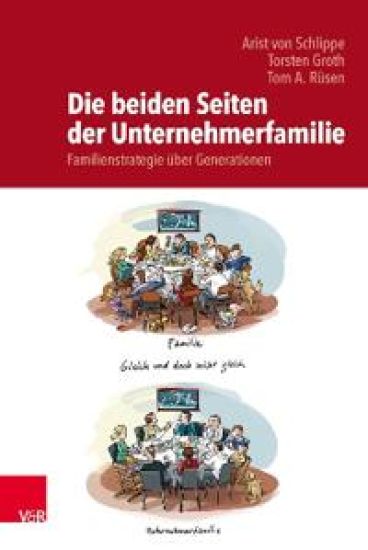
Die beiden Seiten der Unternehmerfamilie

Die beiden Seiten der Unternehmerfamilie

Arist von Schlippe; Torsten Groth; Tom A. Rüsen

VANDENHOECK RUPRECHT GMBH CO KG
2017
sidottu
Unternehmerfamilien sind Familien wie jede andere und sie sind zugleich ganz anders. Sie haben sich um die Wünsche und Bedürfnisse jedes einzelnen Mitglieds zu kümmern, und zusätzlich ist ein Unternehmen zu führen, was mit hohen Anforderungen an die kollektive Entscheidungsfähigkeit verbunden ist. „Familie“ und „Unternehmen“, diese beiden Seiten müssen immer wieder neu ausbalanciert werden, obgleich sie sich als soziale Systeme so grundlegend unterscheiden, dass sie eigentlich überhaupt nicht zusammenpassen. Und doch sind Familienunternehmen bekanntlich trotz aller theoretischer Bedenken oft extrem erfolgreich. Offenbar haben langlebige Familienunternehmen eine Reihe kritischer familienstrategischer Fragen gelöst. Wie haben sie das geschafft? Das Buch gibt einen Einblick in die Erkenntnisse verschiedener Forschungsprojekte, an denen eine Reihe der größten deutschen Familienunternehmen beteiligt waren. Familienstrategische Kernfragen, die sich einer Unternehmerfamilie im Laufe ihrer Entwicklung stellen können, werden vorgestellt und mögliche Fallstricke beschrieben. Den Schwerpunkt bildet der Blick auf die große Bandbreite möglicher Familienstrategien, die sich über Generationen hinweg als erfolgreich erwiesen haben: So gelingt der Generationenwechsel in Familienunternehmen! Die Autoren Arist von Schlippe, Torsten Groth und Tom A. Rüsen blicken auf beinahe zwanzig Jahre Forschung und Theoriebildung am WIFU zurück: Das Wittener Institut für Familienunternehmen an der Universität Witten/Herdecke ist das älteste und größte deutschsprachige Forschungsinstitut für diese besondere Unternehmensform.
Krisen und Krisenmanagement in Familienunternehmen
Der Autor stellt typische Verläufe von Krisen in Familienunternehmen dar und nennt die zentralen Anforderungen an ein Krisenmanagement in dieser Unternehmensform. Eine fundierte Lektüre mit vielen Praxisbeispielen und konkreten Empfehlungen für die Krisenbewältigung in Familienunternehmen. Familienunternehmen bilden das Rückgrat der deutschen Wirtschaft und sind oft sehr erfolgreich, doch mitunter besonderen Risiken ausgesetzt. Viele sanierungsfähige Familienunternehmen gehen in die Insolvenz, weil Mitglieder der Eigentümerfamilie mit der Existenzbedrohung überfordert sind und sich den Empfehlungen der Krisenmanager verschließen. Selbst erfahrene Krisenmanager berücksichtigen den besonderen Einfluss der Unternehmerfamilie meist nur unzureichend. Auch können viele Sanierungsspezialisten nicht richtig mit der Familie des Familienunternehmens in der Extremsituation einer Krise umgehen. Die umfassenden Beratungserfahrungen des Autors und die Ergebnisse einer Befragung von über 100 Persönlichkeiten aus der Wirtschaft sind in das Buch eingeflossen, das nun in der 2., aktualisierten und ergänzten Auflage vorliegt.