Kirjojen hintavertailu – 12 876 020 kirjaa ja 26 kauppaa
Kirjailija
Tom Andersen
Kirjat ja teokset yhdessä paikassa: 10 kirjaa, julkaisuja vuosilta 1991–2026, suosituimpiin kuuluu Wanderings and Crossroads. Vertaile teosten hintoja ja tarkista saatavuus suomalaisista kirjakaupoista.
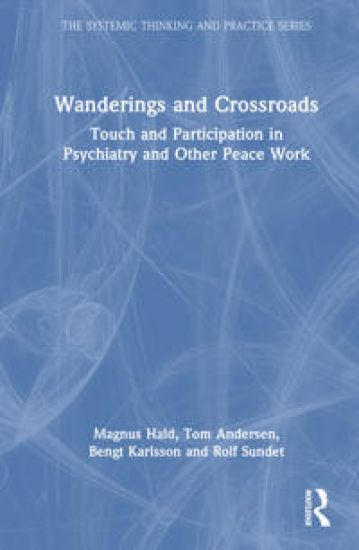
Wanderings and Crossroads: Touch and Participation in Psychiatry and Other Peace Work is made up of three unfinished manuscripts that Andersen was working on at the time of his death, deftly and expertly brought together by the volume editors, and published here in English for the first time. Tom Andersen continues to have a huge influence on the systemic and family therapy field, and on mental health professions more broadly. This unique volume follows on from Andersen’s previous work with his renowned team in Tromsø, presenting the vital work they conducted. This book offers Andersen’s personal history and his development as a doctor and psychiatrist, in his own words, offering a theoretical, practical and autoethnographic insight into this pioneering figure. This book invites readers into the practical and conceptual world of Tom Andersen and will be of interest to those involved in individual, family, group and network therapy and counselling.
Wanderings and Crossroads: Touch and Participation in Psychiatry and Other Peace Work is made up of three unfinished manuscripts that Andersen was working on at the time of his death, deftly and expertly brought together by the volume editors, and published here in English for the first time. Tom Andersen continues to have a huge influence on the systemic and family therapy field, and on mental health professions more broadly. This unique volume follows on from Andersen’s previous work with his renowned team in Tromsø, presenting the vital work they conducted. This book offers Andersen’s personal history and his development as a doctor and psychiatrist, in his own words, offering a theoretical, practical and autoethnographic insight into this pioneering figure. This book invites readers into the practical and conceptual world of Tom Andersen and will be of interest to those involved in individual, family, group and network therapy and counselling.
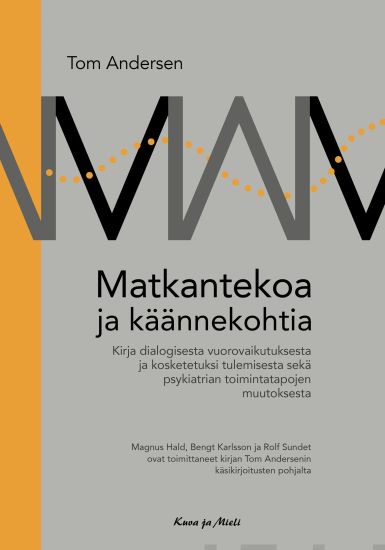
Kirjassa Matkantekoa ja käännekohtia sosiaalipsykiatrian professori Tom Andersen kuvaa omaa ammatillista ja henkilökohtaista kehitystään pitkän uransa aikana lääkärinä, psykiatrina ja perheterapeuttina. Hän oli kriittinen oman alansa perinteitä ja työkäytäntöjä kohtaan ja tuli kansainvälisesti tunnetuksi erityisesti reflektiivisiin ryhmiin ja prosesseihin liittyvästä kehittämistyöstään. Kun Andersen kuoli onnettomuudessa vuonna 2007, jäi häneltä kolme keskeneräistä käsikirjoitusta. Näiden käsikirjoitusten pohjalta Magnus Hald, Bengt Karlsson ja Rolf Sundet ovat toimittaneet tämän kirjan. He ovat myös kirjoittaneet johdantoluvun, jossa esitellään Andersen ja joitain hänen avainkäsitteistään. Kirjassa Andersen kuvaa keskustelun rakenteita, muotoja ja reflektiivisiä työtapoja havainnollistaen, missä yhteyksissä ne ovat osoittautuneet hyödylliseksi. Hän avaa näkökulmia dialogisuuden ja yhteistoiminnallisuuden mahdollisuuksiin mielenterveystyössä ja kertoo edistyksellisellä tavalla ruumiillisuudesta, hengityksestä, sanoista ja niiden merkityksestä ja siitä, mitä on tulla toisten ilmaisujen koskettamaksi. Kirjan ajankohtaista sisältöä voi hyödyntää käytännön työssä, tutkimuksessa ja koulutuksessa. Andersenin ajattelu haastaa lukijan pohtimaan omaa työtään ihmisten parissa.
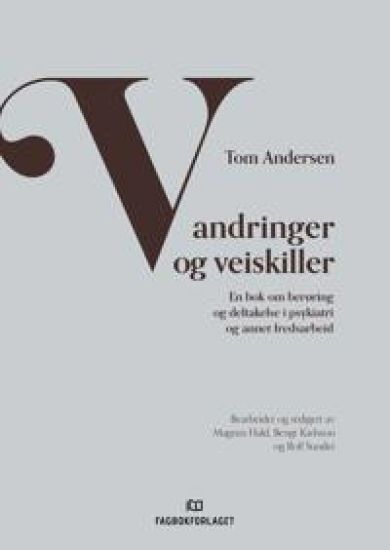
Tom Andersen (f. 1936) var lege og professor i psykiatri ved Universitetet i Tromsø. I hele sin karriere var han kritisk til sitt eget fags tradisjoner og konvensjoner. Han utfordret kontinuerlig etablerte praksiser og utviklet nyskapende og svært innflytelsesrike måter å jobbe og samtale på innenfor helse- og sosialfagene. Han ble særlig kjent for sitt arbeid knyttet til reflekterende team og reflekterende prosesser, og fikk med boken The Reflecting Team: Dialogues and Dialogues about the Dialogues internasjonal gjennomslagskraft. Den er oversatt til ni språk, men er aldri utgitt på norsk. Da Andersen døde i 2007, etterlot han seg tre uferdige bokmanuskripter. På ulikt vis beskriver disse hvordan samtale- og praksisformen reflekterende prosesser ble utviklet, eksemplifiserer i hvilke sammenhenger den har vist seg å være nyttig, og ikke minst utfordres leseren til selv å reflektere videre rundt sitt eget behandlingsarbeid. Magnus Hald, Bengt Karlsson og Rolf Sundet har redigert de tre manusene og satt dem sammen til ett. De har også skrevet et innledende kapittel hvor forfatteren og noen av hans nøkkelkonsepter presenteres.
While ecology is one of the scientific disiplines that most clearly belongs to ''basic research", it also strives to serve as a predictive tool for management. Outstanding examples of predictive ecology are Vollenweider's models on the relationship between phosphorus load and water renewal time of lakes, and the resulting algal biomass. The needed few and easily accessible input parameters to very simple models provided a direct link from basic ecology to management, and today these models are key tools for managers worldwide to control lake eutrophication and algal blooms. The baseline of this success is the general relation between phosphorus concentration and phytoplankton biomass that is observed for most lakes. While these relationships are most frequently presented in log-log diagrams, the aquatic ecologist who replots these a linear scale may ask himself why, in spite of the overall correlation, there is still such a variability. It is possible to predict levels of algal biomass that may be synthesized at a given phosphorus load. Some lakes apparently offer optimal conditions for their phytoplankton communities, while others may support less than half the biomass at the same phosphorus load. There are limits to growth, however, and the predic tive outcome of phosphorus load decreases as the load increases. This holds in particular for the higher trophic levels like zooplankton and fish. With increased enrichment there are signs of decreased efficiency of energy trans fer between foodweb compartments.
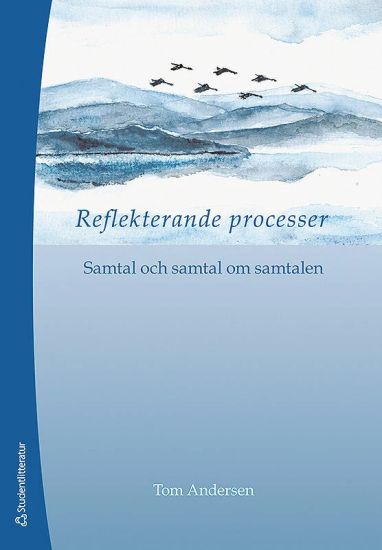
”Jag skulle önska att vi helt slutar att tala om terapi och forskning som människoteknik, och hellre talar om det som människokonst, konsten att delta i band med varandra.” Så skriver Tom Andersen i avslutningen av det nya kapitel som tillfogats i denna upplaga av Reflekterande processer. Vidare utveckling av den ursprungliga bokens tankar redovisas också, till exempel om uttrycksformer som tar tillvara kroppens perspektiv och erfarenheter från arbetsrelationer i praktik och forskning ”där man lagt vikt på att relationerna ska vara till nytta för alla som tar del i dem.” Bokens ursprungliga budskap om reflektion och mångfald av perspektiv i familjeterapeutiskt arbete är fortfarande är lika angelägna, och har visat sin bärkraft och utvecklingsförmåga i långt vidare sammanhang. Eller som författaren uttrycker i förordet till den här upplagan. Reflekterande processer ges numera ut av Studentlitteratur AB. Denna andra upplaga innehåller dock inga förändringar av innehållet jämfört med den första upplagan.
At skabe reflekterende processer - en (sam)arbejdsform hvor samtale og samtale om samtalerne står centralt - blev oprindeligt udviklet som en familieterapeutisk behandlingsform, men har siden vist sig at være anvendelig i mange andre sammenhænge. Bogen demonstrerer, bl.a. ved hjælp af konkrete eksempler på reflekterende samtaler, hvordan man også som supervisor, team, konsulent eller underviser kan have udbytte af metoden. Gennem et væld af konkrete eksempler på reflekterende samtaler illustrerer bogen, hvordan man skaber refleksion i mødet mellem mennesker ved en bevidst sprogbrug, tilpas forstyrrende spørgsmål og ved forskellige måder at lytte på.
Long Island Sound is not only the most heavily used estuary in North America, it is also one of the most beautiful waterways, with picturesque seascapes and landfalls. But centuries of pollution and other abuse have gradually been killing off its marine life and have pushed the Sound to the brink of disaster. This fascinating book traces the history of the Sound and its use as a resource from the time of contact between the Native Americans and Dutch traders through the suburban sprawl of recent decades—and tells how a group of scientists and citizens has been working to save the Sound from ruin. Tom Andersen begins by describing the dramatic events of the summer of 1987, when a condition called hypoxia (lack of dissolved oxygen in the water brought about by a combination of pollution and other factors) killed large numbers of fish and lobsters in the Sound. He discusses how scientists first documented and explained the development of hypoxia and how research and cleanup are now being carried out to restore the Sound. Interweaving current events, natural history, and human history, Andersen presents a cautionary tale of exploitation without concern for preservation.
While ecology is one of the scientific disiplines that most clearly belongs to ''basic research", it also strives to serve as a predictive tool for management. Outstanding examples of predictive ecology are Vollenweider's models on the relationship between phosphorus load and water renewal time of lakes, and the resulting algal biomass. The needed few and easily accessible input parameters to very simple models provided a direct link from basic ecology to management, and today these models are key tools for managers worldwide to control lake eutrophication and algal blooms. The baseline of this success is the general relation between phosphorus concentration and phytoplankton biomass that is observed for most lakes. While these relationships are most frequently presented in log-log diagrams, the aquatic ecologist who replots these a linear scale may ask himself why, in spite of the overall correlation, there is still such a variability. It is possible to predict levels of algal biomass that may be synthesized at a given phosphorus load. Some lakes apparently offer optimal conditions for their phytoplankton communities, while others may support less than half the biomass at the same phosphorus load. There are limits to growth, however, and the predic tive outcome of phosphorus load decreases as the load increases. This holds in particular for the higher trophic levels like zooplankton and fish. With increased enrichment there are signs of decreased efficiency of energy trans fer between foodweb compartments.
What happens when the barriers between therapists and clients are removed, when they all participate in a dialogue about change, and when therapists and clients even trade places? As Lynn Hoffman says in her foreword to this remarkable book, it "dramatically alters a family's position in relation to the professionals they have come to see." In the process, it changes the roles, rules, and expectations of therapy. Operating within the reflecting team format, professionals meet clients without preexisting hypotheses. Together they engage in a conversation that becomes a search for the not-yet-seen and the not-yet-thought-of, as well as for alternative understandings of what has been defined as problematic. As clients and therapists trade places and various members of the entire group participate in conversations, the possibilities for change open wide. This book describes the evolution of this radical strategy in Tromso, Norway, and its adaptation by various family therapists in the United States. It begins in Part I with a description of the settings in which the reflecting team developed and its history and evolution. Then basic concepts, practical considerations, and guidelines for practice are detailed. Part II contains Dialogues About the Dialogues, that is, reflections on the client-therapist-consultant-team dialogues that distinguish this innovative approach to therapy. As roles shift and various participants offer definitions of the problem and possible solutions, traditional ideas about the boundaries of a case study are shattered. Readers will find that this fluid, encompassing perspective stimulates their own thoughts about therapy, shaking them from outgrown assumptions. Since this approach is still evolving, the final chapter is, appropriately, a reflection on the changes that have taken place since the European edition of this book was published.