Kirjailija
Tom O'Donoghue
Kirjat ja teokset yhdessä paikassa: 29 kirjaa, julkaisuja vuosilta 1997–2025, suosituimpiin kuuluu Irish Speakers and Schooling in the Gaeltacht, 1900 to the Present. Vertaile teosten hintoja ja tarkista saatavuus suomalaisista kirjakaupoista.
Nimi esiintyy myös muodoissa: Tom O’Donoghue
29 kirjaa
Kirjojen julkaisuvuodet: 1997–2025.
Understanding Contemporary Education offers an essential exploration of key concepts and issues in education that will allow education studies students, as well as trainee and practising teachers to engage in reflection, not only on work at the classroom level, but on education more broadly. Using detailed examples, the book problematises many popular and taken-for-granted views, allowing the reader to challenge and seriously consider the nature of the education enterprise. In each chapter, a concept is carefully considered, with major features, controversies, and strengths and weaknesses highlighted. Key follow-up questions challenge the reader to reflect on specific issues, and encourage involvement, not just in their own teaching, but in the planning and determination of the total programme of their school, and where possible, that of the nation. The book is divided into seven main parts:The Social Context of EducationEducation PolicyCurriculumTeaching and LearningLeadership in EducationTeacher Preparation International Developments in Education. Drawing upon a wide variety of theoretical positions, Understanding Contemporary Education provides an accessible introduction to key themes and concepts in education, challenging readers to fully consider the purpose of education and to reflect intelligently on issues that affect all schools. It is a must-read book for those on education studies courses, as well as trainee and practising teachers.
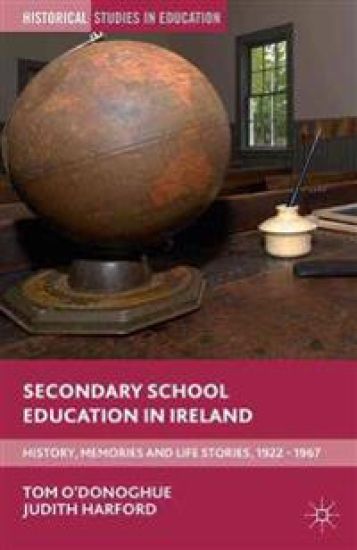
Secondary School Education in Ireland
Tom O'Donoghue; Judith Harford
Palgrave Macmillan
2015
sidottu
Adopting a life story approach, this book explores the memories of those who attended Irish secondary schools prior to 1967. It serves to initiate and enhance the practice of remembering secondary school education amongst those who attended secondary schools not just in Ireland, but around the world.
Global to Local Curriculum Policy Processes
Susan Ledger; Lesley Vidovich; Tom O'Donoghue
Springer International Publishing AG
2014
sidottu
This book explores the dynamics of curriculum policy processes involved in the adoption, production and enactment of the International Baccalaureate Primary Years Programme (IBPYP), accredited by the International Baccalaureate Organization (IBO). It addresses deficits in current literature and provides insight into and the complexities involved within a framework that takes cognisance of the relationships between global, regional, national and local levels of education policy processes. In doing so, it contributes to the current body of research on international education, remote education and policy processes. The IBPYP is one of the three programmes that go to make up the increasingly popular suite of programmes offered by the IBO. Given the exponential growth of international schools caused by an ever changing globalized world and a mobile workforce, international curriculum policy is becoming more complex. This has lead to a recognition of the need for a range of policy analysis studies in the field. The study presented in this book was conceptualised in the light of such recognition. This relatively uncharted field has been explored by focusing on one of the most ‘unusual’ settings. Accordingly, the adoption, production and enactment of the IBPYO at three remote international schools has been examined. The study also addresses how the phenomena of ‘international schools’ and ‘remote schools’ complement or compete with, each other. This results in a better understanding of the educational policies informing both ‘international schools’ and ‘remote schools’ and the interconnectivity that might exist between them.
The Education of Children in Geographically Remote Regions Through Distance Education
Elaine Lopes; Tom O'Donoghue; Marnie O'Neill
Information Age Publishing
2011
nidottu
Australia is a vast sparsely populated land and from an early date this created problems in terms of providing educational facilities. As part of the solution the nation has had a long tradition of using distance education methods to provide an education for its isolated primary and secondary school students. Western Australia epitomises the problems inherent in having a large land area with a highly urbanised population and a small but scattered rural one. Initially, the State established a Correspondence School in 1918. There have been various developments since then, culminating in the establishment of the Schools of Isolated and Distance Education (SIDE) in 1995. Since then the staff at SIDE have investigated and developed ways of providing their students with innovative educational materials in an effort to ensure that the best possible services are provided. Despite its innovative nature, very little research has been conducted on SIDE. The research project reported in this book is one contribution to rectifying the deficit. It had three main aims. The first was to develop an understanding of the emergence of SIDE. Secondly, an understanding of the key functions of SIDE was sought. The third aim was to develop an understanding of the issues which present themselves for those working at SIDE. Implications for policy, practice and future research in relation to the education of children in geographically remote regions through distance education are deduced, and not just in relation to the state of Western Australia, but internationally.
The Education of Children in Geographically Remote Regions Through Distance Education
Elaine Lopes; Tom O'Donoghue; Marnie O'Neill
Information Age Publishing
2011
sidottu
Australia is a vast sparsely populated land and from an early date this created problems in terms of providing educational facilities. As part of the solution the nation has had a long tradition of using distance education methods to provide an education for its isolated primary and secondary school students. Western Australia epitomises the problems inherent in having a large land area with a highly urbanised population and a small but scattered rural one. Initially, the State established a Correspondence School in 1918. There have been various developments since then, culminating in the establishment of the Schools of Isolated and Distance Education (SIDE) in 1995. Since then the staff at SIDE have investigated and developed ways of providing their students with innovative educational materials in an effort to ensure that the best possible services are provided. Despite its innovative nature, very little research has been conducted on SIDE. The research project reported in this book is one contribution to rectifying the deficit. It had three main aims. The first was to develop an understanding of the emergence of SIDE. Secondly, an understanding of the key functions of SIDE was sought. The third aim was to develop an understanding of the issues which present themselves for those working at SIDE. Implications for policy, practice and future research in relation to the education of children in geographically remote regions through distance education are deduced, and not just in relation to the state of Western Australia, but internationally.
The study of educational leadership makes little sense unless it is in relation to who the leaders are, how they are leading, what is being led, and with what effect. Based on the premise that learning is at the heart of leadership and that leaders themselves should be learners, the Leadership for Learning series explores the connections between educational leadership, policy, curriculum, human resources and accountability. Each book in the series approaches its subject matter through a three-fold structure of process, themes and impact. Series Editors - Clive Dimmock, Mark Brundrett and Les BellThe notion that school transformation is dependent on exceptional leaders is increasingly seen as unrealistic and unsustainable. Instead, the idea of distributed leadership, which promotes the view that all stakeholders have complementary leadership roles to play in enhancing student learning, is now being promoted as a more useful framework for understanding schools and how they might be changed. Subscribing to the notion of distributed leadership, O’Donoghue and Clarke identify two key groups: the ‘leaders of learning’ and the ‘leaders for learning’. The leaders of learning – and the focus of this book – are those working at the school level to improve the quality of learning in the classroom, such as teachers, principals, pupils and involved members of the local school community. The leaders for learning are the policy-makers and administrators whose support is crucial. The authors argue that in order to be effective leaders, both groups require an understanding of: Broad trends in contemporary leadership theory Recent views on learning theory The importance of teachers engaging continually in learning about their practice The significance of creating and sustaining schools as learning organisations Forging links between leadership and learning The book’s examination of the shifting approaches to leading learning in contemporary schools is enriched by innovative examples drawn from a range of international contexts. Leading Learning will appeal to students involved in masters and doctoral courses relevant to the field and those undertaking programmes of school leadership preparation and development. It will also be of interest to academics working in the field of educational leadership and management.
Nowadays, lay teachers predominate in Catholic schools throughout the English-speaking world. Yet, for over a century the Catholic teaching force was heavily influenced by the presence of the religious orders. The turning point was the mid 1960s and the opening up of the Catholic Church to the modern world as a result of the Second Vatican Council (1962-65). This opening up resulted in large numbers leaving the orders, a major drop off in new recruits and a consequent need to employ ever-greater numbers of lay teachers. This book is concerned with the period 1922-65. The focus is on the situation prevailing in the United States, England and Wales, Ireland, Australia and New Zealand from 1922 to 1965, whereby Catholic schools were used to maximise the possibility of recruiting new members to the religious orders and to minimise temptation to leave the religious life amongst those who had already joined. Four major practices are examined in this regard. First, Catholic schools deliberately set out to encourage pupils to join the ranks of the religious. Secondly, they replicated within the schools the authoritarianism of the religious life. Thirdly, they worked continuously to marginalize lay teachers from decision-making. Finally, they were ever vigilant in their opposition to co-education and sex education. The contribution of the religious orders to Catholic education is recognised in the final section of the book. However, consideration is also given to the darker side of what sometimes took place, namely, the child abuse, both physical and sexual, in which members of various religious teaching orders engaged. Finally, the book closes with a brief consideration of changes in Catholic education with the demise in the presence of the religious orders in the schools. In particular, it focuses on the new role of the lay teachers and the changes in the Church's attitude towards them.
This is an examination of restructuring in the context of the curriculum and teaching and learning. International case studies are provided from the USA, Hong Kong, Australia and the UK.