Kirjojen hintavertailu – 12 903 725 kirjaa ja 27 kauppaa

Kirjailija

Tomasa Calvo

Kirjat ja teokset yhdessä paikassa: 4 kirjaa, julkaisuja vuosilta 2008–2016, suosituimpiin kuuluu A Practical Guide to Averaging Functions. Vertaile teosten hintoja ja tarkista saatavuus suomalaisista kirjakaupoista.

4 kirjaa

Kirjojen julkaisuvuodet: 2008–2016.

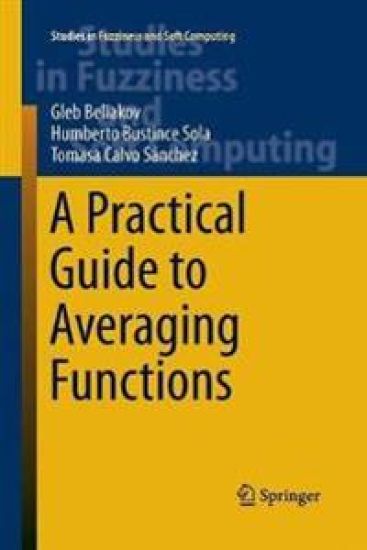
A Practical Guide to Averaging Functions

A Practical Guide to Averaging Functions

Gleb Beliakov; Humberto Bustince Sola; Tomasa Calvo

Springer International Publishing AG
2016
nidottu
This book offers an easy-to-use and practice-oriented reference guide to mathematical averages. It presents different ways of aggregating input values given on a numerical scale, and of choosing and/or constructing aggregating functions for specific applications. Building on a previous monograph by Beliakov et al. published by Springer in 2007, it outlines new aggregation methods developed in the interim, with a special focus on the topic of averaging aggregation functions. It examines recent advances in the field, such as aggregation on lattices, penalty-based aggregation and weakly monotone averaging, and extends many of the already existing methods, such as: ordered weighted averaging (OWA), fuzzy integrals and mixture functions. A substantial mathematical background is not called for, as all the relevant mathematical notions are explained here and reported on together with a wealth of graphical illustrations of distinct families of aggregation functions. The authors mainly focus on practical applications and give central importance to the conciseness of exposition, as well as the relevance and applicability of the reported methods, offering a valuable resource for computer scientists, IT specialists, mathematicians, system architects, knowledge engineers and programmers, as well as for anyone facing the issue of how to combine various inputs into a single output value.
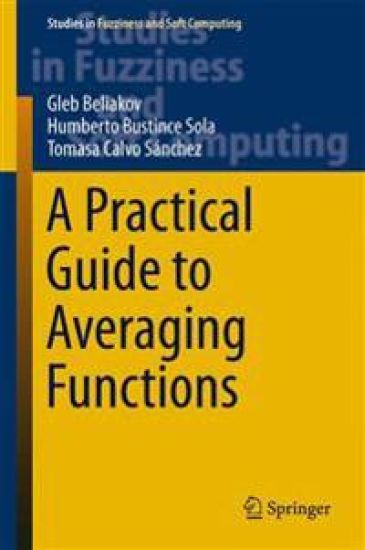
A Practical Guide to Averaging Functions

A Practical Guide to Averaging Functions

Gleb Beliakov; Humberto Bustince Sola; Tomasa Calvo

Springer International Publishing AG
2015
sidottu
This book offers an easy-to-use and practice-oriented reference guide to mathematical averages. It presents different ways of aggregating input values given on a numerical scale, and of choosing and/or constructing aggregating functions for specific applications. Building on a previous monograph by Beliakov et al. published by Springer in 2007, it outlines new aggregation methods developed in the interim, with a special focus on the topic of averaging aggregation functions. It examines recent advances in the field, such as aggregation on lattices, penalty-based aggregation and weakly monotone averaging, and extends many of the already existing methods, such as: ordered weighted averaging (OWA), fuzzy integrals and mixture functions. A substantial mathematical background is not called for, as all the relevant mathematical notions are explained here and reported on together with a wealth of graphical illustrations of distinct families of aggregation functions. The authors mainly focus on practical applications and give central importance to the conciseness of exposition, as well as the relevance and applicability of the reported methods, offering a valuable resource for computer scientists, IT specialists, mathematicians, system architects, knowledge engineers and programmers, as well as for anyone facing the issue of how to combine various inputs into a single output value.
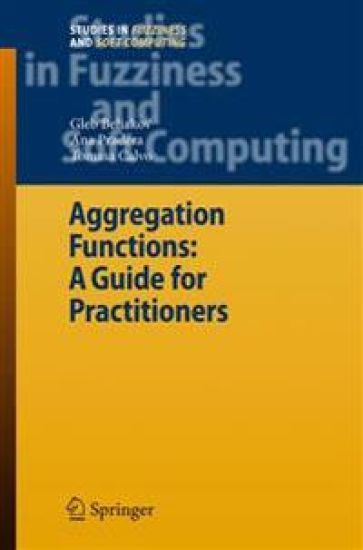
Aggregation Functions: A Guide for Practitioners

Aggregation Functions: A Guide for Practitioners

Gleb Beliakov; Ana Pradera; Tomasa Calvo

Springer-Verlag Berlin and Heidelberg GmbH Co. K
2010
nidottu
Aggregation of information is of primary importance in the construction of knowledge based systems in various domains, ranging from medicine, economics, and engineering to decision-making processes, artificial intelligence, robotics, and machine learning. This book gives a broad introduction into the topic of aggregation functions, and provides a concise account of the properties and the main classes of such functions, including classical means, medians, ordered weighted averaging functions, Choquet and Sugeno integrals, triangular norms, conorms and copulas, uninorms, nullnorms, and symmetric sums. It also presents some state-of-the-art techniques, many graphical illustrations and new interpolatory aggregation functions. A particular attention is paid to identification and construction of aggregation functions from application specific requirements and empirical data. This book provides scientists, IT specialists and system architects with a self-contained easy-to-use guide, as well as examples of computer code and a software package. It will facilitate construction of decision support, expert, recommender, control and many other intelligent systems.
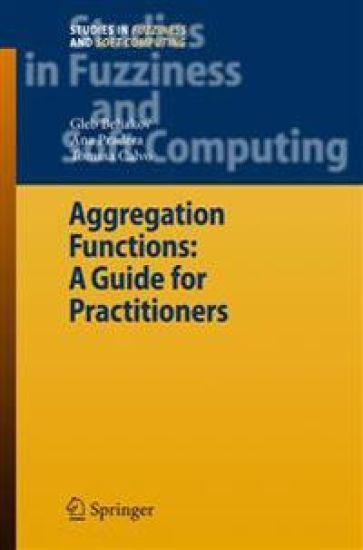
Aggregation Functions: A Guide for Practitioners

Aggregation Functions: A Guide for Practitioners

Gleb Beliakov; Ana Pradera; Tomasa Calvo

Springer-Verlag Berlin and Heidelberg GmbH Co. K
2008
sidottu
Aggregation of information is of primary importance in the construction of knowledge based systems in various domains, ranging from medicine, economics, and engineering to decision-making processes, artificial intelligence, robotics, and machine learning. This book gives a broad introduction into the topic of aggregation functions, and provides a concise account of the properties and the main classes of such functions, including classical means, medians, ordered weighted averaging functions, Choquet and Sugeno integrals, triangular norms, conorms and copulas, uninorms, nullnorms, and symmetric sums. It also presents some state-of-the-art techniques, many graphical illustrations and new interpolatory aggregation functions. A particular attention is paid to identification and construction of aggregation functions from application specific requirements and empirical data. This book provides scientists, IT specialists and system architects with a self-contained easy-to-use guide, as well as examples of computer code and a software package. It will facilitate construction of decision support, expert, recommender, control and many other intelligent systems.