Kirjojen hintavertailu – 12 903 724 kirjaa ja 27 kauppaa

Kirjailija

Tomasz Placek

Kirjat ja teokset yhdessä paikassa: 3 kirjaa, julkaisuja vuosilta 1999–2022, suosituimpiin kuuluu Mathematical Intuitionism and Intersubjectivity. Vertaile teosten hintoja ja tarkista saatavuus suomalaisista kirjakaupoista.

3 kirjaa

Kirjojen julkaisuvuodet: 1999–2022.

Branching Space-Times

Branching Space-Times

Nuel Belnap; Thomas Müller; Tomasz Placek

Oxford University Press Inc
2022
sidottu
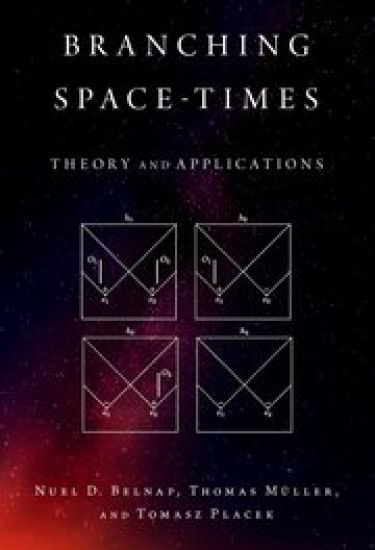
This monograph presents the first detailed exposition of the formal theory of Branching Space-Times. The theory presented here by Nuel Belnap, Thomas Muller, and Tomasz Placek describes how real possibilities can play out in our spatio-temporal world. In our world, some things that are really possible in Cleveland are not really possible in San Francisco; other things were really possible in 1988 but are not really possible in 2021. The authors develop a rigorous, relativity-friendly theory of indeterminism as a local and modal concept, demonstrating that our world contains events with alternative possible outcomes. The book is divided into two parts. The first contains the exposition of the theory, including detailed proofs. The second contains three applications of Branching Space-Times in metaphysics and philosophy of science, focusing on the use of Branching Space-Times to represent pertinent forms of indeterminism in each area. Some specific applications include a formal analysis of modal correlations and of causation and a rigorous theory of objective single-case probabilities, intended to represent degrees of possibility. The authors link their theory to current physics, investigating how local and modal indeterminism relates to issues in the foundations of physics, particularly in quantum non-locality and spatio-temporal relativity. They also relate the theory to philosophy of time, showing how it may be used to explicate the dynamic concept of the past, present, and future based on local indeterminism. The Branching Space-Times theory has been in development over the past 25 years. This volume provides a much needed first systematic and comprehensive book-length exposition of both the theory and its applications. This is an open access title available under the terms of a CC BY-NC-ND 4.0 International license. It is free to read at Oxford Scholarship Online and offered as a free PDF download from OUP and selected open access locations.
Mathematical Intuitionism and Intersubjectivity
In 1907 Luitzen Egbertus Jan Brouwer defended his doctoral dissertation on the foundations of mathematics and with this event the modem version of mathematical intuitionism came into being. Brouwer attacked the main currents of the philosophy of mathematics: the formalists and the Platonists. In tum, both these schools began viewing intuitionism as the most harmful party among all known philosophies of mathematics. That was the origin of the now-90-year-old debate over intuitionism. As both sides have appealed in their arguments to philosophical propositions, the discussions have attracted the attention of philosophers as well. One might ask here what role a philosopher can play in controversies over mathematical intuitionism. Can he reasonably enter into disputes among mathematicians? I believe that these disputes call for intervention by a philo­ sopher. The three best-known arguments for intuitionism, those of Brouwer, Heyting and Dummett, are based on ontological and epistemological claims, or appeal to theses that properly belong to a theory of meaning. Those lines of argument should be investigated in order to find what their assumptions are, whether intuitionistic consequences really follow from those assumptions, and finally, whether the premises are sound and not absurd. The intention of this book is thus to consider seriously the arguments of mathematicians, even if philosophy was not their main field of interest. There is little sense in disputing whether what mathematicians said about the objectivity and reality of mathematical facts belongs to philosophy, or not.
Mathematical Intuitionism and Intersubjectivity
In 1907 Luitzen Egbertus Jan Brouwer defended his doctoral dissertation on the foundations of mathematics and with this event the modem version of mathematical intuitionism came into being. Brouwer attacked the main currents of the philosophy of mathematics: the formalists and the Platonists. In tum, both these schools began viewing intuitionism as the most harmful party among all known philosophies of mathematics. That was the origin of the now-90-year-old debate over intuitionism. As both sides have appealed in their arguments to philosophical propositions, the discussions have attracted the attention of philosophers as well. One might ask here what role a philosopher can play in controversies over mathematical intuitionism. Can he reasonably enter into disputes among mathematicians? I believe that these disputes call for intervention by a philo­ sopher. The three best-known arguments for intuitionism, those of Brouwer, Heyting and Dummett, are based on ontological and epistemological claims, or appeal to theses that properly belong to a theory of meaning. Those lines of argument should be investigated in order to find what their assumptions are, whether intuitionistic consequences really follow from those assumptions, and finally, whether the premises are sound and not absurd. The intention of this book is thus to consider seriously the arguments of mathematicians, even if philosophy was not their main field of interest. There is little sense in disputing whether what mathematicians said about the objectivity and reality of mathematical facts belongs to philosophy, or not.