Kirjojen hintavertailu – 12 903 725 kirjaa ja 27 kauppaa
Kirjailija
Tommaso Ruggeri
Kirjat ja teokset yhdessä paikassa: 10 kirjaa, julkaisuja vuosilta 2011–2026, suosituimpiin kuuluu Rational Mechanics. Vertaile teosten hintoja ja tarkista saatavuus suomalaisista kirjakaupoista.
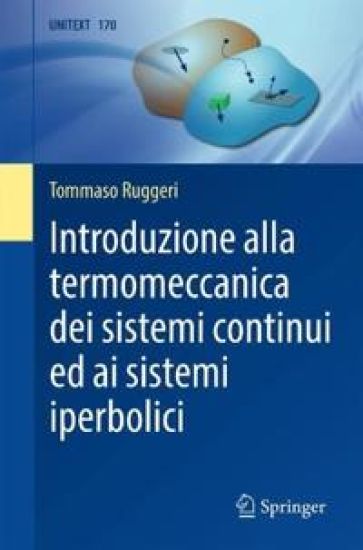
L'obiettivo principale di questo libro è presentare un trattamento unificato della termomeccanica dei continui utilizzando l'approccio assiomatico tipico della meccanica razionale. Mentre molti testi di meccanica dei continui si concentrano su tipi specifici di corpi continui, come i corpi solidi deformabili o i fluidi, questo libro adotta una prospettiva generale. Viene presentata la struttura matematica delle leggi di bilancio e delle equazioni costitutive come un insieme coeso, con particolare attenzione alla moderna teoria delle equazioni costitutive. Si sottolineano principi importanti, come il principio di indifferenza materiale e l'interpretazione contemporanea del principio di entropia. Per garantire la coerenza interna, la prima parte del libro affronta questioni relative all'algebra lineare, con particolare attenzione agli operatori lineari all'interno degli spazi vettoriali a dimensione finita. Successivamente, il libro offre un'esplorazione dettagliata delle deformazioni finite dei continui, seguita da una panoramica sulla cinematica. Vengono caratterizzate le varie forze che possono esistere in un continuo, introdotto il tensore degli sforzi e presentate le leggi di bilancio sia in forma euleriana che lagrangiana. Successivamente viene definita la moderna teoria delle equazioni costitutive, sottolineando il ruolo dei principi generali di indifferenza materiale e di entropia come criteri per la selezione delle classi fisicamente accettabili di equazioni costitutive. Le equazioni di campo risultanti sono specializzate per vari casi, tra cui la termoelasticità, i fluidi euleriani, i fluidi di Fourier-Navier-Stokes e i conduttori rigidi di calore. Nell'ultima parte del libro vengono discussi i sistemi di equazioni alle derivate parziali nella meccanica dei continui, con particolare attenzione ai sistemi iperbolici. Il metodo delle caratteristiche viene introdotto sia nei casi lineari che non lineari, e si discute la necessità di ampliare la classe delle soluzioni introducendo le soluzioni deboli, con le onde d'urto come caso significativo. Come esempio illustrativo di soluzione debole, viene presentato il problema di Riemann per il modello fluidodinamico del traffico veicolare, in cui le automobili sono inizialmente ferme a un semaforo rosso e poi iniziano a muoversi quando il semaforo diventa verde. Questo libro sarà utile non solo per gli studenti di ingegneria, ma anche per gli studenti di altre discipline scientifiche in cui si studiano aspetti della meccanica dei continui. Fornisce l'opportunità di considerare argomenti tradizionalmente distinti in un contesto più ampio e interconnesso.
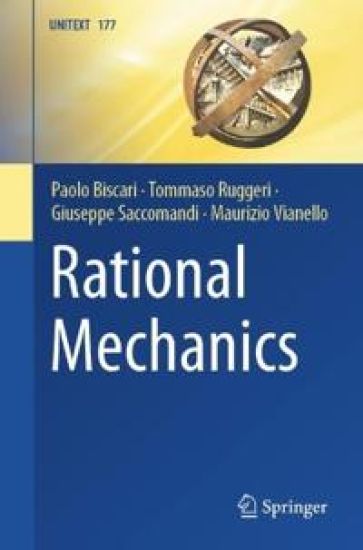
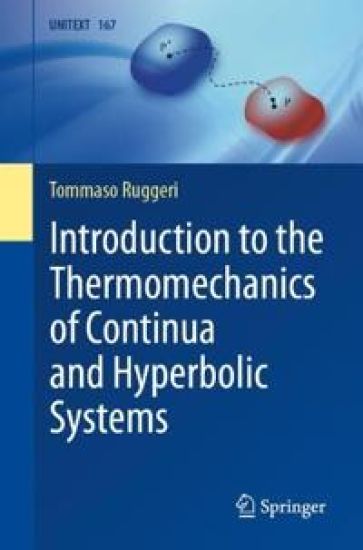
The primary aim of this book is to present a unified treatment of the thermomechanics of continua using the axiomatic approach typical of rational mechanics. While many books on continuum mechanics focus on specific types of continuous bodies, such as deformable solid bodies or fluids, this book adopts a general perspective. It presents the mathematical structure of balance laws and constitutive equations as a cohesive whole, with special attention given to the modern theory of constitutive equations. Notable principles such as the principle of material indifference and the contemporary interpretation of the principle of entropy are emphasized. This book will be beneficial not only to engineering students but also to students from other scientific disciplines where aspects of continuum mechanics are studied. It provides an opportunity to view traditionally distinct topics in a broader, interconnected context. To ensure self-consistency, the first part of the book addresses issues related to linear algebra, with a particular focus on linear operators within finite-dimensional vector spaces. The book then offers a detailed exploration of finite deformations of continua, followed by an overview of kinematics. It characterizes the various forces that can exist in a continuum, introduces the stress tensor, and presents the balance laws in both Eulerian and Lagrangian forms. Next, the modern theory of constitutive equations is defined, emphasizing the role of the general principles of material indifference and entropy as criteria for selecting physically acceptable classes of constitutive equations. The resulting field equations are specialized for various cases, including thermoelasticity, Eulerian fluids, Fourier-Navier-Stokes fluids, and rigid heat conductors. In the final part of the book, partial differential equations in continuum mechanics are discussed, with particular attention given to hyperbolic systems. The method of characteristics is introduced in both linear and nonlinear cases, and the need to expand the class of solutions by introducing weak solutions is discussed, with shock waves being a significant case. As an illustrative example of a weak solution, the Riemann problem is presented for the fluid dynamic model of vehicular traffic, where cars are initially stopped at a red light and then start moving when the light turns green.
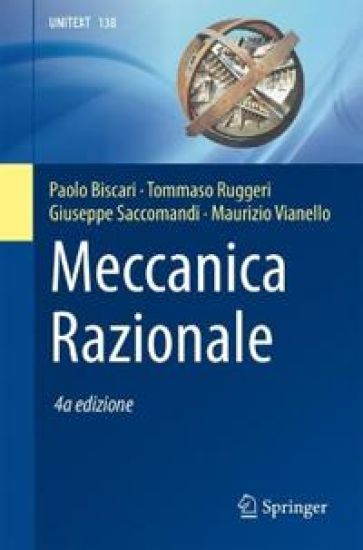
Questo testo, che giunge ora alla quarta edizione, è stato concepito principalmente per le necessità delle Scuole di Ingegneria, dove la Meccanica Razionale ha il duplice ruolo di introdurre sia alla modellizzazione fisico-matematica rigorosa che a specifiche applicazioni sviluppate poi in altri insegnamenti. La trattazione che qui proponiamo vuole presentare i concetti fondamentali mantenendo sempre l'attenzione rivolta alle applicazioni, a volte comuni ad altre discipline, in vista di sinergie didattiche favorite dalla presenza di corsi integrati. Abbiamo cercato di dare al libro una impostazione il più possibile coerente con questa finalità, soprattutto in alcune sezioni tradizionalmente caratterizzate da una trattazione più astratta: dai vincoli al Principio dei lavori virtuali, dal Principio di d'Alembert alla Meccanica Analitica. Abbiamo comunque mantenuto la tradizionale e, a nostro parere, irrinunciabile struttura ipotetico-deduttiva nello svolgimento delleargomentazioni, che fa ancora della Meccanica Razionale un disciplina formalmente rigorosa. Sono perciò presenti dimostrazioni anche complesse, sia pure sempre motivate alla luce del contesto applicativo nel quale si vanno a collocare. Questa edizione è frutto di un ampio lavoro di riorganizzazione e rielaborazione rispetto alla precedente e contiene, oltre a numerosi nuovi esempi, miglioramenti nella presentazione dei concetti principali e nello svolgimento delle dimostrazioni, per renderle didatticamente più efficaci.
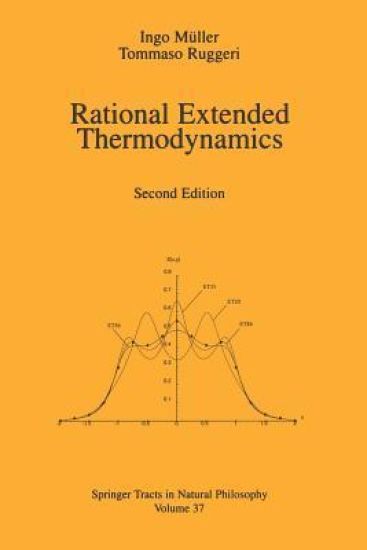
Rational extended thermodynamics (RET) is the theory that is applicable to nonequilibrium phenomena out of local equilibrium. It is expressed by the hyperbolic system of field equations with local constitutive equations and is strictly related to the kinetic theory with the closure method of the hierarchies of moment equations. The book intends to present, in a systematic way, new results obtained by RET of gases in both classical and relativistic cases, and it is a natural continuation of the book "Rational Extended Thermodynamics beyond the Monatomic Gas" by the same authors published in 2015. However, this book addresses much wider topics than those of the previous book. Its contents are as follows: RET of rarefied monatomic gases and of polyatomic gases; a simplified RET theory with 6 fields being valid far from equilibrium; RET where both molecular rotational and vibrational modes exist; mixture of gases with multi-temperature. The theory is applied to several typical topics (sound waves, shock waves, etc.) and is compared with experimental data. From a mathematical point of view, RET can be regarded as a theory of hyperbolic symmetric systems, of which it is possible to conduct a qualitative analysis. The book represents a valuable resource for applied mathematicians, physicists, and engineers, offering powerful models for many potential applications such as reentering satellites into the atmosphere, semiconductors, and nanoscale phenomena.
Rational extended thermodynamics (RET) is the theory that is applicable to nonequilibrium phenomena out of local equilibrium. It is expressed by the hyperbolic system of field equations with local constitutive equations and is strictly related to the kinetic theory with the closure method of the hierarchies of moment equations. The book intends to present, in a systematic way, new results obtained by RET of gases in both classical and relativistic cases, and it is a natural continuation of the book "Rational Extended Thermodynamics beyond the Monatomic Gas" by the same authors published in 2015. However, this book addresses much wider topics than those of the previous book. Its contents are as follows: RET of rarefied monatomic gases and of polyatomic gases; a simplified RET theory with 6 fields being valid far from equilibrium; RET where both molecular rotational and vibrational modes exist; mixture of gases with multi-temperature. The theory is applied to several typical topics (sound waves, shock waves, etc.) and is compared with experimental data. From a mathematical point of view, RET can be regarded as a theory of hyperbolic symmetric systems, of which it is possible to conduct a qualitative analysis. The book represents a valuable resource for applied mathematicians, physicists, and engineers, offering powerful models for many potential applications such as reentering satellites into the atmosphere, semiconductors, and nanoscale phenomena.
This book is dedicated to the recent developments in RET with the aim to explore polyatomic gas, dense gas and mixture of gases in non-equilibrium. In particular we present the theory of dense gases with 14 fields, which reduces to the Navier-Stokes Fourier classical theory in the parabolic limit. Molecular RET with an arbitrary number of field-variables for polyatomic gases is also discussed and the theory is proved to be perfectly compatible with the kinetic theory in which the distribution function depends on an extra variable that takes into account a molecule’s internal degrees of freedom. Recent results on mixtures of gases with multi-temperature are presented together with a natural definition of the average temperature. The qualitative analysis and in particular, the existence of the global smooth solution and the convergence to equilibrium are also studied by taking into account the fact that the differential systems are symmetric hyperbolic. Applications to shock and soundwaves are analyzed together with light scattering and heat conduction and the results are compared with experimental data. Rational extended thermodynamics (RET) is a thermodynamic theory that is applicable to non-equilibrium phenomena. It is described by differential hyperbolic systems of balance laws with local constitutive equations. As RET has been strictly related to the kinetic theory through the closure method of moment hierarchy associated to the Boltzmann equation, the applicability range of the theory has been restricted within rarefied monatomic gases. The book represents a valuable resource for applied mathematicians, physicists and engineers, offering powerful models for potential applications like satellites reentering the atmosphere, semiconductors and nano-scale phenomena.
This book is dedicated to the recent developments in RET with the aim to explore polyatomic gas, dense gas and mixture of gases in non-equilibrium. In particular we present the theory of dense gases with 14 fields, which reduces to the Navier-Stokes Fourier classical theory in the parabolic limit. Molecular RET with an arbitrary number of field-variables for polyatomic gases is also discussed and the theory is proved to be perfectly compatible with the kinetic theory in which the distribution function depends on an extra variable that takes into account a molecule’s internal degrees of freedom. Recent results on mixtures of gases with multi-temperature are presented together with a natural definition of the average temperature. The qualitative analysis and in particular, the existence of the global smooth solution and the convergence to equilibrium are also studied by taking into account the fact that the differential systems are symmetric hyperbolic. Applications to shock and soundwaves are analyzed together with light scattering and heat conduction and the results are compared with experimental data. Rational extended thermodynamics (RET) is a thermodynamic theory that is applicable to non-equilibrium phenomena. It is described by differential hyperbolic systems of balance laws with local constitutive equations. As RET has been strictly related to the kinetic theory through the closure method of moment hierarchy associated to the Boltzmann equation, the applicability range of the theory has been restricted within rarefied monatomic gases. The book represents a valuable resource for applied mathematicians, physicists and engineers, offering powerful models for potential applications like satellites reentering the atmosphere, semiconductors and nano-scale phenomena.
Physicists firmly believe that the differential equations of nature should be hyperbolic so as to exclude action at a distance; yet the equations of irreversible thermodynamics - those of Navier-Stokes and Fourier - are parabolic. This incompatibility between the expectation of physicists and the classical laws of thermodynamics has prompted the formulation of extended thermodynamics. After describing the motifs and early evolution of this new branch of irreversible thermodynamics, the authors apply the theory to mon-atomic gases, mixtures of gases, relativistic gases, and "gases" of phonons and photons. The discussion brings into perspective the various phenomena called second sound, such as heat propagation, propagation of shear stress and concentration, and the second sound in liquid helium. The formal mathematical structure of extended thermodynamics is exposed and the theory is shown to be fully compatible with the kinetic theory of gases. The study closes with the testing of extended thermodynamics through the exploitation of its predictions for measurements of light scattering and sound propagation.
Ordinary thermodynamics provides reliable results when the thermodynamic fields are smooth, in the sense that there are no steep gradients and no rapid changes. In fluids and gases this is the domain of the equations of Navier-Stokes and Fourier. Extended thermodynamics becomes relevant for rapidly varying and strongly inhomogeneous processes. Thus the propagation of high frequency waves, and the shape of shock waves, and the regression of small-scale fluctuation are governed by extended thermodynamics. The field equations of ordinary thermodynamics are parabolic while extended thermodynamics is governed by hyperbolic systems. The main ingredients of extended thermodynamics are • field equations of balance type, • constitutive quantities depending on the present local state and • entropy as a concave function of the state variables. This set of assumptions leads to first order quasi-linear symmetric hyperbolic systems of field equations; it guarantees the well-posedness of initial value problems and finite speeds of propaga tion. Several tenets of irreversible thermodynamics had to be changed in subtle ways to make extended thermodynamics work. Thus, the entropy is allowed to depend on nonequilibrium vari ables, the entropy flux is a general constitutive quantity, and the equations for stress and heat flux contain inertial terms. New insight is therefore provided into the principle of material frame indifference. With these modifications an elegant formal structure can be set up in which, just as in classical thermostatics, all restrictive conditions--derived from the entropy principle-take the form of integrability conditions.