Kirjojen hintavertailu – 12 903 725 kirjaa ja 27 kauppaa

Kirjailija

Tony Fry

Kirjat ja teokset yhdessä paikassa: 24 kirjaa, julkaisuja vuosilta 2010–2026, suosituimpiin kuuluu Political Breakout. Vertaile teosten hintoja ja tarkista saatavuus suomalaisista kirjakaupoista.

24 kirjaa

Kirjojen julkaisuvuodet: 2010–2026.

Contrapractice

Contrapractice

Tony Fry

BLOOMSBURY PUBLISHING PLC
2026
sidottu
Building on his foundational work on ‘defuturing,’ a deconstructive method that exposes historically the unsustainability of a great deal of design practice and its products, Tony Fry now offers a powerful response. There is no shortage of analysis of the current state of the world. Climate change impacts are increasing, environmental destruction will follow, populations and settlements will be displaced, food security will become critical, geopolitical instability and escalating dangers of conflict will grow. Such an entangled complexity threatens life itself more seriously than at any time since the Ice Age. Against the real threats to life on Earth, what are the world’s political leaders doing? The answers sit between nothing and very little. So, what is to be done? There is no immediate or simple answer. But what Contrapractice acknowledges is that nothing changes unless practices change. The intent is for the process to take on a life of its own by the many people who care about securing a viable future. It does not provide template solutions, but the ability to act. Every reader is viewed as a communicator of its message and a change agent of their own practice. Fry’s dialogue in the book with Dulmini Perera is a prompt for the book to be an object of discussion.
Contrapractice

Contrapractice

Tony Fry

BLOOMSBURY PUBLISHING PLC
2026
nidottu
Building on his foundational work on ‘defuturing,’ a deconstructive method that exposes historically the unsustainability of a great deal of design practice and its products, Tony Fry now offers a powerful response. There is no shortage of analysis of the current state of the world. Climate change impacts are increasing, environmental destruction will follow, populations and settlements will be displaced, food security will become critical, geopolitical instability and escalating dangers of conflict will grow. Such an entangled complexity threatens life itself more seriously than at any time since the Ice Age. Against the real threats to life on Earth, what are the world’s political leaders doing? The answers sit between nothing and very little. So, what is to be done? There is no immediate or simple answer. But what Contrapractice acknowledges is that nothing changes unless practices change. The intent is for the process to take on a life of its own by the many people who care about securing a viable future. It does not provide template solutions, but the ability to act. Every reader is viewed as a communicator of its message and a change agent of their own practice. Fry’s dialogue in the book with Dulmini Perera is a prompt for the book to be an object of discussion.
Disappearing Cities

Disappearing Cities

Tony Fry

ANTHEM PRESS
2025
nidottu
Disappearing Cities is a collection of over fifty short stories of invented cities, set in the not too distant future, destroyed by varied climate change impacts and linked natural disasters. The stories bring into question the relation between the natural and unnatural forces of change and expose responses to, and lessons learnt, from different disaster crises situations. Stories also focus on how means to adapt are sought. The projected fictions are created from projected current climate facts; trends; and the author’s experience of population displacement, relocation and design-based climate change responsive action. Central to the book is the recognition that to be able to respond and adapt to the scale of coming changes in the climate requires going beyond existing practical action and embracing a new way of imagining futures. Disappearing Cities aims to stimulate ways of meeting this need. The book opens with a Prologue that establishes the contextual frame of empirical foundation out of which the fictions are created. It recognises that we all live in a world in which the conditions that will result in huge numbers of cities disappearing are underway. From the human perspective, the process appears to be very slow, whereas in historico-geological time, it is happening exceptionally quickly. The number of the loss of cities is going to be huge, yet the recognition that this will occur is not arriving, In part, this is because of a lack of knowledge, but equally, it reflects a lack of imagination. Transposing what is known about climate change by a significant percentage of the societies of many nations to actual environments in which they live is just not arriving. What appears so solid and established fails to be seen and imagined as a risk and vulnerable. From establishing this opening perspective, the first part of the book presents stories of cities already disappearing as a result of the forces of nature changed by anthropogenically created global warming. Part two discusses the impacts of natural disasters being made unnaturally. For example, by the way industrial societies are damaging and changing natural systems, including the climatic. The final part goes to cities destroyed by completely un-natural means, including war. Disappearing Cities aims to contribute to meeting the need for a better understanding of, and ability to imagine, the risks to which vast numbers of cities are, and will be, exposed to forces of disappearance. To do this, the narratives are a hybrid of fact and fiction. The work was inspired by Italo Calvino’s book Invisible Cities and is intended to be a salient contemporary companion to this text. It mirrors its form but differs in style and content. Invisible Cities attained diverse readership, Disappearing Cities aspires to do likewise.

Disappearing Cities

Disappearing Cities

Tony Fry

ANTHEM PRESS
2025
sidottu
Disappearing Cities is a collection of over fifty short stories of invented cities, set in the not too distant future, destroyed by varied climate change impacts and linked natural disasters. The stories bring into question the relation between the natural and unnatural forces of change and expose responses to, and lessons learnt, from different disaster crises situations. Stories also focus on how means to adapt are sought. The projected fictions are created from projected current climate facts; trends; and the author’s experience of population displacement, relocation and design-based climate change responsive action. Central to the book is the recognition that to be able to respond and adapt to the scale of coming changes in the climate requires going beyond existing practical action and embracing a new way of imagining futures. Disappearing Cities aims to stimulate ways of meeting this need. The book opens with a Prologue that establishes the contextual frame of empirical foundation out of which the fictions are created. It recognises that we all live in a world in which the conditions that will result in huge numbers of cities disappearing are underway. From the human perspective, the process appears to be very slow, whereas in historico-geological time, it is happening exceptionally quickly. The number of the loss of cities is going to be huge, yet the recognition that this will occur is not arriving, In part, this is because of a lack of knowledge, but equally, it reflects a lack of imagination. Transposing what is known about climate change by a significant percentage of the societies of many nations to actual environments in which they live is just not arriving. What appears so solid and established fails to be seen and imagined as a risk and vulnerable. From establishing this opening perspective, the first part of the book presents stories of cities already disappearing as a result of the forces of nature changed by anthropogenically created global warming. Part two discusses the impacts of natural disasters being made unnaturally. For example, by the way industrial societies are damaging and changing natural systems, including the climatic. The final part goes to cities destroyed by completely un-natural means, including war. Disappearing Cities aims to contribute to meeting the need for a better understanding of, and ability to imagine, the risks to which vast numbers of cities are, and will be, exposed to forces of disappearance. To do this, the narratives are a hybrid of fact and fiction. The work was inspired by Italo Calvino’s book Invisible Cities and is intended to be a salient contemporary companion to this text. It mirrors its form but differs in style and content. Invisible Cities attained diverse readership, Disappearing Cities aspires to do likewise.
Defuturatsija: novaja filosofija dizajna

Defuturatsija: novaja filosofija dizajna

Tony Fry

Izdatelskij Dom "delo" Rankhigs
2023
nidottu
V rabote izvestnogo filosofa i teoretika dizajna Toni Fraja "Defuturatsija: novaja filosofija dizajna", vpervye opublikovannoj v 1999 godu, no obraschennoj k voprosam dizajna i mira, kotorye, nesmotrja na ikh neotlozhnost, i sejchas esche tolko-tolko nachinajut osoznavatsja, predprinimaetsja popytka sozdat to, chto sam avtor nazyvaet "novym osnovaniem myshlenija i praktiki" dizajna i mira, osnovu "novoj povestki myshlenija, sozidanija i zhizni". Eto osnovanie i povestka kasajutsja togo, sposobny li my - i esli da, to naskolko - na myshlenie, namerennoe dejstvovat khorosho, otnositelno vozmozhnostej immanentnoj neminuemoj katastrofy togo, chto est.
Writing Design Fiction

Writing Design Fiction

Tony Fry

BLOOMSBURY PUBLISHING PLC
2023
nidottu
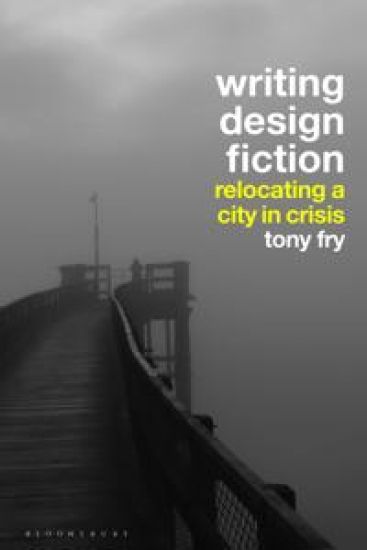
Written by leading design philosopher Tony Fry, Writing Design Fiction: Relocating a City in Crisis is both an introduction to the power of “design fiction” in the design process, and a novella-length work of fiction in itself—telling the dramatic story of the relocation of the City of Harshon. Set in the near future, Harshon, a delta city, is facing environmental catastrophe due to rising sea levels—consequently, a decision is made to relocate the entire city inland. A diverse cast of voices—including an architect, a journalist, an economist, a construction worker, and residents—narrate the extraordinary challenges and complexities which follow. This work presents a real-world scenario which, in coming decades, will face many of the world’s cities. The fictional format provides a novel way of exploring the very serious inherent technical, social, political, economic and cultural challenges. The story provides a rehearsal of the design challenges which are likely to face architects, planners, and designers in an uncertain global future. “Design fiction” is a fast-growing area within design and architecture, increasingly deployed as a serious methodology by designers as a tool in scenario planning. Writing Design Fiction takes the practice to a higher level conceptually and theoretically, but also practically. The book is divided into four parts, with the fictional narrative bookended by further critical analysis. Part One shows how a critique of existing modes of design fiction can lead to more grounded and critical thinking and practice. Part Three critically reflects on the narrative, while Part Four presents the practical application of the second order design fiction approach. This book demonstrates the value of a more developed mode of design fiction to students, professional designers and architects across the breadth of design practices, as well as to other disciplines interested in the future of cities.
A New Political Imagination

A New Political Imagination

Tony Fry; Madina Tlostanova

TAYLOR FRANCIS LTD
2022
nidottu
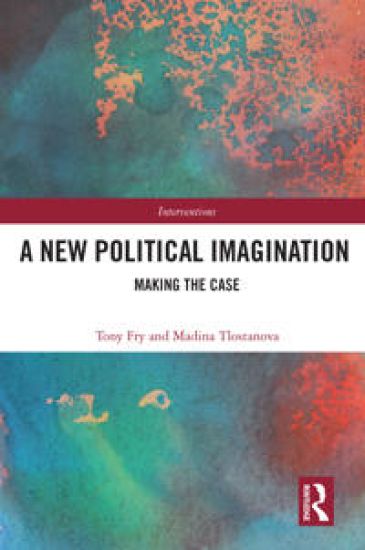
The book presents the case for the making of a new political imagination by offering a critique of existing political institutions, philosophy and practices that are unable to provide the thinking, means and leadership to deal with the complexity and crises of specific locales and the world at large. The authors make clear that there is a fundamental disjuncture between the complexity of the combined critical conditions that are now putting life on Earth at risk, and the divisions and theories of knowledge that are dominantly and instrumentally trying to understand the situation. In response, this work makes the case for the need for a new political imagination that rejects the sufficiency of existing political ideologies (including democracy) being the end point of politics. The book tackles the political underpinnings of social and economic life in a world still embedded in the inequities of the afterlife of colonialism and state socialism. Thereafter it engages narratives of change, rethinks imagination and critical practices, to finally present a relationally connected way to move forward. This trans-disciplinary volume is directed at those working in political philosophy and epistemology, critical global and security studies, decoloniality and postcolonial studies, design, critical anthropology and the post humanities. It is accessible to both academic audiences and activists and practitioners.
Writing Design Fiction

Writing Design Fiction

Tony Fry

Bloomsbury Visual Arts
2021
sidottu
Written by leading design philosopher Tony Fry, Writing Design Fiction: Relocating a City in Crisis is both an introduction to the power of “design fiction” in the design process, and a novella-length work of fiction in itself—telling the dramatic story of the relocation of the City of Harshon. Set in the near future, Harshon, a delta city, is facing environmental catastrophe due to rising sea levels—consequently, a decision is made to relocate the entire city inland. A diverse cast of voices—including an architect, a journalist, an economist, a construction worker, and residents—narrate the extraordinary challenges and complexities which follow. This work presents a real-world scenario which, in coming decades, will face many of the world’s cities. The fictional format provides a novel way of exploring the very serious inherent technical, social, political, economic and cultural challenges. The story provides a rehearsal of the design challenges which are likely to face architects, planners, and designers in an uncertain global future.“Design fiction” is a fast-growing area within design and architecture, increasingly deployed as a serious methodology by designers as a tool in scenario planning. Writing Design Fiction takes the practice to a higher level conceptually and theoretically, but also practically. The book is divided into four parts, with the fictional narrative bookended by further critical analysis. Part One shows how a critique of existing modes of design fiction can lead to more grounded and critical thinking and practice. Part Three critically reflects on the narrative, while Part Four presents the practical application of the second order design fiction approach. This book demonstrates the value of a more developed mode of design fiction to students, professional designers and architects across the breadth of design practices, as well as to other disciplines interested in the future of cities.
A New Political Imagination

A New Political Imagination

Tony Fry; Madina Tlostanova

Routledge
2020
sidottu
The book presents the case for the making of a new political imagination by offering a critique of existing political institutions, philosophy and practices that are unable to provide the thinking, means and leadership to deal with the complexity and crises of specific locales and the world at large. The authors make clear that there is a fundamental disjuncture between the complexity of the combined critical conditions that are now putting life on Earth at risk, and the divisions and theories of knowledge that are dominantly and instrumentally trying to understand the situation. In response, this work makes the case for the need for a new political imagination that rejects the sufficiency of existing political ideologies (including democracy) being the end point of politics. The book tackles the political underpinnings of social and economic life in a world still embedded in the inequities of the afterlife of colonialism and state socialism. Thereafter it engages narratives of change, rethinks imagination and critical practices, to finally present a relationally connected way to move forward. This trans-disciplinary volume is directed at those working in political philosophy and epistemology, critical global and security studies, decoloniality and postcolonial studies, design, critical anthropology and the post humanities. It is accessible to both academic audiences and activists and practitioners.
Defuturing

Defuturing

Tony Fry

Bloomsbury Visual Arts
2020
nidottu
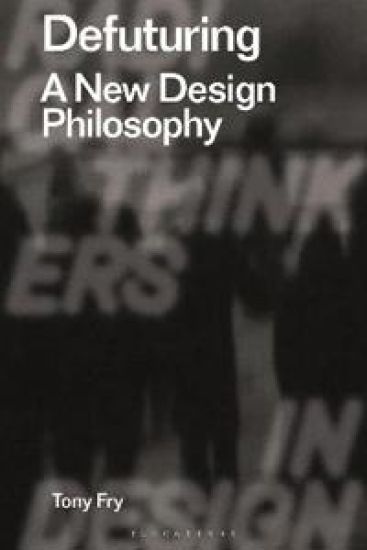
“Once one understands the nature and magnitude of defuturing as the negation of world futures, how one has to account for the history and making of the material world – including design - dramatically changes. Defuturing as our condition forces the generation of a new philosophy of design.” With these thoughts this book presents a radically new understanding of the history, context and futures of designing. First published in 1999, now reissued with a new preface by the author, Defuturing: A New Design Philosophy is a prescient and powerful account of what it means to comprehend that we live in world that is taking away futures for ourselves and non-human others. Arguing that designing is doubly implicated in this process, first in its roles in helping to create the unsustainable, but second, re-thought through the lens of defuturing, as a mode of acting in the world that can help contest the negation of the world, Defuturing transforms our comprehension of designing and of how futures can be constituted. Working not through abstract theorizing but through the analysis of concrete examples, the book uses historical material on design to expose the archaeology of defuturing. Shattering the illusion that the future simply “is”, Defuturing confronts designing with the challenge of remaking while offering the elements of a new practical reasoning of design acting.
Unstaging War, Confronting Conflict and Peace

Unstaging War, Confronting Conflict and Peace

Tony Fry

Springer Nature Switzerland AG
2020
nidottu
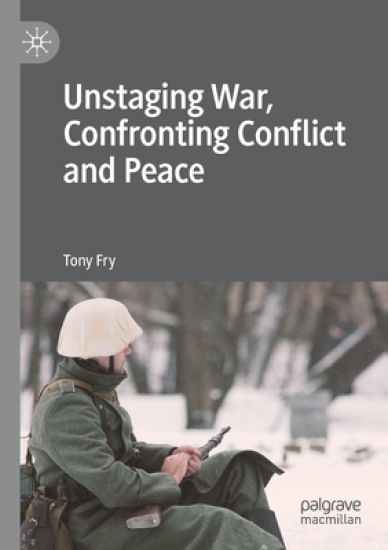
This book presents the concept of ‘unstaging’ war as a strategic response to the failure of the discourse and institutions of peace. This failure is explained by exploring the changing character of conflict in current and emergent global circumstances, such as asymmetrical conflicts, insurgencies, and terrorism. Fry argues that this pluralisation of war has broken the binary relation between war and peace: conflict is no longer self-evident, and consequentially the changes in the conditions, nature, systems, philosophies and technologies of war must be addressed. Through a deep understanding of contemporary war, Fry explains why peace fails as both idea and process, before presenting ‘Unstaging War’ as a concept and nascent practice that acknowledges conflict as structurally present, and so is not able to be dealt with by attempts to create peace. Against a backdrop of increasingly tense relations between global power blocs, the beginnings of a new nuclear arms race, and the ever-increasing human and environmental impacts of climate change, a more viable alternative to war is urgently needed. Unstaging War is not claimed as a solution, but rather as an exploration of critical problems and an opening into the means of engaging with them.
Unstaging War, Confronting Conflict and Peace

Unstaging War, Confronting Conflict and Peace

Tony Fry

Springer Nature Switzerland AG
2019
sidottu
This book presents the concept of ‘unstaging’ war as a strategic response to the failure of the discourse and institutions of peace. This failure is explained by exploring the changing character of conflict in current and emergent global circumstances, such as asymmetrical conflicts, insurgencies, and terrorism. Fry argues that this pluralisation of war has broken the binary relation between war and peace: conflict is no longer self-evident, and consequentially the changes in the conditions, nature, systems, philosophies and technologies of war must be addressed. Through a deep understanding of contemporary war, Fry explains why peace fails as both idea and process, before presenting ‘Unstaging War’ as a concept and nascent practice that acknowledges conflict as structurally present, and so is not able to be dealt with by attempts to create peace. Against a backdrop of increasingly tense relations between global power blocs, the beginnings of a new nuclear arms race, and the ever-increasing human and environmental impacts of climate change, a more viable alternative to war is urgently needed. Unstaging War is not claimed as a solution, but rather as an exploration of critical problems and an opening into the means of engaging with them.
Design Futuring

Design Futuring

Tony Fry

Bloomsbury Visual Arts
2018
nidottu
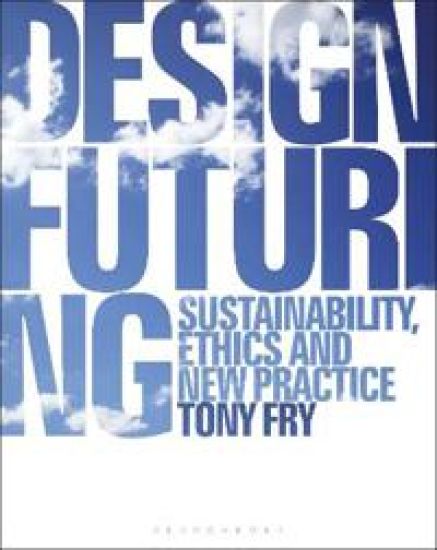
Sustainability is now a buzzword both among professionals and scholars. However, though climate change and resource depletion are now widely recognized by business as major challenges, and while new practices like 'green design' have emerged, efforts towards change remain weak and fragmented. Exposing these limitations, Design Futuring systematically presents ideas and methods for Design as an expanded ethical and professional practice. Design Futuring argues that responding to ethical, political, social and ecological concerns now requires a new type of practice that recognizes design's importance in overcoming a world made unsustainable. Illustrated throughout with international case material, Design Futuring presents the author's ground-breaking ideas in a coherent framework, focusing specifically on the ways in which concerns for ethics and sustainability can change the practice of Design for the twenty-first century. Design Futuring - a pathfinding text for the new era - extends far beyond Design courses and professional practice, and will also be invaluable to students and practitioners of Architecture, the Creative Arts, Business and Management.
Remaking Cities

Remaking Cities

Tony Fry

Bloomsbury Academic
2017
nidottu
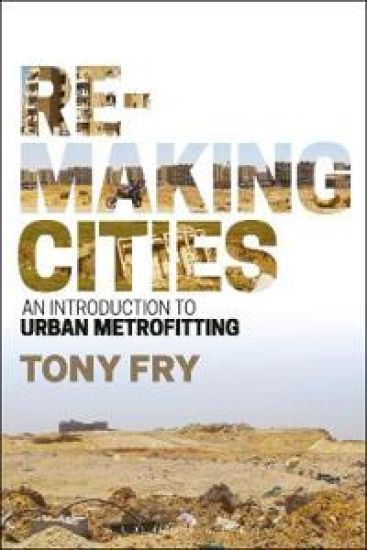
Unprecedented challenges await the future of the world’s cities. Accelerating population pressure, climate change, food insecurity, poverty and geopolitical instability – in the face of such problems our current attempts at producing a sustainable agenda for the world’s cities appear fragmented and inadequate. Fresh thinking is needed. In Remaking Cities, renowned design theorist Tony Fry brings a conceptual design perspective to the challenge of urban sustainability and resilience. In a typically far-sighted and provocative work, Fry presents ideas and actions for ‘metrofitting’ – a new kind of practice in architecture and urban design. Metrofitting expands the technological concept of retrofit up to the city scale, placing social, cultural, political and ethical concerns at its heart. Metrofitting is not about visionary technology, it is about transforming existing cities by combining available resources with human creativity, prompted by new thinking about new and old urban problems. It requires overcoming outmoded Eurocentric assumptions of what constitutes a city, rethinking their forms and structures, and understanding their metabolic processes and social and economic functions. This book provides conceptually strong practical approaches that will ultimately change the whole way we view cities and the way the urban future is designed. Illustrated with international case studies of metrofitting in action, Remaking Cities will provoke and stimulate debate among architects, urban designers, and anyone concerned with the urban environment and social and cultural change.
Design and the Question of History

Design and the Question of History

Tony Fry; Clive Dilnot; Susan Stewart

Bloomsbury Academic
2015
nidottu
Design and the Question of History is not a work of Design History. Rather, it is a mixture of mediation, advocacy and polemic that takes seriously the directive force of design as an historical actor in and upon the world. Understanding design as a shaper of worlds within which the political, ethical and historical character of human being is at stake, this text demands radically transformed notions of both design and history. Above all, the authors posit history as the generational site of the future. Blindness to history, it is suggested, blinds us both to possibility, and to the foreclosure of possibilities, enacted through our designing. The text is not a resolved, continuous work, presented through one voice. Rather, the three authors cut across each other, presenting readers with the task of disclosing, to themselves, the commonalities, repetitions and differences within the deployed arguments, issues, approaches and styles from which the text is constituted. This is a work of friendship, of solidarity in difference, an act of cultural politics. It invites the reader to take a position – it seeks engagement over agreement.
Design and the Question of History

Design and the Question of History

Tony Fry; Clive Dilnot; Susan Stewart

Bloomsbury Academic
2015
sidottu
Design and the Question of History is not a work of Design History. Rather, it is a mixture of mediation, advocacy and polemic that takes seriously the directive force of design as an historical actor in and upon the world. Understanding design as a shaper of worlds within which the political, ethical and historical character of human being is at stake, this text demands radically transformed notions of both design and history. Above all, the authors posit history as the generational site of the future. Blindness to history, it is suggested, blinds us both to possibility, and to the foreclosure of possibilities, enacted through our designing. The text is not a resolved, continuous work, presented through one voice. Rather, the three authors cut across each other, presenting readers with the task of disclosing, to themselves, the commonalities, repetitions and differences within the deployed arguments, issues, approaches and styles from which the text is constituted. This is a work of friendship, of solidarity in difference, an act of cultural politics. It invites the reader to take a position - it seeks engagement over agreement.
Steel

Steel

Tony Fry; Anne-Marie Willis

Bloomsbury Academic
2015
sidottu
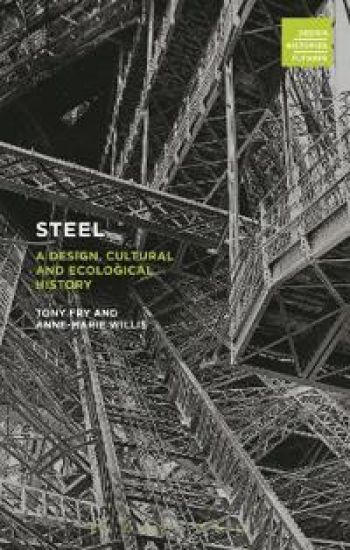
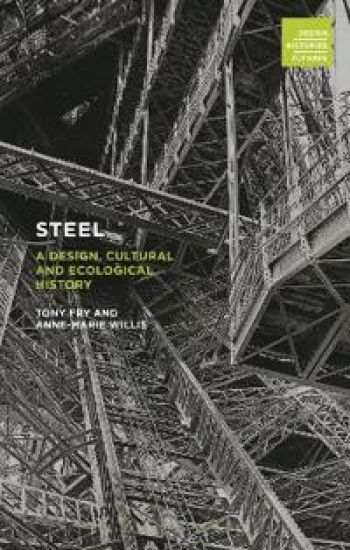
Steel has, over centuries, played a crucial role in shaping our material, and in particular, urban landscapes. This books undertakes a cultural and ecological history of the material, examining the relationship between steel and design at a micro and macro level – in terms of both what it has been used to design and how it has functioned as a ‘world-making force’. The research for the book is informed by diverse sources including industry journals, contemporary accounts and technical literature – all framed by rich, early accounts of iron and steel making from the middle ages to the opening of the industrial age, and most notably, the crucial works of Vannoccio Biringuccio, Georgius Agricola, Andrew Ure and Harry Scrivenor. In contrast, trans-cultural accounts of the history of metallurgy from eminent sinologists and cultural historians like Joseph Needham and G. E. R. Lloyd are used. Readings on the pre-history and history of science, as well as histories and philosophies technology from scholars such as Siegfried Giedion, Merritt Roe Smith, L. T. C Rolt, Robert B. Gordon inform the analysis. Social and economic history from historians such as Eric Hobsbawn, William T. Hogan and David Brody are consulted; labour process theory is also examined, particularly the influential writings of F. W. Taylor in the late 19th and early 20th centuries and his contemporary critics, like David Nobel and Harry Braverman. Many other disciples also inform the account: histories of urban design and architecture, transport and military history, environmental history and geography.
Steel

Steel

Tony Fry; Anne-Marie Willis

Bloomsbury Academic
2015
nidottu
Steel has, over centuries, played a crucial role in shaping our material, and in particular, urban landscapes. This books undertakes a cultural and ecological history of the material, examining the relationship between steel and design at a micro and macro level – in terms of both what it has been used to design and how it has functioned as a ‘world-making force’. The research for the book is informed by diverse sources including industry journals, contemporary accounts and technical literature – all framed by rich, early accounts of iron and steel making from the middle ages to the opening of the industrial age, and most notably, the crucial works of Vannoccio Biringuccio, Georgius Agricola, Andrew Ure and Harry Scrivenor. In contrast, trans-cultural accounts of the history of metallurgy from eminent sinologists and cultural historians like Joseph Needham and G. E. R. Lloyd are used. Readings on the pre-history and history of science, as well as histories and philosophies technology from scholars such as Siegfried Giedion, Merritt Roe Smith, L. T. C Rolt, Robert B. Gordon inform the analysis. Social and economic history from historians such as Eric Hobsbawn, William T. Hogan and David Brody are consulted; labour process theory is also examined, particularly the influential writings of F. W. Taylor in the late 19th and early 20th centuries and his contemporary critics, like David Nobel and Harry Braverman. Many other disciples also inform the account: histories of urban design and architecture, transport and military history, environmental history and geography.
City Futures in the Age of a Changing Climate
This book goes beyond current ways that the impact of climate change upon the city are understood. In doing so it addresses climate in a variety of its connotations. It looks to the nomadic behaviour patterns of the past for lessons for today’s population unsettlement, and argues that as human survival will increasingly be linked directly to movement, the city can no longer be defined as a constrained space. The impacts of climate change must be understood as a combination of the actual and the expected, and have to be addressed both practically and culturally. City Futures in an Age of Changing Climate looks at how cities can adapt and respond to the unsustainable conditions they are now facing. The book considers possible post-urban futures, exposing a range of very different urban forms, and addresses the concept of fragmentation; the breaking up of any coherent economic or cultural nucleic urban spaces. Urban planners, designers, development practitioners, and anyone seeking to understand what the future is likely to look like for our cities, and how to prepare for it, will find this an essential read.