Kirjojen hintavertailu – 12 859 829 kirjaa ja 27 kauppaa

Kirjailija

Tudor S. Ratiu

Kirjat ja teokset yhdessä paikassa: 6 kirjaa, julkaisuja vuosilta 1999–2023, suosituimpiin kuuluu Hamiltonian Reduction by Stages. Vertaile teosten hintoja ja tarkista saatavuus suomalaisista kirjakaupoista.

6 kirjaa

Kirjojen julkaisuvuodet: 1999–2023.

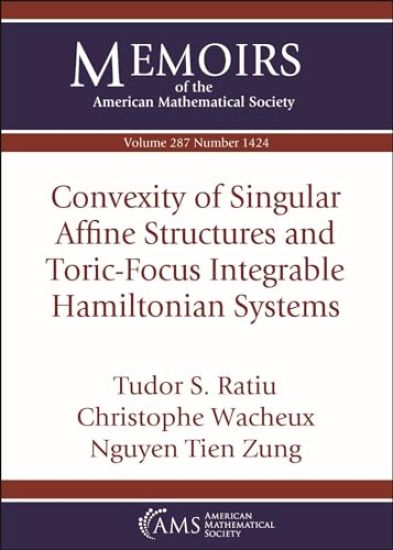
Convexity of Singular Affine Structures and Toric-Focus Integrable Hamiltonian Systems

Convexity of Singular Affine Structures and Toric-Focus Integrable Hamiltonian Systems

Tudor S. Ratiu; Christophe Wacheux; Nguyen Tien Zung

AMERICAN MATHEMATICAL SOCIETY
2023
nidottu
This work is devoted to a systematic study of symplectic convexity for integrable Hamiltonian systems with elliptic and focus-focus singularities. A distinctive feature of these systems is that their base spaces are still smooth manifolds (with boundary and corners), analogous to the toric case, but their associated integral affine structures are singular, with non-trivial monodromy, due to focus singularities. We obtain a series of convexity results, both positive and negative, for such singular integral affine base spaces. In particular, near a focus singular point, they are locally convex and the local-global convexity principle still applies. They are also globally convex under some natural additional conditions. However, when the monodromy is sufficiently large, the local-global convexity principle breaks down and the base spaces can be globally non-convex, even for compact manifolds. As a surprising example, we construct a 2-dimensional "integral affine black hole", which is locally convex but for which a straight ray from the center can never escape.

Momentum Maps and Hamiltonian Reduction

Momentum Maps and Hamiltonian Reduction

Juan-Pablo Ortega; Tudor S. Ratiu

Birkhauser Boston Inc
2013
nidottu
The use of the symmetries of a physical system in the study of its dynamics has a long history that goes back to the founders of c1assical mechanics. Symmetry-based tech­ niques are often implemented by using the integrals 01 motion that one can sometimes associate to these symmetries. The integrals of motion of a dynamical system are quan­ tities that are conserved along the fiow of that system. In c1assieal mechanics symme­ tries are usually induced by point transformations, that is, they come exc1usively from symmetries of the configuration space; the intimate connection between integrals of motion and symmetries was formalized in this context by NOETHER (1918). This idea can be generalized to many symmetries of the entire phase space of a given system, by associating to the Lie algebra action encoding the symmetry, a function from the phase space to the dual of the Lie algebra. This map, whose level sets are preserved by the dynamics of any symmetrie system, is referred to in modern terms as a momentum map of the symmetry, a construction already present in the work of LIE (1890). Its remarkable properties were rediscovered by KOSTANT (1965) and SOURlAU (1966, 1969) in the general case and by SMALE (1970) for the lifted action to the co tangent bundle of a configuration space. For the his tory of the momentum map we refer to WEINSTEIN (1983b) and MARSDEN AND RATIU (1999), §11. 2.
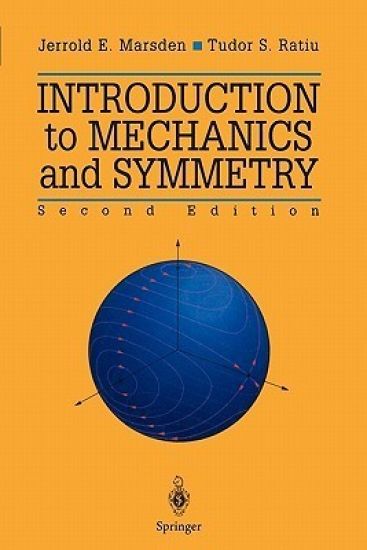
Introduction to Mechanics and Symmetry

Introduction to Mechanics and Symmetry

Jerrold E. Marsden; Tudor S. Ratiu

Springer-Verlag New York Inc.
2010
nidottu
Symmetry has always played an important role in mechanics, from fundamental formulations of basic principles to concrete applications. The theme of the book is to develop the basic theory and applications of mechanics with an emphasis on the role of symmetry. In recent times, the interest in mechanics, and in symmetry techniques in particular, has accelerated because of developments in dynamical systems, the use of geometric methods and new applications to integrable and chaotic systems, control systems, stability and bifurcation, and the study of specific rigid, fluid, plasma and elastic systems. Introduction to Mechanics and Symmetry lays the basic foundation for these topics and includes numerous specific applications, making it beneficial to physicists and engineers. This text has specific examples and applications showing how the theory works, and up-to-date techniques, all of which makes it accessible to a wide variety of readers, expecially senior undergraduate and graduate students in mathematics, physics and engineering. For this second edition, the text has been rewritten and updated for clarity throughout, with a major revamping and expansion of the exercises. Internet supplements containing additional material are also available on-line.
Hamiltonian Reduction by Stages

Hamiltonian Reduction by Stages

Jerrold E. Marsden; Gerard Misiolek; Juan-Pablo Ortega; Matthew Perlmutter; Tudor S. Ratiu

Springer-Verlag Berlin and Heidelberg GmbH Co. K
2007
nidottu
In this volume readers will find for the first time a detailed account of the theory of symplectic reduction by stages, along with numerous illustrations of the theory. Special emphasis is given to group extensions, including a detailed discussion of the Euclidean group, the oscillator group, the Bott-Virasoro group and other groups of matrices. Ample background theory on symplectic reduction and cotangent bundle reduction in particular is provided. Novel features of the book are the inclusion of a systematic treatment of the cotangent bundle case, including the identification of cocycles with magnetic terms, as well as the general theory of singular reduction by stages.
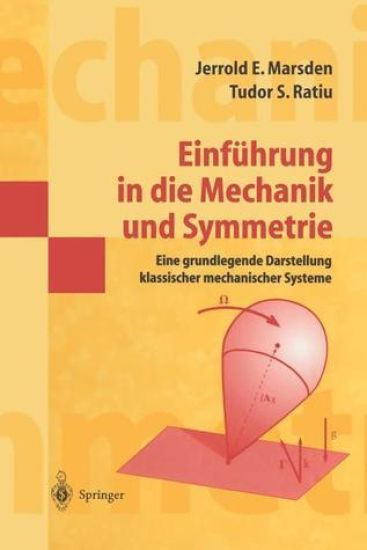
Einführung in die Mechanik und Symmetrie

Einführung in die Mechanik und Symmetrie

Jerrold E. Marsden; Tudor S. Ratiu

Springer-Verlag Berlin and Heidelberg GmbH Co. K
2001
nidottu
Symmetrie hat in der Mechanik schon immer eine große Rolle gespielt - von der grundlegenden Formulierung elementarer Theorien bis hin zu konkreten Anwendungen. Thema dieses Buches ist die Entwicklung der zugrunde liegenden Theorien, wobei der Rolle der Symmetrie besonderes Gewicht beigemessen wird. Ursache hierfür sind neben den Entwicklungen im Bereich dynamischer Systeme auch der Einsatz geometrischer Verfahren und neuer Anwendungen bei integrierbaren und chaotischen Systemen, Steuerungssystemen, Stabilität und Bifurkation sowie die Erforschung starrer, flüssiger, plasmaförmiger und elastischer Systeme. Das vorliegende Lehrbuch stellt die Grundlagen für die Behandlung dieser Themen bereit und schließt zahlreiche spezifische Anwendungen mit ein, wodurch es insbesondere auch für Physiker und Ingenieure interessant ist. Ausgewählte Beispiele und Anwendungen sowie aktuelle Verfahren/Techniken veranschaulichen die dargelegte Theorie.
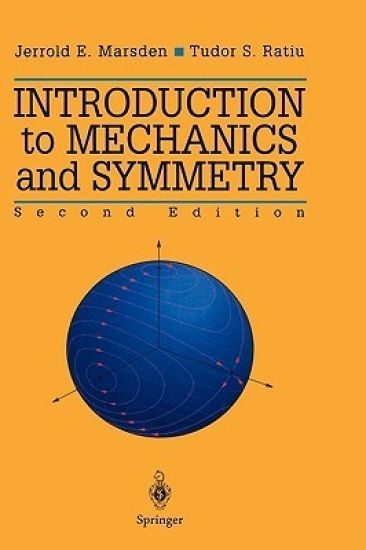
Introduction to Mechanics and Symmetry

Introduction to Mechanics and Symmetry

Jerrold E. Marsden; Tudor S. Ratiu

Springer-Verlag New York Inc.
1999
sidottu
Symmetry has always played an important role in mechanics, from fundamental formulations of basic principles to concrete applications. The theme of the book is to develop the basic theory and applications of mechanics with an emphasis on the role of symmetry. In recent times, the interest in mechanics, and in symmetry techniques in particular, has accelerated because of developments in dynamical systems, the use of geometric methods and new applications to integrable and chaotic systems, control systems, stability and bifurcation, and the study of specific rigid, fluid, plasma and elastic systems. Introduction to Mechanics and Symmetry lays the basic foundation for these topics and includes numerous specific applications, making it beneficial to physicists and engineers. This text has specific examples and applications showing how the theory works, and up-to-date techniques, all of which makes it accessible to a wide variety of readers, expecially senior undergraduate and graduate students in mathematics, physics and engineering. For this second edition, the text has been rewritten and updated for clarity throughout, with a major revamping and expansion of the exercises. Internet supplements containing additional material are also available on-line.