Kirjojen hintavertailu – 12 903 724 kirjaa ja 27 kauppaa
Kirjailija
U S Army Corps of Engineers
Kirjat ja teokset yhdessä paikassa: 56 kirjaa, julkaisuja vuosilta 1997–2018, suosituimpiin kuuluu Bearing Capacity of Soils. Vertaile teosten hintoja ja tarkista saatavuus suomalaisista kirjakaupoista.
Nimi esiintyy myös muodoissa: U. S. Army Corps of Engineers, U.S. Army Corps of Engineers
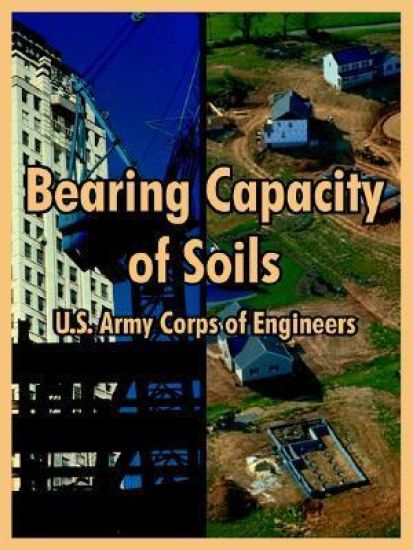
The purpose of this manual is to provide guidelines for calculation of the bearing capacity of soil under shallow and deep foundations supporting various types of structures and embankments. This manual is intended as a guide for determining allowable and ultimate bearing capacity. It is not intended to replace the judgment of the design engineer on a particular project. Principles for evaluating bearing capacity presented in this manual are applicable to numerous types of structures such as buildings and houses, towers and storage tanks, fills, embankments and dams. These guidelines may be helpful in determining soils that will lead to bearing capacity failure or excessive settlements for given foundations and loads.
The Unified Facilities Criteria (UFC) system is prescribed by MIL-STD 3007 and provides planning, design, construction, sustainment, restoration, and modernization criteria, and applies to the Military Departments, the Defense Agencies, and the DoD Field Activities in accordance with USD(AT&L) Memorandum dated 29 May 2002. UFC will be used for all DoD projects and work for other customers where appropriate. All construction outside of the United States is also governed by Status of Forces Agreements (SOFA), Host Nation Funded Construction Agreements (HNFA), and in some instances, Bilateral Infrastructure Agreements (BIA). Therefore, the acquisition team must ensure compliance with the more stringent of the UFC, the SOFA, the HNFA, and the BIA, as applicable. UFC are living documents and will be periodically reviewed, updated, and made available to users as part of the ServicesO responsibility for providing technical criteria for military construction.
The overall objective of this manual is to provide risk assessors with the recommended basic/minimum requirements for developing scopes of work, evaluating Architect-Engineer (A-E) prepared human health risk assessments, and documenting risk management options associated with Hazardous, Toxic, and Radioactive Waste (HTRW) investigations, studies, and designs consistent with principles of good science in defining the quality of risk assessments. This EM is intended for use by U. S. Army Corps of Engineers (USACE) Project Managers, technical personnel, and contractor personnel.
This circular provides United States Army Corps of Engineers (USACE) guidance for incorporating the direct and indirect physical effects of projected future sea-level change in managing, planning, engineering, designing, constructing, operating, and maintaining USACE projects and systems of projects. Recent climate research by the Intergovernmental Panel on Climate Change (IPCC) predicts continued or accelerated global warming for the 21st Century and possibly beyond, which will cause a continued or accelerated rise in global mean sea-level. Impacts to coastal and estuarine zones caused by sea-level change must be considered in all phases of Civil Works programs.
Risk involves exposure to a chance of injury or loss. The fact that risk inherently involves chance leads directly to a need to describe and to deal with uncertainty. Corps policy has long been (1) to acknowledge risk and the uncertainty in predicting floods and flood impacts, and (2) to plan accordingly. Historically, that planning relied on analysis of the expected long-term performance of flood-damage-reduction measures, on application of safety factors and freeboard, on designing for worst-case scenarios, and on other indirect solutions to compensate for uncertainty. These indirect approaches were necessary because of the lack of technical knowledge of the complex interaction of uncertainties in predicting hydrologic, hydraulic, and economic functions and because of the complexities of the mathematics required to do otherwise.
Since the U. S. Department of the Army (through the U. S. Army Corps of Engineers), U. S. Department of Energy (through the Office of Energy Efficiency and Renewable Energy), and U. S. Department of the Interior (through the Bureau of Reclamation) signed their Memorandum of Understanding (MOU) for Hydropower in 2010, these agencies have endeavored to advance their mutual goals for greater development and utilization of clean, reliable, cost-effective, and sustainable hydropower generation in the U. S. This Action Plan renews the commitments of the three agencies to the 2010 MOU and details the second phase of collaboration, which seeks to support the Administration's goals for doubling renewable energy generation by 2020 and improving federal permitting processes for clean energy as established in the President's Climate Action Plan. Through continued collaboration and partnerships with other federal agencies, the hydropower industry, the research community, and numerous stakeholders, these agencies intend to continue working toward the objectives and goals of the MOU. The MOU agencies have complementary and overlapping roles in the domain of hydropower research, planning, development, and operations. This Action Plan provides a structure for collaborative activities that clarifies those roles and enhances the efficiency and benefits of coordinated activities in the following areas: (a) Technology Development, (b) Asset Management, (c) Hydropower Sustainability, (d) Quantifying Hydropower Capabilities and Value in Power Systems, and (e) Information Sharing, Coordination, and Strategic Planning. The sections that follow describe the roles of the MOU agencies in each of these areas and the specific action items on which the MOU agencies plan to collaborate to accomplish their goals.