Kirjojen hintavertailu – 12 903 725 kirjaa ja 27 kauppaa

Kirjailija

U S Army

Kirjat ja teokset yhdessä paikassa: 81 kirjaa, julkaisuja vuosilta 1968–2024, suosituimpiin kuuluu U.S. Army Anti-Guerrilla Warfare Manual. Vertaile teosten hintoja ja tarkista saatavuus suomalaisista kirjakaupoista.

Nimi esiintyy myös muodoissa: U. S. Army, U.S. Army

81 kirjaa

Kirjojen julkaisuvuodet: 1968–2024.

BIOMETRICS Multi-Service Tactics, Techniques, and Procedures for Tactical Employment of Biometrics in Support of Operations

BIOMETRICS Multi-Service Tactics, Techniques, and Procedures for Tactical Employment of Biometrics in Support of Operations

U. S. Army; U. S. Navy; U. S. Air Force

Createspace Independent Publishing Platform
2015
nidottu
This publication provides a standardized multi-Service framework for planning, integrating, and employing biometrics data collection efforts by tactical units designed to improve data quality and maximize system capability in direct support of military operations. It provides small unit leaders and collectors a clear, fundamental understanding of the impact accurate and valid data has on the overall biometrics process. Also, it provides planning considerations for enrollment site selection and procedures designed to maximize data quality. This publication: - Supplements established doctrine and TTP.- Describes the impact of properly collecting biometrics on operations.- Provides a detailed explanation of procedures.- Provides information to effectively organize, plan, and execute biometrics data collection employment in a multi-Service environment.

DWIGHT D. EISENHOWER National Security Conference 2005

DWIGHT D. EISENHOWER National Security Conference 2005

U. S. Army

Createspace Independent Publishing Platform
2014
nidottu
As the global war on terrorism enters its fifth year, the efforts of that struggle are beginning to bear fruit. Although democratic elections in Iraq and Afghanistan represent hope for the future, our nation faces grave threats from around the world. Finding answers demands a unique and informed approach. The 2005 Eisenhower National Security Conference, the culminating event of the 2005 Dwight D. Eisenhower National Security Series, was held September 27-28 in the Ronald Reagan Building and International Trade Center, Washington, D. C. The conference presentations and discussions worked to accomplish several objectives: Provide a broad and unique forum to discuss and debate contemporary and future national security issues; Examine and advance ways to focus the instruments of national power more effectively; and Contribute to the ongoing national security dialogue while broadening the experience of midlevel and senior Army leaders through exposure to diverse issues, institutions, and perspectives. Five addresses challenged the participants with diverse viewpoints, which provided for a balanced and informative discussion. The five distinguished speak-ers were His Royal Highness Prince El Hassan bin Talal of Jordan; Hernando de Soto, president, Institute for Liberty and Democracy; Eliot Cohen, Ph. D., Robert E. Osgood professor of strategic studies, director of the Philip Merrill Center for Strategic Studies, Paul H. Nitze School of Advanced International Studies, Johns Hopkins University; Ambassador Carlos Pascual, coordinator, Office of Reconstruc-tion and Stabilization, Department of State; and U. S. Representative Ike Skelton (D-MO), ranking member, House Armed Services Committee
Dwight D. Eisenhower National Security Conference 2003

Dwight D. Eisenhower National Security Conference 2003

U. S. Army

Createspace Independent Publishing Platform
2014
nidottu
The 2003 Dwight D. Eisenhower National Security Conference was held September 25-26. The conference presentations and discussions worked to accomplish several objectives: Provide a broad and unique forum to discuss and debate contemporary and future national security issues; Examine and advance ways to focus the instruments of national power more effectively; and Contribute to the ongoing national security dialogue while broadening the experience of midlevel and senior Army leaders through exposure to diverse issues, institutions, and perspectives
Center of Military History Style

Center of Military History Style

U. S. Army

Createspace Independent Publishing Platform
2014
nidottu
This Book will help with:1. Names and Terms2. Punctuation3. Spelling, Abbreviations, Compounds, and Distinctive Treatment of Words4. Geographic Terms5. Numbers6. Dates, Time, and Measurements7. Tables, Charts, Maps, and Photographs8. Documentation9. Front and Back Matter10. Indexes
Operations of Encircled Forces: German Experiences in Russia
Your units are surrounded: what next? This book was prepared by a committee of former German officers under the supervision of the U. S. Army's Historical Division. Among the contributors were former corps commanders and general staff officers at corps, army, and army group level, who had extensive experience on the Russian front during the period 1941-45. In addition to discussing the tactical and logistical problems peculiar to operations of encircled forces, the authors take issue with Hitler's conviction that significant advantages can be gained by leaving isolated forces behind the advancing enemy lines. Rich in anecdotes, this volume was written by Germans from the German point of view and is presented without interpretation. Out of print since 1952, this edition is lavishly illustrated, including maps. This is not a facsimile reprint but newly typeset in a modern book design.
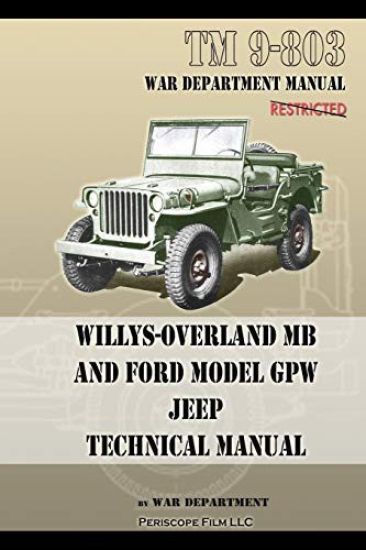
TM 9-803 Willys-Overland MB and Ford Model GPW Jeep Technical Manual
Designated as a light truck, the Jeep was the primary four-wheel drive vehicle for the U. S. Army during WWII. The Jeep's design owed a great deal to Karl Probst, a freelance designer employed by the American Bantam Car Co. Probst's prototype "Blitz Buggy" was built in a mere 49 days. It clearly impressed the Army in head-to-head competition against a design submitted by Willys-Overland. However the Buggy's engine failed to meet requirements, and the Army determined that Bantam could not produce the vehicle in quantity. As a result, the Army bought the Bantam design and asked both Willys and Ford to improve it. The Willys model MB, equipped with a L134 straight-4 "Go Devil"engine, was eventually accepted as the standard. Ford models built to Willys specifications were designated GPW ("G" for government vehicle, "P" designating the 80" wheelbase, and "W" indicating the Willys engine design). (Notably, the "GP" part of the designation is often misinterpreted to mean "General Purpose", and some have suggested this is the reason the vehicle wasnick-named the "Jeep". In reality it was probably named after a character in the Popeye cartoons). Roughly 640,000 Jeeps were built during WWII by Ford and Willys, and used on every front. Utilitarian, rugged, and easy to maintain, Jeeps saw service as scout cars, ambulances, firefighting vehicles, as tractors for artillery, and more. The vehicle so impressed war correspondent Ernie Pyle that he called it one of the "two most important pieces of non-combat equipment ever developed" - the other being the pocket stove. Jeeps remained in service for the U. S. military in Korea and in the Vietnam War. Created in 1944, this technical manual reveals a great deal about the Jeep's design and capabilities. Intended as a manual for those charged with operation and maintenance, this manual shows many aspects of its engine, cooling, power, drive train and other systems. Originally labeled restricted, this manual was declassified long ago and is here reprinted in book form. Care has been taken to preserve the integrity of the text.
Small Group Instructor Training Course (SGITC): Volume 2: Training Support Packages
The United States Army is recognized internationally as the standard for complete, efficient and effective adult education. The Army has a tradition of pioneering training systems (including computer-based training) that then transition into the corporate sector. This manual has been continuously tested and updated to successfully educate every member of the modern United States Army. The needs of the instructor, the student, and the Army are perfectly balanced. This is the model all educators should follow when developing and delivering training programs. This book is Volume 2 of a 2 volume set and provides an example of how training materials should be designed and delivered for any adult education training program, but especially for any industry that is subject to government regulation. Included Documents and Features: - Overhead Presentation Slides and Student Handouts - Lesson 1: Orientation - Lesson 2: Roles/Responsibilities/Definitions - Group Consensus Exercise (Problem with SGI) - Lesson 3: Group Development - Behavioral Change Chart - Exercise B: Leadership Decision Matrix - Exercise C: Active Listening Exercise - Exercise E: Johari Window Self-Rating Sheet - Lesson 4: Experiential Learning Cycle - The Experiential Learning Model (Blank) - The Experiential Learning Model (Complete) - ELC Questions - Lesson 5: Intervention - Situation 1 - Instructor Qualifications - Situation 2 - War Stories and "Bull Sessions - Situation 3 - Nonparticipation - Situation 4 - Late Student - Situation 5 - The "Angry Huff" - Situation 6 - Les Miserables - Situation 7 - The Filibuster - Situation 8 - The "Corrector" - Situation 9 - "I Agree" - Situation 10 - Critique - Situation 11 - Attack - Situation 12 - Delay - Situation 13 - Self-worth - Situation 14 - Group Norms - Situation 15 - Adam Ant - Lesson 6: Leaderless Discussions - Rules for the Generating Phase of Brainstorming - Rules for Evaluating Phase of Brainstorming - Performance Evaluation Checklist - Performance Evaluation Checklist - Performance Evaluation Checklist - Lesson 7: The Conference - Performance Evaluation Checklist - Lesson 8: Role Playing - The Situation - Observer's Worksheet - Performance Evaluation Checklist - Lesson 9: Committee Problem Solving - Committee Problem Solving-Training Development Exercise - Performance Evaluation Checklist - Lesson 10: Case Studies - Basic Training Instructions: Group Discussion - Basic Training Reading - Performance Evaluation Checklist - Performance Evaluation Checklist - Team Instruction Sheet - Performance Evaluation Checklist
Small Group Instructor Training Course (SGITC): Volume 1: Course Management Plan and Student Handbook
The United States Army is recognized internationally as the standard for complete, efficient and effective adult education. The Army has a tradition of pioneering training systems (including computer-based training) that then transition into the corporate sector. This manual has been continuously tested and updated to successfully educate every member of the modern United States Army. The needs of the instructor, the student, and the Army are perfectly balanced. This is the model all educators should follow when developing and delivering training programs. This book is Volume 1 of a 2 volume set and provides an example of how training materials should be designed and delivered for any adult education training program, but especially for any industry that is subject to government regulation. Included Documents and Features: 1. Course Management Plan - Overview - Administrative Data - Course Map - Training Facility Requirements - Planning - Instructional Guidance - Student Evaluation Plan - Appendix A: Program of Instruction - Appendix B: Course Management Forms - Appendix C: Course Critique - Appendix D: Student Advance Sheets - Appendix E: Course Schedule - Appendix F: Seating Charts - Appendix G: Course Summary - Appendix H: VTT Suite Equipment 2. Student Handbook - Student Advance Sheet - Student Reference 1. Orientation 2. Experiential Learning Cycle 3. Group Development, Consensus, and Feedback 4. Interventions 5. Johari Window 6. Small Group Instruction: Theory and Practice - Student Guide - Lesson 1: Orientation - Lesson 2: Roles/Responsibilities/Definitions - Lesson 3: Group Development - Lesson 4: Experiential Learning Cycle - Lesson 5: Intervention - Lesson 6: Leaderless Discussions - Lesson 7: The Conference - Lesson 8: Role Playing - Lesson 9: Committee Problem Solving - Lesson 10: Case Studies