Kirjojen hintavertailu – 12 903 725 kirjaa ja 27 kauppaa
Kirjailija
U. S. Department of Agriculture
Kirjat ja teokset yhdessä paikassa: 223 kirjaa, julkaisuja vuosilta 2001–2020, suosituimpiin kuuluu Homemade Jellies, Jams and Preserves: Farmers' Bulletin 1800. Vertaile teosten hintoja ja tarkista saatavuus suomalaisista kirjakaupoista.
Nimi esiintyy myös muodoissa: U S Department of Agriculture, U.S. Department of Agriculture
China's 2014/15 corn production is estimatedat 214.0 million tons, down 3.0 million tons or1.0 percent from last month and down 4.5million tons or 2.0 percent from last year'srecord crop. Area is estimated at 36.8 millionhectares, surpassing last year's record by 1.0percent. Area has shown a strong upward trendin recent years, particularly in Northeast China, as farmers have switched to corn from less profitable crops such as soybeans. Yield isestimated at 5.82 tons per hectare, down 1percent from last month and down 3.4 percentfrom last year's record. The revision is basedon information from crop models and satelliteimagery, and reports from local government and industry sources. A serious drought developed in July and August in parts of Northeast China and the North ChinaPlain. At its peak in late August, the drought affected approximately 5 million hectares of crops(mostly corn) in the critical reproductive/filling stage. Sharply lower yields have been reportedin some of the drought-impacted areas, particularly in Henan and Liaoning provinces
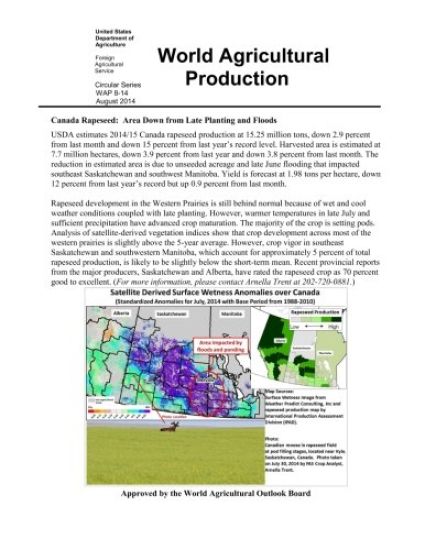
USDA estimates 2014/15 Canada rapeseed production at 15.25 million tons, down 2.9 percentfrom last month and down 15 percent from last year's record level. Harvested area is estimated at7.7 million hectares, down 3.9 percent from last year and down 3.8 percent from last month. Thereduction in estimated area is due to unseeded acreage and late June flooding that impactedsoutheast Saskatchewan and southwest Manitoba. Yield is forecast at 1.98 tons per hectare, down12 percent from last year's record but up 0.9 percent from last month. Rapeseed development in the Western Prairies is still behind normal because of wet and coolweather conditions coupled with late planting. However, warmer temperatures in late July andsufficient precipitation have advanced crop maturation. The majority of the crop is setting pods. Analysis of satellite-derived vegetation indices show that crop development across most of the western prairies is slightly above the 5-year average. However, crop vigor in southeastSaskatchewan and southwestern Manitoba, which account for approximately 5 percent of totalrapeseed production, is likely to be slightly below the short-term mean. Recent provincial reportsfrom the major producers, Saskatchewan and Alberta, have rated the rapeseed crop as 70 percent good to excellent.
Conquest of the Land through 7,000 Years" is Dr. Lowdermilk's personal report of a study he made in 1938 and 1939. Despite changes in names of countries, in political boundaries, and in conservation technology, the bulletin still has significance for all peoples concerned with maintaining and improving farm production. Dr. Lowdermilk studied the record of agriculture in countries where the land had been under cultivation for hundreds, even thousands, of years. His immediate mission was to find out if the experience of these older civilizations could help in solving the serious soil erosion and land use problems in the United States, then struggling with repair of the Dust Bowl and the Sullied South. He discovered that soil erosion, deforestation, overgrazing, neglect, and conflicts between cultivators and herdsman have helped topple empires and wipe out entire civilizations. At the same time, he learned that careful stewardship of the earth's resources, through terracing, croprotation, and other soil conservation measures, has enabled other societies to flourish for centuries. The Natural Resources Conservation Service has reprinted this bulletin without change to meet the continuing demand from teachers, clergymen, writers, college professors, garden clubs, environmental groups, and service organizations for copies of the report as originally written by Dr. Lowdermilk