Kirjojen hintavertailu – 12 903 725 kirjaa ja 27 kauppaa

Kirjailija

U. S. Department of Heal Human Services

Kirjat ja teokset yhdessä paikassa: 538 kirjaa, julkaisuja vuosilta 2012–2017, suosituimpiin kuuluu Treatment Choices for Men With Early-Stage Prostate Cancer. Vertaile teosten hintoja ja tarkista saatavuus suomalaisista kirjakaupoista.

538 kirjaa

Kirjojen julkaisuvuodet: 2012–2017.

National Healthcare Quality Report, 2012

National Healthcare Quality Report, 2012

Agency for Healthcare Resea And Quality; U. S. Department of Heal Human Services

Createspace Independent Publishing Platform
2014
nidottu
The U. S. health care system is designed to improve the physical and mental well-being of all Americans by preventing, diagnosing, and treating illness and by supporting optimal function. Across the lifespan, health care helps people stay healthy, recover from illness, live with chronic disease or disability, and cope with death and dying. Quality health care delivers these services in ways that are safe, timely, patient centered, efficient, and equitable. Unfortunately, Americans too often do not receive care they need, or they receive care that causes harm. Care can be delivered too late or without full consideration of a patient's preferences and values. Many times, our system of health care distributes services inefficiently and unevenly across populations. Some Americans receive worse care than others. These disparities may occur for a variety of reasons, including differences in access to care, social determinants, provider biases, poor provider-patient communication, and poor health literacy. Each year since 2003, the Agency for Healthcare Research and Quality (AHRQ) has reported on progress and opportunities for improving health care quality and reducing health care disparities. As mandated by the U. S. Congress, the National Healthcare Quality Report (NHQR) focuses on "national trends in the quality of health care provided to the American people". The National Healthcare Disparities Report (NHDR) focuses on "prevailing disparities in health care delivery as it relates to racial factors and socioeconomic factors in priority populations". As in previous years, we have integrated findings from the 2012 NHQR and NHDR to produce a single summary chapter. This is intended to reinforce the need to consider concurrently the quality of health care and disparities across populations when assessing our health care system. The National Healthcare Reports Highlights seeks to address three questions critical to guiding Americans toward the optimal health care they need and deserve: What is the status of health care quality and disparities in the United States? How have health care quality and disparities changed over time? Where is the greatest need to improve health care quality and reduce disparities? Three themes from the 2012 NHQR and NHDR emphasize the need to accelerate progress if the Nation is to achieve higher quality and more equitable health care in the near future: Health care quality and access are suboptimal, especially for minority and low-income groups; Overall quality is improving, access is getting worse, and disparities are not changing; Urgent attention is warranted to ensure continued improvements in: Quality of diabetes care, maternal and child health care, and adverse events; Disparities in cancer care; Quality of care among states in the South.
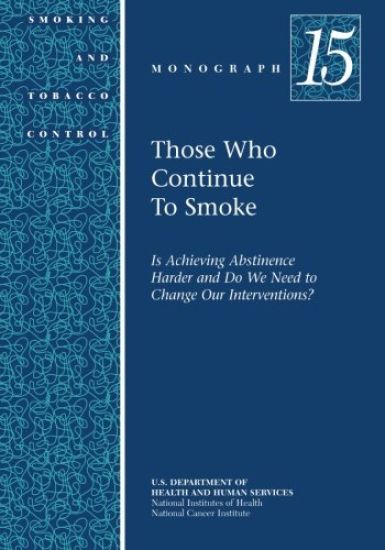
Those Who Continue to Smoke: Smoking and Tobacco Control Monograph No. 15

Those Who Continue to Smoke: Smoking and Tobacco Control Monograph No. 15

National Institutes of Health; National Cancer Institute; U. S. Department of Heal Human Services

Createspace Independent Publishing Platform
2014
nidottu
The decline in U. S. smoking prevalence since the publication of the first Surgeon General's Report in 1964 has been hailed as one of the greatest public health accomplishments of the past century. Forty four million Americans-almost half of those who ever smoked-have quit, and lung cancer death rates have decreased greatly as a result. As a nation, we've launched wide-reaching tobacco control programs in worksites, schools, communities, and all 50 states, and we've witnessed enormous shifts in social norms, policies, and public attitudes. Growth in clean indoor-air laws and smoking restrictions have made quit-smoking cues "persistent and inescapable", and new data shows that tobacco price increases and mass media cessation campaigns can significantly increase population quit rates. Over the last three decades, we have developed effective clinical treatments-psychosocial and pharmacological-and seen the publication and update of authoritative practice guidelines recommending evidence based treatments that, if universally applied, could double our national annual quit rate in a highly cost-effective way. Prospects for preventing and treating tobacco use and addiction have never been better. Yet the papers in this monograph, Those Who Continue to Smoke: Is Achieving Abstinence Harder and Do We Need to Change Our Interventions?, raise important questions about what it will take to build on the successes of the last century and, in particular, on the last few decades of research and practice. While efforts to promote tobacco cessation need to be part of a much broader national tobacco control strategy that emphasizes prevention, it is clear that the greatest gains in reducing tobacco-caused morbidity, mortality, and health care costs in the next 30 to 40 years will come from helping addicted smokers quit. Further declines in adult smoking are likely to strengthen prevention efforts as well, since adult smoking is a critical determinant of social norms and a vector for youth initiation. In this context, the findings presented in this monograph have important implications for the next generation of research and practice to help addicted smokers quit. Specifically, these papers and the findings they present indicate that helping more smokers quit will require: (1) developing more powerful treatments that can break through the 25% to 30% quit-rate ceiling achieved with our best existing treatments; (2) refining, targeting and tailoring treatments for high-risk populations; (3) greatly improving surveillance of quitting patterns and determinants; (4) developing combined clinical-public health approaches that harness synergies between evidence based clinical treatments, and macro-level policy and environmental cessation strategies; and (5) improving the use of and demand for treatments that work.