Kirjojen hintavertailu – 12 903 724 kirjaa ja 27 kauppaa
Kirjailija
U. S. Department of Interior
Kirjat ja teokset yhdessä paikassa: 21 kirjaa, julkaisuja vuosilta 2012–2015, suosituimpiin kuuluu Mourning Dove (Zenaida macroura) Harvest and Population Parameters Derived From a National Banding Study. Vertaile teosten hintoja ja tarkista saatavuus suomalaisista kirjakaupoista.
Since the U. S. Department of the Army (through the U. S. Army Corps of Engineers), U. S. Department of Energy (through the Office of Energy Efficiency and Renewable Energy), and U. S. Department of the Interior (through the Bureau of Reclamation) signed their Memorandum of Understanding (MOU) for Hydropower in 2010, these agencies have endeavored to advance their mutual goals for greater development and utilization of clean, reliable, cost-effective, and sustainable hydropower generation in the U. S. This Action Plan renews the commitments of the three agencies to the 2010 MOU and details the second phase of collaboration, which seeks to support the Administration's goals for doubling renewable energy generation by 2020 and improving federal permitting processes for clean energy as established in the President's Climate Action Plan. Through continued collaboration and partnerships with other federal agencies, the hydropower industry, the research community, and numerous stakeholders, these agencies intend to continue working toward the objectives and goals of the MOU. The MOU agencies have complementary and overlapping roles in the domain of hydropower research, planning, development, and operations. This Action Plan provides a structure for collaborative activities that clarifies those roles and enhances the efficiency and benefits of coordinated activities in the following areas: (a) Technology Development, (b) Asset Management, (c) Hydropower Sustainability, (d) Quantifying Hydropower Capabilities and Value in Power Systems, and (e) Information Sharing, Coordination, and Strategic Planning. The sections that follow describe the roles of the MOU agencies in each of these areas and the specific action items on which the MOU agencies plan to collaborate to accomplish their goals.
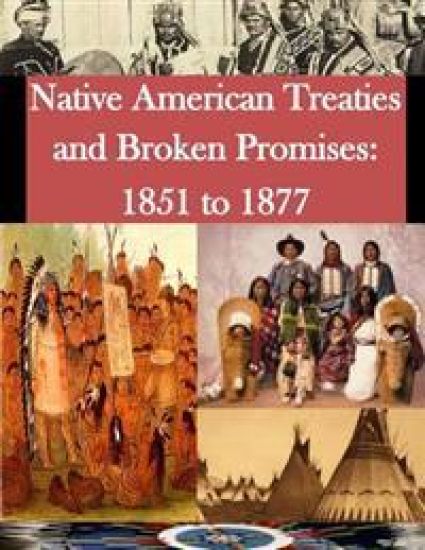
Although only a short span of time in the history of the Black Hills, the decades between 1851 and 1877 were momentous ones. This was a time when bison began to disappear from the Black Hills and the surrounding prairies, forcing local tribes to move even farther away to find good bison hunting grounds. By the 1860s, only a few areas in the Plains, including the Republican Fork and the Tongue/Powder river countries, held bison herds large enough to sustain a livelihood for the Lakotas, Cheyennes, and Arapahos who hunted there. This was also a period when the growing presence of foreigners created even more hardship for local tribes and when the United States entered into treaties with tribal nations that led to the relinquishment of large tracts of tribal territory. Most of all it was the era of the gold rush when American soldiers, scientists, prospectors, speculators, and settlers entered the Black Hills illegally and made claims on the land, eventually leading the United States to seize the area from the Lakotas, Cheyennes, and Arapahos: as the U. S. Court of Claims wrote in 1975, "a more ripe and rank case of dis-honorable dealings will never, in all probability be found in our history..." (quoted from Lazarus 1991:344). The history of the Black Hills between 1851 and 1877 is written from two very different, and at times antagonistic perspectives. On one side are the writings of Americans who were attempting to "civilize" local tribes, confine them to reservations and take possession of their lands. These records, which include the writings of soldiers, scientists, government agents, and early settlers, depict a history that ultimately favors and defends American expansionism and the taking of the Black Hills. On the other side are accounts by Indians as well as non-Indians, including traders and federal agents, who viewed the Black Hills in a light more sympathetic to tribal interests and traditions. Today, this divide persists in the various ways the history of the Hills is depicted and interpreted in the writings of contemporary scholars. While all history gets written from different, and at times contested, vantage points, the story of the Black Hills stands out be-cause it continues to be told in a context where questions of their "ownership" on historical, legal, political, cultural, and even religious grounds are still being challenged.
Part 1 of 2Chapters 1 through 11This study attempts to view Washington's activity in the siege of Boston based on what he and his colleagues knew in 1775-76, not through the hindsight of later developments. Most of the chapters, organized by themes rather than chronologically, lay out an alternative narrative of the general learning on the job. When George Washington came to Boston, he was forty-three years old. He had never led more than a few hundred soldiers, participated in a large siege, or been the commander-in-chief of an army. The campaign was therefore a learning experience for him. Because of the British commanders' lack of aggression, Washington's situation was actually much less risky than he feared. He was able to make mistakes and gain experience, whetherthe challenge was picking the right staff or maintaining strict secrecy on intelligence. As the siege of Boston began, the British army had several clear advantages: trained soldiers; weapons, gunpowder, and other military supplies; hard currency; and the support of a much stronger, larger navy. The Americans, on the other hand, had more men (though Washington did not always realize just how big his advantage was, and his army's numbers dipped low at the turn of the year); far better access to food, forage, and firewood; and enthusiastic civilian support. Each army's strengths corresponded to the other's weaknesses. The classic strategy for conducting a siege was to cut off the enemy troops' resources from outside while gradually hemming them into a smaller area. Both goals were close to impossible for the new American military. The strength of the Royal Navy and the resources of the royal government, once London bureaucrats learned that war had begun, meant thatthe British garrison inside Boston was relatively well supplied. Furthermore, that royal army had excellent natural and man-made defenses because it was situated on two narrow-necked peninsulas and a well-fortified island. The Continental Army was necessarily at a distance; short of heavy guns and powder, it could do little damage. Washington was eager to do something to win the campaign because of his active temperament, his desire to please the Continental Congress, and his hope for a decisive early victory that would convince the government in London to back down. But he could see only one basic strategy available: forcing a battle. Much of the general's activity during the siege was directed toward that goal. In 1775-76, Washington had not yet learned the value of simply keeping the Continental Army together until it wore out the enemy, a strategy that didnot bring him many glorious battlefield victories but in the end won the war.
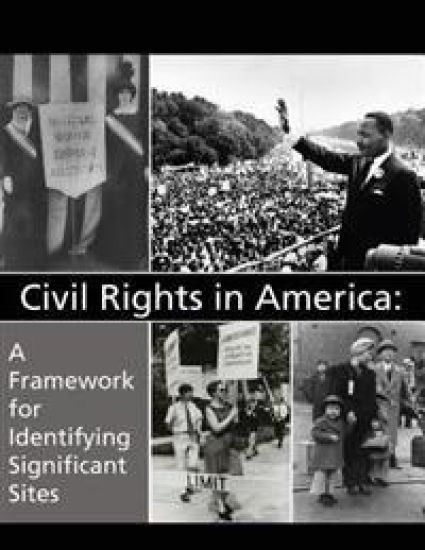
In November 1999, the U. S. Congress passed the National Park System New Area Study Act of 2000 (S. 1349) as contained in Public Law 106-113, Appendix C, "National Park Service Studies Act of 1999." The act instructed the Secretary of the Interior "to direct special resource studies to determine the national significance of the sites, and/or areas, listed in Section 5 of this Act todetermine the national significance of each site, and/or area, as well as the suitability and feasibility of their inclusion as units of the National Park System." Among the areas to be studied were "Civil Rights Sites" on a "multi-state" level. As part of its National Historic Landmarks program, the National Park Service in partnership with the Organization of American Historians (OAH) prepared this civil rights framework study to assist the National Park Service in identifying and prioritizing those areas of history significant in illustrating the civil rights story. Implementation of the framework's recommendations will help planners evaluate proposals by Congress and others for additions toboth the National Park System and the National Trails System, and will also assist the responsible authorities in states, federal agencies, and Indian tribes to identify sites for National Historic Landmarks designation. The period of significance for the study begins in 1776, when Thomas Jefferson wrote in the Declaration of Independence that "all men are created equal." The period ends in 1976, to include the growing civil rights movements of several minority groups in the dozen years following the passage of the Civil Rights Act of 1964. Before 1776, certainly, the rights of enslaved people, women, American Indians, and immigrants such as the Scots-Irish were routinely violated within the boundaries of the present United States, especially with respect to personal liberty, voting, educational opportunities, property ownership, and religious affiliation. During this period, however, such rights were subject not only to the laws of the mother country but also to the laws and judicial interpretations of the several colonies, some of which took a more liberal approach than did others. There was no national government to define or ensure civil rights, much less a national consensus about what those rights were. It was not until 1776 that a clear statement regarding civil rights rang out, in the words of the Declaration: "We hold these truths to be self-evident: That all men are created equal; that they are endowed by their Creator with certain inalienable rights; that among these are life, liberty, and the pursuit of happiness." Although Thomas Jefferson's words have sometimes seemed to ring hollow, they nonetheless constitute one of America's shining ideals-an inspiration to the world-that all citizens have equal rights and stand equal before the law.
Part 2 of 2Chapters 12 through The EndThis study attempts to view Washington's activity in the siege of Boston based on what he and his colleagues knew in 1775-76, not through the hindsight of later developments. Most of the chapters, organized by themes rather than chronologically, lay out an alternative narrative of the general learning on the job. When George Washington came to Boston, he was forty-three years old. He had never led more than a few hundred soldiers, participated in a large siege, or been the commander-in-chief of an army. The campaign was therefore a learning experience for him. Because of the British commanders' lack of aggression, Washington's situation was actually much less risky than he feared. He was able to make mistakes and gain experience, whetherthe challenge was picking the right staff or maintaining strict secrecy on intelligence. As the siege of Boston began, the British army had several clear advantages: trained soldiers; weapons, gunpowder, and other military supplies; hard currency; and the support of a much stronger, larger navy. The Americans, on the other hand, had more men (though Washington did not always realize just how big his advantage was, and his army's numbers dipped low at the turn of the year); far better access to food, forage, and firewood; and enthusiastic civilian support. Each army's strengths corresponded to the other's weaknesses. The classic strategy for conducting a siege was to cut off the enemy troops' resources from outside while gradually hemming them into a smaller area. Both goals were close to impossible for the new American military. The strength of the Royal Navy and the resources of the royal government, once London bureaucrats learned that war had begun, meant thatthe British garrison inside Boston was relatively well supplied. Furthermore, that royal army had excellent natural and man-made defenses because it was situated on two narrow-necked peninsulas and a well-fortified island. The Continental Army was necessarily at a distance; short of heavy guns and powder, it could do little damage. Washington was eager to do something to win the campaign because of his active temperament, his desire to please the Continental Congress, and his hope for a decisive early victory that would convince the government in London to back down. But he could see only one basic strategy available: forcing a battle. Much of the general's activity during the siege was directed toward that goal. In 1775-76, Washington had not yet learned the value of simply keeping the Continental Army together until it wore out the enemy, a strategy that didnot bring him many glorious battlefield victories but in the end won the war.
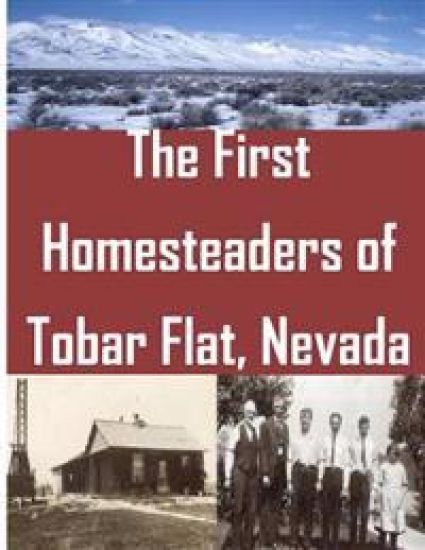
This collection of essays focuses on the Flat's first settlers: those who were on the land before the end of 1910. It describes their lives before they settled here, examines their activities during the years that they were on the land, and follows them after they left the area. It is not a standard compilation of complete life histories, however, for it concentrates heavily on the relatively short periods of time when these individuals and families were residents of Tobar Flat. Itintegrates biography with the area's geography and history, in essence weaving these elements into geo-historical treatments of the men, women, and children who dared to venture into a land that promised little, and delivered even less.
As part of its regular program to provide timely information on domestic mineral commodities, the Bureau of Mines conducted an engineering appraisal of more than 1,300 lode and placer gold deposits in the United States to determine their gold production potential. While these deposits were estimated to contain over 400 million ounces of gold, only 9 million ounces, or slightlymore than 2 percent, was found to be producible at $35 per ounce under prevailing mining and metallurgical technologies. The study revealed that any significant increase in available gold in the United States is most likely to come from the discovery of new sources, intensive exploration and development of the more promising known mineralized areas, and development of new or improved mining and metallurgical techniques.
The purpose of this document is to identify migratory and non-migratory birds of the United States and its territories that are of conservation concern so as to stimulate coordinated and proactive conservation actions among Federal, State, Tribal, and private partners. The conservation concerns may be the result of population declines, naturally or human-caused small ranges or population sizes, threats to habitat, or other factors. The primary statutory authority for Birds of Conservation Concern 2008 (BCC 2008) is the Fish and Wildlife Conservation Act of 1980 (FWCA), as amended; other authorities include the Endangered Species Act (ESA) of 1973, the Fish and Wildlife Act of 1956, and 16 U. S. C. 701. The 1988 amendment (Public Law 100-653, Title VIII) to the FWCA requires the Secretary of the Interior, through the United States Fish and Wildlife Service (USFWS), to "identify species, subspecies, and populations of all migratory nongame birds that, without additional conservation actions, are likely to become candidates for listing under the Endangered Species Act of 1973." BCC 2008 is the most recent effort by the USFWS to carry out this proactive conservation mandate and update Birds of Conservation Concern 2002 (USFWS 2002). The overall goal of this report is to accurately identify those species (beyond those already federally listed as threatened or endangered) in greatest need of conservation action at three different geographic scales. A primary goal of the USFWS is to conserve avian diversity in North America (USFWS 1990, 2004). This goal includes reducing or removing threats that may necessitate that a species be considered for listing under the ESA. The Birds of Conservation Concern are largely a subset of a larger list known as the Birds of Management Concern (BMC). The BMC is a subset of all species protected by the Migratory Bird Treaty Act (MBTA, see 50 CFR 10.13), and includes those which pose special management challenges due to a variety of factors (e.g., too few, too many, conflicts with human interests, or societal demands) (USFWS 2004). The BMC includes both game birds below their desired condition and nongame birds. As indicated in its strategic plan (USFWS 2004), the Migratory Bird Program places priority emphasis on these birds in its activities. The philosophy underlying this report is that proactive bird conservation is necessary at a time when human impacts are at an all-time high. We strongly believe that a well-designed program that addresses resource-management issues up front will prevent or remove the need to consider listing species as threatened or endangered, and will promote and conserve long-term avian diversity in the United States. In addition, proactive conservation clearly is more cost-effective than the extensive recovery efforts required once a species is federally listed under the ESA. Our intent is for BCC 2008 to stimulate coordinated efforts to develop and implement comprehensive and integrated approaches for the study, management, and protection of "non-ESA listed" bird species deemed to be in the most need of additional conservation actions. It should also be noted that, while the inclusion of native species not listed under the MBTA is beyond the scope of the FWCA, the USFWS has an incentive to encourage proactive management of these species by State agencies and other partners to prevent the need for listing them as endangered or threatened.
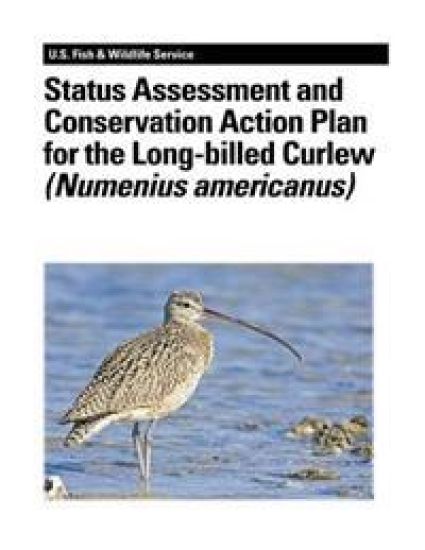
The historical breeding range of Long-billed Curlews (Numenius americanus) was the western U. S. and the southern Canadian Prairie Provinces from California north to British Columbia and east to southern Manitoba and Wisconsin, northern Iowa and eastern Kansas. However, this breeding distribution has contracted and Long-billed Curlews have lost about 30% of their historical range. The eastern edge of the current breeding range is the western Great Plains from the Texas panhandle north throughout southwestern and south central Saskatchewan. Long-billed Curlews currently winter along the southwestern U. S. coast from central California, southern Texas and Louisiana south along both of M xico's coasts to Guatemala, and are casual along the Atlantic coast north to New Brunswick, the southeastern South Carolina and Florida coasts, and the West Indies. Long-billed Curlews are federally protected in the U. S., Canada, and M xico under the Migratory Bird Treaty Act. In the U. S., they are listed as a U. S. Fish and Wildlife Service Bird of Conservation Concern: nationally, in five U. S. Fish and Wildlife Service regions, and in several Bird Conservation Regions. They are listed as a species of concern in several U. S. states. In Canada, they are on Schedule 1 of the Species at Risk Act as a "Species of Special Concern" and are "Blue Listed" in Alberta and British Columbia. In addition, they are listed as "Highly Imperiled" in both the U. S. and Canadian shorebird conservation plans. Long-billed Curlews are a protected migratory bird species but do not have an official conservation designation in M xico. The high levels of concern are due to the loss of the eastern third of their historical breeding range and apparent population declines, particularly in the shortgrass and mixed-grass prairies of the western Great Plains. The Breeding Bird Survey does not show any significant trends for Long-billed Curlews throughout much of their range; however, the applicability of BBS to adequately monitor Longbilled Curlews has been questioned. Documented declines have occurred in several portions of their range, including historical population declines, the contraction of breeding range, and reductions in the number of migrants along the Atlantic coast. Initial population declines were attributed to over-hunting and plowing of the native prairies for agriculture. Current threats include habitat loss and destruction due to urban development, grassland conversion for agricultural purposes, changes in the natural fire regime and the spread of exotic invasive species. Predation, grazing practices, energy development, diseases, and pesticides may also threaten Longbilled Curlew populations. Long-billed Curlews breed, migrate, and winter across multiple geographical ranges; therefore, effective conservation actions will require cooperation by local, regional, and international entities. Several important steps have been taken towards identifying limiting factors affecting Longbilled Curlew populations. Current conservation needs include: population monitoring, breeding ground studies that identify local micro-habitat use, and identification of critical wintering and migration areas. The development and use of management recommendations for maintaining native grasslands, invasive species control, and water and wetland conservation are also important to the maintenance of Long-billed Curlew populations. Investigation of the effects of energy development and subsequent operations is increasingly important as the demand for alternative "green" energy sources increases. Public outreach will continue to be an important tool in the conservation of Long-billed Curlew populations. Currently, while there are very few specific Long-billed Curlew management and conservation projects on-going, there are many identified needs. This status assessment and conservation action plan is intended to be a summary of the current state of the species, and a guide to its conservati