Kirjojen hintavertailu – 12 903 725 kirjaa ja 27 kauppaa
Kirjailija
Ulf Grenander
Kirjat ja teokset yhdessä paikassa: 11 kirjaa, julkaisuja vuosilta 1977–2013, suosituimpiin kuuluu Statistical Analysis of Stationary Time Series. Vertaile teosten hintoja ja tarkista saatavuus suomalaisista kirjakaupoista.
Toeplitz Forms And Their Applications is a comprehensive book written by Ulf Grenander, a renowned mathematician. The book is a part of the California Monographs In Mathematical Sciences series and is aimed at students, researchers, and professionals in the field of mathematics. The book covers the theory and application of Toeplitz forms, which are matrices with constant diagonals. The author explains the properties and characteristics of Toeplitz forms, including their eigenvalues, eigenvectors, and inverses. The book also covers the various methods and techniques used to solve problems involving Toeplitz forms. The author provides a detailed analysis of the applications of Toeplitz forms in various fields, including signal processing, image processing, and quantum mechanics. The book also includes numerous examples and exercises to help readers understand the concepts and techniques presented. Overall, Toeplitz Forms And Their Applications is an essential reference for anyone interested in the theory and application of Toeplitz forms. The book is well-written, easy to understand, and provides a comprehensive overview of the subject matter. Additional Editors Are Jerzy Neyman And Michel Loeve. This scarce antiquarian book is a facsimile reprint of the old original and may contain some imperfections such as library marks and notations. Because we believe this work is culturally important, we have made it available as part of our commitment for protecting, preserving, and promoting the world's literature in affordable, high quality, modern editions, that are true to their original work.
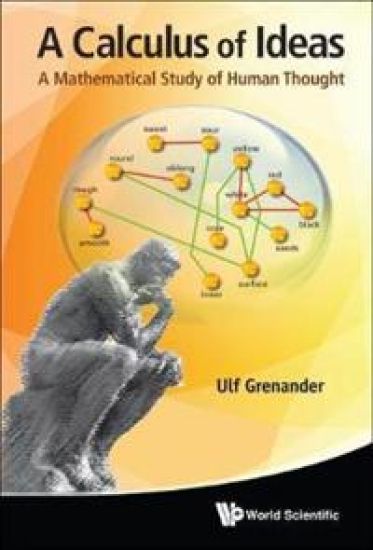
This monograph reports a thought experiment with a mathematical structure intended to illustrate the workings of a mind. It presents a mathematical theory of human thought based on pattern theory with a graph-based approach to thinking. The method illustrated and produced by extensive computer simulations is related to neural networks. Based mainly on introspection, it is speculative rather than empirical such that it differs radically in attitude from the conventional wisdom of current cognitive science.
Written in the terminology of the theoretical statistician, this book presents an approach to time series analysis. It presents a unified treatment of methods that are being used in the physical sciences and technology.
Pattern Theory provides a comprehensive and accessible overview of the modern challenges in signal, data, and pattern analysis in speech recognition, computational linguistics, image analysis and computer vision. Aimed at graduate students in biomedical engineering, mathematics, computer science, and electrical engineering with a good background in mathematics and probability, the text includes numerous exercises and an extensive bibliography. Additional resources including extended proofs, selected solutions and examples are available on a companion website. The book commences with a short overview of pattern theory and the basics of statistics and estimation theory. Chapters 3-6 discuss the role of representation of patterns via condition structure. Chapters 7 and 8 examine the second central component of pattern theory: groups of geometric transformation applied to the representation of geometric objects. Chapter 9 moves into probabilistic structures in the continuum, studying random processes and random fields indexed over subsets of Rn. Chapters 10 and 11 continue with transformations and patterns indexed over the continuum. Chapters 12-14 extend from the pure representations of shapes to the Bayes estimation of shapes and their parametric representation. Chapters 15 and 16 study the estimation of infinite dimensional shape in the newly emergent field of Computational Anatomy. Finally, Chapters 17 and 18 look at inference, exploring random sampling approaches for estimation of model order and parametric representing of shapes.
Pattern Theory: From Representation to Inference provides a comprehensive and accessible overview of the modern challenges in signal, data and pattern analysis in speech recognition, computational linguistics, image analysis and computer vision. Aimed at graduate students in biomedical engineering, mathematics, computer science and electrical engineering with a good background in mathematics and probability, the text includes numerous exercises and an extensive bibliography. Additional resources including extended proofs, selected solutions and examples are available on a companion website. The book commences with a short overview of pattern theory and the basics of statistics and estimation theory. Chapters 3-6 discuss the role of representation of patterns via conditioning structure and Chapters 7 and 8 examine the second central component of pattern theory: groups of geometric transformation applied to the representation of geometric objects. Chapter 9 moves into probabilistic structures in the continuum, studying random processes and random fields indexed over subsets of Rn, and Chapters 10, 11 continue with transformations and patterns indexed over the continuum. Chapters 12-14 extend from the pure representations of shapes to the Bayes estimation of shapes and their parametric representation. Chapters 15 and 16 study the estimation of infinite dimensional shape in the newly emergent field of Computational Anatomy, and finally Chapters 17 and 18 look at inference, exploring random sampling approaches for estimation of model order and parametric representing of shapes.
Deals with the theory of Toeplitz forms. This work also focuses on applications, in particular to the calculus of probability and mathematical statistics. It intends to elucidate the principal ideas of this chapter of modern analysis and to help the interested student of mathematical statistics to acquire a working knowledge of the subject.
The aim of pattern theory is to create mathematical knowledge representations of complex systems, analyse the mathematical properties of the resulting regular structures, and to apply them to practically occuring patterns in nature and the man-made world. Starting from an algebraic formulation of such representations they are studied in terms of their topological, dynamical and probabilistic aspects. Patterns are expressed through their typical behaviour as well as through their variability around their typical form. Employing the representations (regular structures) algorithms are derived for the understanding, recognition, and restoration of observed patterns. The algorithms are investigated through computer experiments.
In this book a global shape model is developed and applied to the analysis of real pictures acquired with a visible light camera under varying conditions of optical degradation. Computational feasibility of the algorithms derived from this model is achieved by analytical means. The aim is to develop methods for image understanding based on structured restoration, for example automatic detection of abnormalities. We also want to find the limits of applicability of the algorithms. This is done by making the optical degradations more and more severe until the algorithms no longer succeed in their task. This computer experiment in pattern theory is one of several. The others, LEAVES, X-RAYS, and RANGE are described elsewhere. This book is suitable for an advanced undergraduate or graduate seminar in pattern theory, or as an accompanying book for applied probability, computer vision, or pattern recognition.
From the Preface (1955): The first part of the present exposition is devoted to the theory of Toeplitz forms. The second part deals with applications, in particular to the calculus of probability and mathematical statistics. Neither part claims completeness in any way. Our purpose has been to elucidate the principal ideas of this remarkable chapter of modern analysis and to help the interested student of mathematical statistics to acquire a working knowledge of the subject. The somewhat protracted Chapter 1 explains not only the notation employed but contains also the definition of important auxiliary concepts and the exposition of basic results which will be used later. This arrangement avoids interruptions in the main text ... [It is assumed] that the reader is in possession of the fundamental facts of the theory of functions. ""In chapters 2 and 3 certain topics appear which were treated in the book on orthogonal polynomials by G. Szego. In view of the progress made in this subject since the publication of that book (1939) it was possible to bring some details in an improved setting. The other chapters contain partly old and partly more recent results, some older facts in a new setting, and finally some completely new results. Chapter 1-6 and Chapter 9 have been prepared by Szego, the other chapters by Grenander ...""
This book arose out of a number of different contexts, and numerous persons have contributed to its conception and development. It had its origin in a project initiated jointly with the IBM Cambridge Scien tific Center, particularly with Dr. Rhett Tsao, then of that Center. We are grateful to Mr. Norman Rasmussen, Manager of the IBM Scientific Center Complex, for his initial support. The work is being carried on at Brown University with generous support from the Office of Computing Activities of the National Science Foundation (grants GJ-174 and GJ-7l0); we are grateful to Dr. John Lehmann of this Office for his interest and encouragement. Professors Donald McClure and Richard Vitale of the Division of Applied Mathematics at Brown University contributed greatly to the project and taught courses in its spirit. We are indebted to them and to Dr. Tore Dalenius of the University of Stockholm for helpful criticisms of the manuscript. The final stimulus to the book's completion came from an invLtation to teach a course at the IBM European Systems Research Institute at Geneva. We are grateful to Dr. J. F. Blackburn, Director of the Institute, for his invitation, and to him and his wife Beverley for their hospitality. We are greatly indebted to Mrs. Katrina Avery for her splendid secretarial and editorial work on the manuscript.