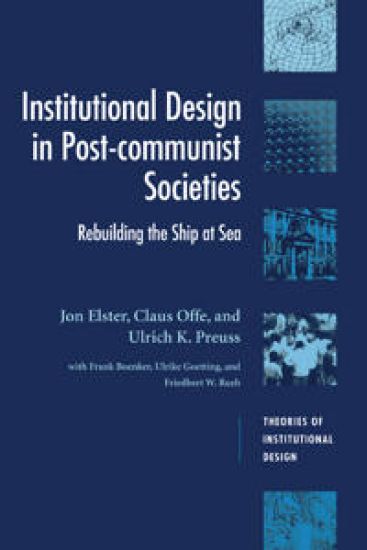
Kirjojen hintavertailu – 12 903 725 kirjaa ja 27 kauppaa

Kirjailija

Ulrich K. Preuss

Kirjat ja teokset yhdessä paikassa: 4 kirjaa, julkaisuja vuosilta 1998–2016, suosituimpiin kuuluu Citizens in Europe. Vertaile teosten hintoja ja tarkista saatavuus suomalaisista kirjakaupoista.

4 kirjaa

Kirjojen julkaisuvuodet: 1998–2016.

Citizens in Europe

Citizens in Europe

Claus Offe; Ulrich K. Preuss

ECPR Press
2016
sidottu
This interdisciplinary collection of essays by a constitutionalist and a political sociologist examines how fragmented societies can be held together by appropriate and effective constitutional arrangements providing for bonds of democratic citizenship. Exploring the political order dilemmas of capitalist democracies, the authors address moral and institutional prerequisites on which the deepening of European integration depends. The desirability of such deepening is currently contested, with the membership of some states (and their compliance with the spirit of the Union's treaties) at stake. The authors do not consider the `renationalisation’ of Europe to be a feasible (and even less so a desirable) way out of Europe's current malaise. Yet whatever the way out, charting it calls not just for the vision and imagination of political elites but also for the intellectual efforts of social scientists. With this book, Preuß and Offe contribute to those efforts. Key Features: • original insights on the nature of the European crisis • analysis of how fragmented societies can be held together by appropriate constitutional arrangements • how state sovereignty and federal structures can be merged • account of the moral prerequisites and resources of democratic polities • dilemmas of political order under democratic capitalism
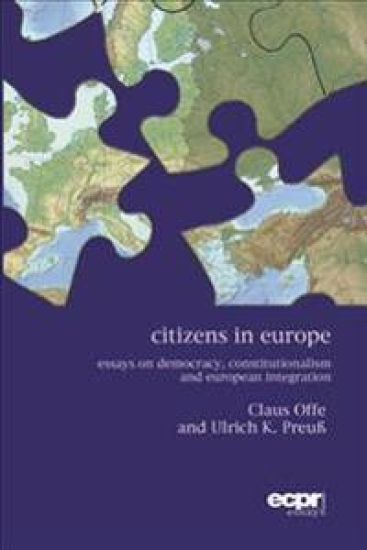
Citizens in Europe

Citizens in Europe

Claus Offe; Ulrich K. Preuss

ECPR Press
2016
nidottu
This interdisciplinary collection of essays by a constitutionalist and a political sociologist examines how fragmented societies can be held together by appropriate and effective constitutional arrangements providing for bonds of democratic citizenship. Exploring the political order dilemmas of capitalist democracies, the authors address moral and institutional prerequisites on which the deepening of European integration depends. The desirability of such deepening is currently contested, with the membership of some states (and their compliance with the spirit of the Union's treaties) at stake. The authors do not consider the ‘renationalisation' of Europe to be a feasible (and even less so a desirable) way out of Europe's current malaise. Yet whatever the way out, charting it calls not just for the vision and imagination of political elites but also for the intellectual efforts of social scientists. With this book, Preuß and Offe contribute to those efforts. Key Features:• original insights on the nature of the European crisis• analysis of how fragmented societies can be held together by appropriate constitutional arrangements • how state sovereignty and federal structures can be merged• account of the moral prerequisites and resources of democratic polities• dilemmas of political order under democratic capitalism
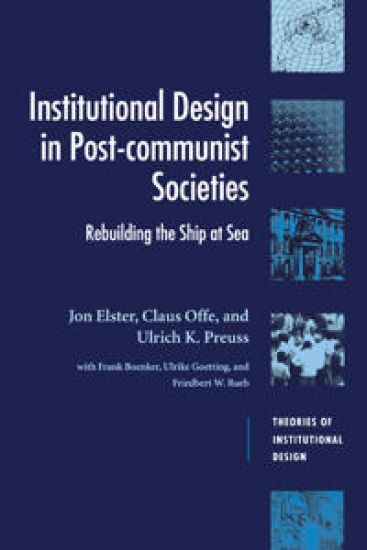
Institutional Design in Post-Communist Societies

Institutional Design in Post-Communist Societies

Jon Elster; Claus Offe; Ulrich K. Preuss

Cambridge University Press
1998
pokkari
The authors of this book have developed a new and stimulating approach to the analysis of the transitions of Bulgaria, the Czech Republic, Hungary, and Slovakia to democracy and a market economy. They integrate interdisciplinary theoretical work with elaborate empirical data on some of the most challenging events of the twentieth century. Three groups of phenomena and their causal interconnection are explored: the material legacies, constraints, habits and cognitive frameworks inherited from the past; the erratic configuration of new actors, and new spaces for action; and a new institutional order under which agency is institutionalized and the sustainability of institutions is achieved. The book studies the interrelations of national identities, economic interests, and political institutions with the transformation process, concentrating on issues of constitution making, democratic infrastructure, the market economy, and social policy.
Institutional Design in Post-Communist Societies

Institutional Design in Post-Communist Societies

Jon Elster; Claus Offe; Ulrich K. Preuss

Cambridge University Press
1998
sidottu
The authors of this book have developed a new and stimulating approach to the analysis of the transitions of Bulgaria, the Czech Republic, Hungary, and Slovakia to democracy and a market economy. They integrate interdisciplinary theoretical work with elaborate empirical data on some of the most challenging events of the twentieth century. Three groups of phenomena and their causal interconnection are explored: the material legacies, constraints, habits and cognitive frameworks inherited from the past; the erratic configuration of new actors, and new spaces for action; and a new institutional order under which agency is institutionalized and the sustainability of institutions is achieved. The book studies the interrelations of national identities, economic interests, and political institutions with the transformation process, concentrating on issues of constitution making, democratic infrastructure, the market economy, and social policy.