Kirjojen hintavertailu – 12 859 829 kirjaa ja 27 kauppaa

Kirjailija

Ulrich Magnus

Kirjat ja teokset yhdessä paikassa: 5 kirjaa, julkaisuja vuosilta 1987–2009, suosituimpiin kuuluu CISG Part II Conference, Stockholm, 4-5 September 2008. Vertaile teosten hintoja ja tarkista saatavuus suomalaisista kirjakaupoista.

5 kirjaa

Kirjojen julkaisuvuodet: 1987–2009.

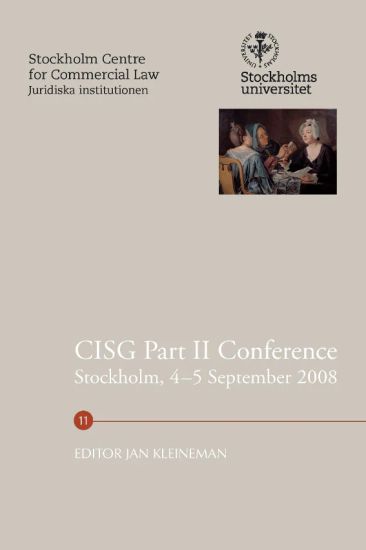
CISG Part II Conference, Stockholm, 4-5 September 2008

CISG Part II Conference, Stockholm, 4-5 September 2008

Jan Kleineman; Michael Bridge; Torsten Iversen; Tom Madell; Joseph Lookofsky; Ulrich Magnus; Jan Ramberg; Carolina Saf; Ingeborg Schwenzer; Pascal Hachem; Leif Sevón; Lena Sisula-Tulokas

Stockholm Centre for Commercial Law
2009
nidottu
The CISG Part II Conference was held in Stockholm on 4–5 September 2008. The Conference was held in honour and remembrance of the late Supreme Court Justice Hans-Gunnar Solerud, the first chairman of the Stockholm Centre for Commercial Law. The Conference was organised by the Stockholm Centre for Commercial Law in co-operation with the Swedish Ministry of Justice. CONTENTS: - The CISG from a Common Law Perspective Michael Bridge - Scandinavian Contract Law and its Implication on CISG – the Danish Approach Torsten Iversen - Changes proposed in the Nordic stance on the CISG Jan Kleineman and Tom Madell - CISG Case Law and the Scandinavian Part II Reservations - Some Reflections on the CISG Part II Conference at the University of Stockholm, 4–5 September 2008 Joseph Lookofsky - The Scandinavian Reservation under Art. 92 CISG Ulrich Magnus - The Effect of CISG on Swedish Contract Law – now and in the Future Jan Ramberg - CISG – a Uniform Law within the Sphere of Conflict of Laws Carolina Saf - The CISG – A Story of Worldwide Success Ingeborg Schwenzer and Pascal Hachem - Scandinavian Contract Law and its Implication on CISG – The Finnish Approach Leif Sevón - Nordic hesitancy regarding Part II of the CISG Lena Sisula-Tulokas
Jan Hellner in memoriam  Commercial Law Challenges in the 21st Century

Jan Hellner in memoriam Commercial Law Challenges in the 21st Century

Michael Bogdan; Ross Cranston; Roy Goode; Lars Gorton; Attila Harmathy; Ewoud Hondius; Boris Kozolchyk; Ulrich Magnus; Pilar Perales Viscasillas; Jan Ramberg; Peter Schlechtriem; Ingeborg Schwenzer; Benjamin Leisinger; Jacob Ziegel

Stockholm Centre for Commercial Law
2007
sidottu
Contents: Conflict of Laws Regarding Liability Allocation between Insurers in Cases of Double Insurance by Michael Bogdan The Rise and Rise of Standard Form Contracts: International Commodity Sales 1800-1970 by Ross Cranston Is the Lex Mercatoria Autonomous? by Roy Goode Letters of commitment and loan agreements by Lars Gorton Law of business in transition in Hungary by Attila Harmathy Commercial Law: is it Special? by Ewoud Hondius A Roadmap to Economic Development through Law: Third Parties and Comparative Legal Culture by Boris Kozolchyk Last Shot vs. Knock Out – Still Battle over the Battle of Forms Under the CISG by Ulrich Magnus Directive 2000/35 of 29 June 2000 on combating late payment in commercial transactions: the period for payment (art. 3.1 b) by Pilar Perales Viscasillas Electronic Communications and Incoterms 2000 by Jan Ramberg Calculation of damages in case of anticipatory breach under the CISG by Peter Schlechtriem Ethical Values and International Sales Contracts by Ingeborg Schwenzer & Benjamin Leisinger The Globalization of Law and its Limitations, with Particular Reference to the Globalization of Commercial Law by Jacob Ziegel
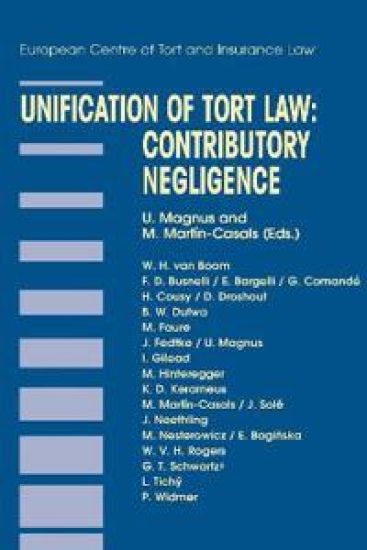
Unification of Tort Law: Contributory Negligence

Unification of Tort Law: Contributory Negligence

Ulrich Magnus; M. Martin-Casals

Kluwer Law International
2004
sidottu
The foundations of tort law in European systems differ considerably. Until recently, there was no attempt to harmonize the entire field of tort law in a consistent and comprehensive manner. A group of tort law experts, the "European Group on Tort Law," has been engaged over the last 11 years in systematically researching the most fundamental questions underlying the various tort law systems. The result of their work is this important series of books, which seeks a common law of Europe without the need to lay these principles down in formal legal texts, such as a European civil code. In this volume, the authors provide an overview of contributory negligence and its relevance in the allocation of damages under their respective national tort system. Of immense practical importance, the concept of contributory negligence is further examined in an analysis of actual cases. This volume also contains an economic analysis of this area of tort law as well as a comparative report which summarizes and compares the most important elements identified by the individual country reports. In summary, this volume shows the common grounds of contributory negligence in the various legal systems under examination. In addition, it provides the academic and the practitioner with the fundamental aspects of contributory negligence in the countries covered.
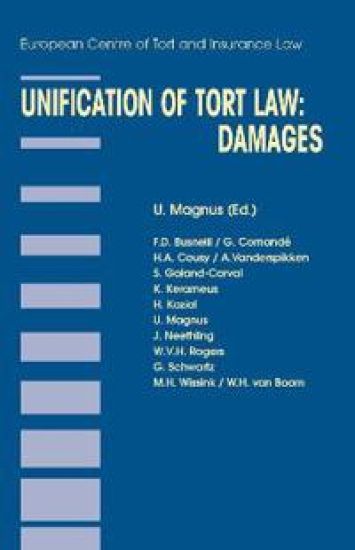
Unification of Tort Law: Damages

Unification of Tort Law: Damages

Ulrich Magnus

Kluwer Law International
1997
sidottu
The foundations of tort law in various European legal systems differ considerably. Until now, there has not been an attempt to harmonize the entire field of tort law in a consistent manner. To rectify this, a group of tort lawyers has proposed to address the fundamental questions underlying every tort law system. The result is this important series of books, which searches for a common law of Europe to lay these principles down in formal legal texts, such as a European civil code. Identifying the most relevant factors in establishing liability as wrongfulness, causation, damage, fault, and the area of strict liability, the authors concentrate on the tort liability factor under discussion in each volume, combining theoretical abstract analysis with the discussion of concrete cases. Each author gives an overview of the particular tort liability factor under his or her national legal system - primarily by working out the concept and its importance in establishing liability - and then applies the analysis to actual cases. The subsequent conclusions aim at the coordination of the results and other important factors. In summary, each volume tries to make clear what common ground pertaining to each tort liability factor underlies all the legal systems concerned with respect to the law of tort. Each volume also provides the academic and practitioner with the fundamental issues relating to that factor underlying the law of tort in the countries covered.