Kirjojen hintavertailu – 12 903 724 kirjaa ja 27 kauppaa

Kirjailija

United States Air Force

Kirjat ja teokset yhdessä paikassa: 85 kirjaa, julkaisuja vuosilta 2001–2020, suosituimpiin kuuluu U.S. Air Force Survival Handbook: The Portable and Essential Guide to Staying Alive. Vertaile teosten hintoja ja tarkista saatavuus suomalaisista kirjakaupoista.

85 kirjaa

Kirjojen julkaisuvuodet: 2001–2020.

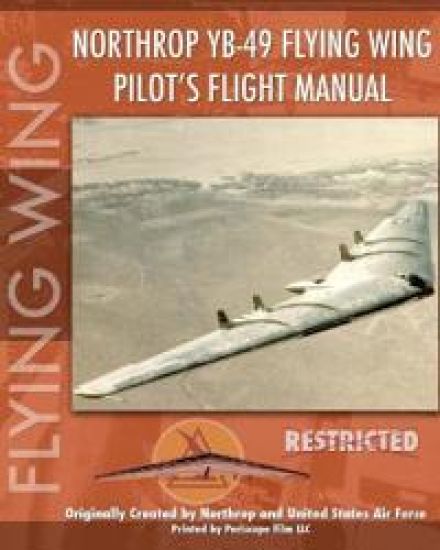
Northrop YB-49 Flying Wing Pilot's Flight Manual

Northrop YB-49 Flying Wing Pilot's Flight Manual

United States Air Force

Periscope Film LLC
2010
pokkari
Visionary designer Jack Northrop built a series of experimental "flying wing" aircraft both before and during WWII. The YB-35, a propeller-driven strategic bomber featuring the drag-reducing all-wing design, offered enormous payload capacity and terrific endurance. The YB-49, a turbojet-powered variant built on the YB-35 airframe, captured the imagination of the world when it first flew in 1947. It quickly set both an unofficial endurance record and a trans-continental speed record, and appeared poised for rapidly deployment. Tragically, in June of 1948 one of two flying prototypes was destroyed when the aircraft suffered a structural failure during a test flight. In hearings after the accident, evidence was presented that in certain circumstances the aircraft could become unstable and exceed the capabilities of a human pilot. Shortly thereafter the YB-49 program was canceled. Jack Northrop's radical design was shelved for a generation, only to re-emerge in the form of the B-2 Spirit Stealth bomber - an aircraft that relies upon computerized controls to ensure stability in flight. Originally printed by Northrop Aircraft in 1948, this YB-49 Flying Wing pilot's flight manual taught pilots everything they needed to know before entering the cockpit. Originally classified "Restricted", the manual was declassified long ago and is here reprinted in book form. This affordable facsimile has been slightly reformatted. Care has been taken however to preserve the integrity of the text.
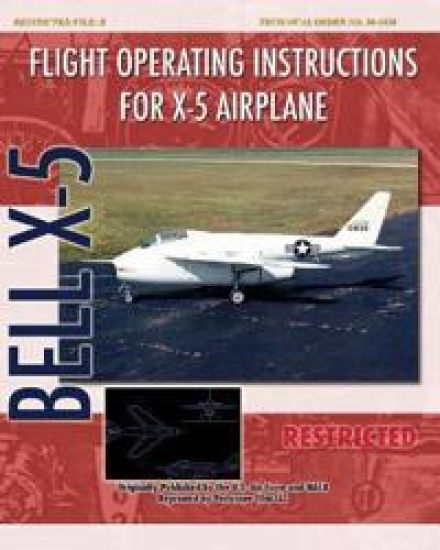
Flight Operating Instructions for X-5 Airplane

Flight Operating Instructions for X-5 Airplane

United States Air Force

Periscope Film, LLC
2009
pokkari
An outgrowth of the Third Reich's Emergency Fighter Program, the Messerschmitt P.1101 jet fighter featured a radical new design in which the sweep of the wing could be altered in flight. Captured by the Allies before it could be completed, the P.1101 was sent to the United States where it inspired the Bell X-5. Produced by a team led by Robert J. Wood, the X-5 was a true "variable geometry" platform that offered in-flight wing positions of 20 , 40 , and 60 . Far more complex than the P.1101, the X-5 utilized a jackscrew to move the wings along horizontal rails, and disc brakes to lock the wing into position. Two X-5s were built, and almost 200 flights were made between 1951 and 1955. While the design initially showed promise, the X-5 had a tendency to go into a violent spin. That characteristic led to the crash of the second prototype in 1953, an accident that killed test pilot Capt. Ray Popson. The accident led to the cancellation of tentative plans to mass produce a modified design as a low-cost tactical fighter. Still, the X-5 successfully demonstrated the utility of a swept-wing design, and inspired a whole generation of aircraft from the F-111 and F-14 to the B-1. Originally produced in 1951 by the United States Air Force and NACA, this flight operating handbook was originally restricted. It has now been declassified and made available in its entirety. Please note, due to the age and rarity of this manual, some images may be substandard.

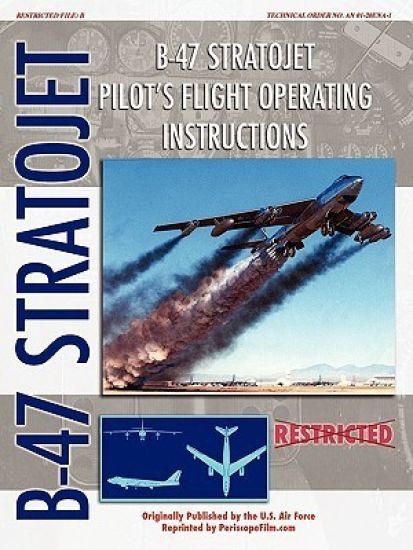
B-47 Stratojet Pilot's Flight Operating Instructions
The Air Force's first all-jet strategic bomber, the swept-wing Boeing B-47 Stratojet had a range of 3,500 nautical miles and a payload capacity of 20,000 pounds. It served as the mainstay of Strategic Air Command in the 1950s into the mid 1960s. The B-47 was an outgrowth of WWII research and development efforts, and the prototype aircraft first flew in December of 1947. The unique six-jet design featured twin engine pods on the wing near the fuselage, and one outboard. It also incorporated an elegant bicycle-type landing gear with two-wheel struts on the forward and aft fuselage and outrigger wheels. In 1956, over 1300 B-47s and 250 RB-47s were on alert. It was the high water mark for the aircraft, which was fully supplanted by the B-52 by 1967. This B-47 pilot's flight operating handbook was originally produced by the USAF. It has been slightly reformatted but is reproduced here in its entirety. It provides a fascinating view inside the cockpit of one of history's great planes.