Kirjojen hintavertailu – 12 903 725 kirjaa ja 27 kauppaa
Kirjailija
United States Marine Corps
Kirjat ja teokset yhdessä paikassa: 29 kirjaa, julkaisuja vuosilta 2007–2025, suosituimpiin kuuluu The Marines in Vietnam, 1954-1973. Vertaile teosten hintoja ja tarkista saatavuus suomalaisista kirjakaupoista.
Nimi esiintyy myös muodoissa: United States. Marine Corps
The purpose of this period of instruction is to familiarize the student with the twelve mountain safety considerations and the acronym used to remember them. This lesson relates to all training conducted in a mountainous environment.
The mission of the History and Museums Division is to collect, collate, analyze, and display the cumulative operational and institutional experiences of the U. S. Marine Corps. In this endeavor, its first priority is to help orient, educate, and train Marines to accomplish their mission, and to inform the American public about what it is that we Marines do. The collection phase falls to the Field History Branch, which comprises a handful of Reserve historians and combat artists. Their job is to observe and document military operations at first hand. During Operation Iraqi Freedom (OIF), the field historians and combat artists served in theater with their supported units, under wartime conditions. Once attention has shifted from Iraq and new conflicts arise, the interviews, documents, photographs and artwork collected and created by these Marines will serve as permanent reminders of the efforts and achievements of individual Marines and their units. In recognition of their efforts during Operations Enduring...
Now, more than ever, the rapid-responsiveness, readiness, flexibility, precision and strategic mobility of maritime forces are essential to ensuring continued access and security in the global commons and the littoral regions that border them. As the Nation prepares for an uncertain future, its maritime and amphibious capabilities are essential to deterrence, building alliances, denying sanctuary, projecting influence and, when required, projecting power against increasingly lethal and asymmetric adversaries. Rapidly evolving security and fiscal environments, however, demand corresponding changes in our forward-deployed, crisis response force to include operational thinking, concepts, education, training, capabilities, and partnerships. Increasingly more capable and irregular threats to our national interests require an integrated, multidomain approach informed by continuous innovation in naval war fighting, littoral maneuver, and amphibious operations. Amphibious capability has an aggregate utility across the range of military operations that is reflected in combatant commander demand. Approaches such as single naval battle, an integrated naval expeditionary system, broadened combined arms, and special operations integration are an effective counter to increasingly capable anti-access and area denial (A2AD) threats that seek to limit our freedom of action. Above all, we guard against surprise and preserve our nation's readiness through vigorous professional education, training, war gaming, experimentation and exercises that integrate the naval, special operations forces (SOF), joint, inter-agency and multinational force. Future fights are most likely short warning, --come as you are challenges from an irregular threat. As the joint, expeditionary force in readiness the Marine Corps, and its Navy partner, will maneuver from the sea to apply influence and power at a time and place of its choosing. In doing so, the naval team mitigates risk and sets initial conditions for the joint and inter-agency force
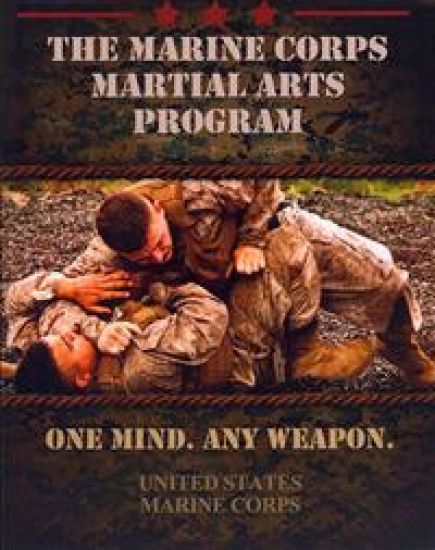
The complete manual to the fighting system of the United States Marine Corps. The Marine Corps Martial Arts Program (MCMAP) was designed as a synergy of mental, character, and physical disciplines with application across the full spectrum of violent encounters. MCMAP draws from the best martial arts techniques of boxing, jiu-jitsu, judo, sambo, krav maga, karate, aikido, escrima, arnis, hap ki do, karate, tae kwon do, kung fu, and kick boxing. Fighting techniques including: battle skill orientation; stance; posture; movement; weapons handling and function; striking; cutting; grappling; restraints and manipulations; and integration of weapons. The program teaches lethal and nonlethal techniques as well as pain inducing compliance techniques to provide a Marine with the maximum flexibility for adapting to any possible threat level. Since its introduction, MCMAP has been continually tested, evaluated, and refined. It combines the best combat tested martial arts training and time-honored, close combat training techniques. This manual was published in November 2011 and includes the latest updates to the Marine Corps Martial Arts Program. The chapters cover all of the required techniques for the basic level tan belt through the expert level black belt. Subjects include: Fundamentals of the Marine Corps Martial Arts ProgramRanges of close combat engagements, target areas of the body, weapons of the body, basic warrior stance, and angles of movement. Punches-muscle relaxation, making a fist, weight transfer, rapid retraction, telegraphing, lead hand bunch, rear hand punch, upper cut, hook, and actions of the aggressor. Break-Falls-front, back, and side falls, and forward shoulder rolls. Bayonet Techniques-straight thrust, horizontal and vertical butt strokes, smash, slash, and disrupt. Upper Body Strikes-principles, hammer fist, eye gouge, elbow strikes, chin jab/palm heel strike, knife hand strike, inside/reverse knife hand strike, rear horizontal elbow strike, and face smash. Lower Body Strikes-vertical knee strike, front kick, round kick, vertical stomp, horizontal knee strike, side kick, and axe stomp. Chokes-front, side, and rear choke, and the figure four variation, ground choke, triangle choke, and guillotine choke. Throws-hip throw, shoulder throw, and outside reaping throw. Counters to Strikes-counter to rear and leading hand punches, counter to rear and leading leg kicks, counter to round punches and kicks. Counters to Chokes and Holds-counter to front and rear chokes, counters to headlocks, counter to front and rear bear hugs, and counter to front choke. Unarmed Manipulation-compliance techniques, distraction techniques, wrist lock come along and takedown, enhanced pain compliance, controlling techniques, and neck crank. Joint Manipulation-wrist locks, and arm bar takedown. Armed Manipulation-rifle and shotgun retention techniques. Knife Fighting-principles of knife fighting, vertical and forward slashes, vertical and forward thrusts, and reverse slash. Bayonet-fundamentals of bayonet techniques, execution, movement, and closing. Weapons of Opportunity and Improvised WeaponsGround Fighting-counter to the mount position, counter to the guard position, arm bars from the mount and guard positions, basic leg lock, face rip, and rolling and sitting knee bars. Firearms Retention and Firearms Counters