
Kirjojen hintavertailu – 12 903 725 kirjaa ja 27 kauppaa

Kirjailija

Unurjargal Nyambuu

Kirjat ja teokset yhdessä paikassa: 3 kirjaa, julkaisuja vuosilta 2018–2024, suosituimpiin kuuluu Sustainable Macroeconomics, Climate Risks and Energy Transitions. Vertaile teosten hintoja ja tarkista saatavuus suomalaisista kirjakaupoista.

3 kirjaa

Kirjojen julkaisuvuodet: 2018–2024.

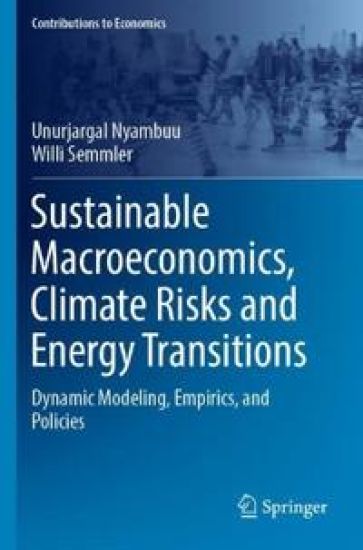
Sustainable Macroeconomics, Climate Risks and Energy Transitions

Sustainable Macroeconomics, Climate Risks and Energy Transitions

Unurjargal Nyambuu; Willi Semmler

Springer International Publishing AG
2024
nidottu
Given the industrialized world’s historical dependence on fossil fuel-based energy resources and the now-realized perils of moving beyond the earth’s carbon budget, this book explores the myriad challenges of climate change and in reaching a low-carbon economy. Reconciling the medium-term competing, yet frequently complementary, needs for transition policies, the book provides guidelines for complex and often conflicting climate policy tasks. The book presents empirical trends in the use of carbon-emitting resources and evaluates market-driven short-termism and its adverse impact on resource use and the environment; it emphasizes a medium-term macroeconomic perspective for the transition. The authors attempt a paradigm shift towards a framework of sustainable macroeconomics. They survey relevant historical models, conduct empirical and numerical analyses ofthe climate change-relevant dynamic models, provide empirical illustrations, and evaluate diverse policy options and implementations together with their historical evolution. New analytical issues are also considered, e.g., strategic behavior in the energy and resource sectors, energy competition and the dynamics of market shares in new energy technology, and supporting policies for dealing with the tipping points encountered in climate change. The authors suggest a multitude of market-based strategies and public fiscal, monetary, and financial policies, and longer-run planning for resource extraction -all suitable for driving sustainable growth and a transformation of the energy sector. The book also examines the multiple delaying forces slowing the transition to a low-carbon economy; these typically arise from short-termism, lock-ins, irreversibility, leakages, non-cooperative games, and other political strategies. Thus, they explain the snail’s pace evolution of current national and global climate policies. The book will appeal to scholars and students of economics and environmental science. It is also relevant for policymakers and practitioners in multilateral institutions, research institutions as well as governments and ministries of countries interested in alternative energy sources, climate economists, and those who study the implementation of sustainable and low carbon-based policies.
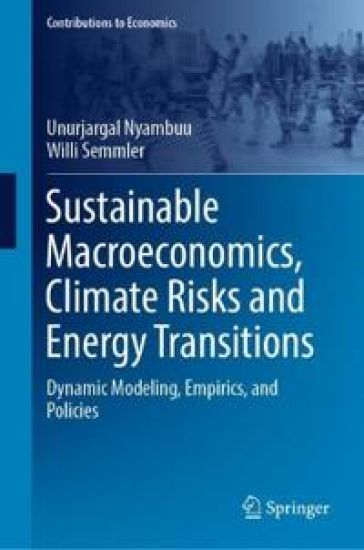
Sustainable Macroeconomics, Climate Risks and Energy Transitions

Sustainable Macroeconomics, Climate Risks and Energy Transitions

Unurjargal Nyambuu; Willi Semmler

Springer International Publishing AG
2023
sidottu
Given the industrialized world’s historical dependence on fossil fuel-based energy resources and the now-realized perils of moving beyond the earth’s carbon budget, this book explores the myriad challenges of climate change and in reaching a low-carbon economy. Reconciling the medium-term competing, yet frequently complementary, needs for transition policies, the book provides guidelines for complex and often conflicting climate policy tasks. The book presents empirical trends in the use of carbon-emitting resources and evaluates market-driven short-termism and its adverse impact on resource use and the environment; it emphasizes a medium-term macroeconomic perspective for the transition. The authors attempt a paradigm shift towards a framework of sustainable macroeconomics. They survey relevant historical models, conduct empirical and numerical analyses ofthe climate change-relevant dynamic models, provide empirical illustrations, and evaluate diverse policy options and implementations together with their historical evolution. New analytical issues are also considered, e.g., strategic behavior in the energy and resource sectors, energy competition and the dynamics of market shares in new energy technology, and supporting policies for dealing with the tipping points encountered in climate change. The authors suggest a multitude of market-based strategies and public fiscal, monetary, and financial policies, and longer-run planning for resource extraction -all suitable for driving sustainable growth and a transformation of the energy sector. The book also examines the multiple delaying forces slowing the transition to a low-carbon economy; these typically arise from short-termism, lock-ins, irreversibility, leakages, non-cooperative games, and other political strategies. Thus, they explain the snail’s pace evolution of current national and global climate policies. The book will appeal to scholars and students of economics and environmental science. It is also relevant for policymakers and practitioners in multilateral institutions, research institutions as well as governments and ministries of countries interested in alternative energy sources, climate economists, and those who study the implementation of sustainable and low carbon-based policies.
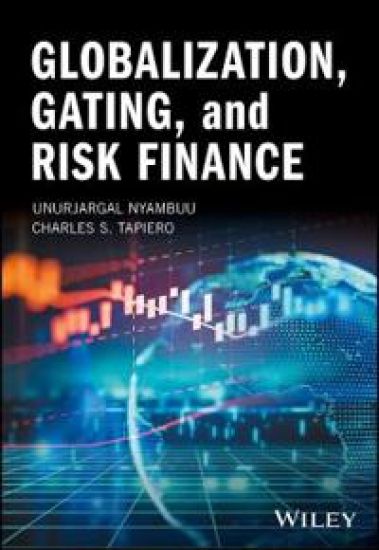
Globalization, Gating, and Risk Finance

Globalization, Gating, and Risk Finance

Unurjargal Nyambuu; Charles S. Tapiero

Wiley-Blackwell
2018
sidottu
An in-depth guide to global and risk finance based on financial models and data-based issues that confront global financial managers. Globalization, Gating, and Risk Finance offers perspectives on global risk finance in a world with economies in transition. Developed from lectures and research projects investigating the consequences of globalization and strategic approaches to fundamental economics and finance, it provides an approach based on financial models and data; it includes many case-study problems. The book departs from the traditional macroeconomic and financial approaches to global and strategic risk finance, where economic power and geopolitical issues are intermingled to create complex and forward-looking financial systems. Chapter coverage includes: Globalization: Economies in Collision; Data, Measurements, and Global Finance; Global Finance: Utility, Financial Consumption, and Asset Pricing; Macroeconomics, Foreign Exchange, and Global Finance; Foreign Exchange Models and Prices; Asia: Financial Environment and Risks; Financial Currency Pricing, Swaps, Derivatives, and Complete Markets; Credit Risk and International Debt; Globalization and Trade: A Changing World; and Compliance and Financial Regulation. Provides a framework for global financial and inclusive models, some of which are not commonly covered in other books. Considers risk management, utility, and utility-based multi-agent financial theories. Presents a theoretical framework to assist with a variety of problems ranging from derivatives and FX pricing to bond default to trade and strategic regulation. Provides detailed explanations and mathematical proofs to aid the readers’ understanding. Globalization, Gating, and Risk Finance is appropriate as a text for graduate students of global finance, general finance, financial engineering, and international economics, and for practitioners.