Kirjailija
Valerie M. Hudson
Kirjat ja teokset yhdessä paikassa: 11 kirjaa, julkaisuja vuosilta 2005–2026, suosituimpiin kuuluu Foreign Policy Analysis. Vertaile teosten hintoja ja tarkista saatavuus suomalaisista kirjakaupoista.
Nimi esiintyy myös muodoissa: Valerie M Hudson
11 kirjaa
Kirjojen julkaisuvuodet: 2005–2026.
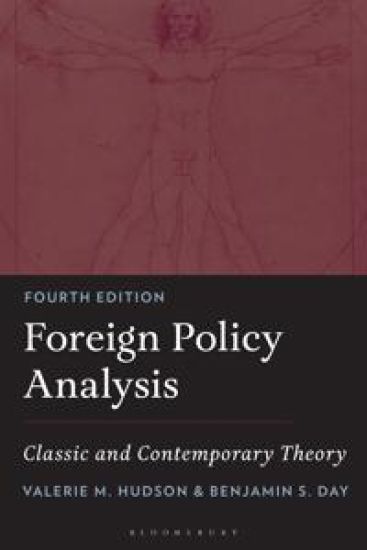
The go-to text for understanding both the historical development and contemporary contours of foreign policy analysis. This comprehensive introduction to Foreign Policy Analysis (FPA) is geared toward advanced undergraduate and beginning graduate students. Cogently written, clearly organized, and filled with illuminating examples, the fourth edition has been thoroughly revised and updated. Beginning with an overview of this broad field of study, Hudson and Day consider theory and research at multiple levels of analysis, including personality and psychology of foreign policy decision makers, small group dynamics, the organizational process, bureaucratic politics, domestic politics, cultural and societal influences, national attributes, and system-level effects on foreign policy. The authors also examine the promise and frustration of theoretical integration in FPA and overview promising new work by non-North American scholars.

Political Psychology And Foreign Policy
Eric Singer; Valerie M Hudson
TAYLOR FRANCIS LTD
2024
nidottu
First published in 1992. One of the issues of particular interest to political psychologists centers around how foreign policy decisions are made. The psychological phenomena that political psychologists examine have to do with how individuals perceive, interpret, feel about, an d react to their environment. The political factors have to do with the activities involved in governing or the making of public policy?€” that is, with how the material and human resources of a collectivity are allocated. The research presented in this volume addresses 6 key questions that link psychological and political processes, and the chapters are organized a round three conceptual clusters: perception studies, personality studies, and studies of group dynamics.
This book provides an overview of the study of international relations using a computational modeling approach (abbreviated as Al/IR). It deals with general theoretical and applied issues in AI/IR subfield and also showcases actual research produced by those working in the AI/IR subfield.
First published in 1992. One of the issues of particular interest to political psychologists centers around how foreign policy decisions are made. The psychological phenomena that political psychologists examine have to do with how individuals perceive, interpret, feel about, an d react to their environment. The political factors have to do with the activities involved in governing or the making of public policy— that is, with how the material and human resources of a collectivity are allocated. The research presented in this volume addresses 6 key questions that link psychological and political processes, and the chapters are organized a round three conceptual clusters: perception studies, personality studies, and studies of group dynamics.
Foreign Policy Analysis
Valerie M. Hudson; Benjamin S. Day
Rowman Littlefield
2019
nidottu
Halvin toimitettuna 62,40 €
This succinct yet comprehensive introduction to Foreign Policy Analysis (FPA) is geared toward advanced undergraduate and beginning graduate students. Cogently written, clearly organized, and filled with illuminating examples, the third edition has been thoroughly revised and updated. Beginning with an overview of this broad field of study, Hudson and Day consider theory and research at multiple levels of analysis, including personality and psychology of foreign policy decision makers, small group dynamics, the organizational process, bureaucratic politics, domestic politics, cultural and societal influences, national attributes, and system-level effects on foreign policy. The authors also examine the promise and frustration of theoretical integration in FPA and overview promising new work by non-North American scholars.

This book provides an overview of the study of international relations using a computational modeling approach (abbreviated as Al/IR). It deals with general theoretical and applied issues in AI/IR subfield and also showcases actual research produced by those working in the AI/IR subfield.
Sex and World Peace
Valerie M. Hudson; Bonnie Ballif-Spanvill; Mary Caprioli; Chad F. Emmett
Columbia University Press
2014
pokkari
Sex and World Peace unsettles a variety of assumptions in political and security discourse, demonstrating that the security of women is a vital factor in the security of the state and its incidence of conflict and war. The authors compare micro-level gender violence and macro-level state peacefulness in global settings, supporting their findings with detailed analyses and color maps. Harnessing an immense amount of data, they call attention to discrepancies between national laws protecting women and the enforcement of those laws, and they note the adverse effects on state security of abnormal sex ratios favoring males, the practice of polygamy, and inequitable realities in family law, among other gendered aggressions. The authors find that the treatment of women informs human interaction at all levels of society. Their research challenges conventional definitions of security and democracy and shows that the treatment of gender, played out on the world stage, informs the true clash of civilizations. In terms of resolving these injustices, the authors examine top-down and bottom-up approaches to healing wounds of violence against women, as well as ways to rectify inequalities in family law and the lack of parity in decision-making councils. Emphasizing the importance of an R2PW, or state responsibility to protect women, they mount a solid campaign against women's systemic insecurity, which effectively unravels the security of all.
Sex and World Peace
Valerie M. Hudson; Bonnie Ballif-Spanvill; Mary Caprioli; Chad F. Emmett
Columbia University Press
2012
sidottu
Sex and World Peace unsettles a variety of assumptions in political and security discourse, demonstrating that the security of women is a vital factor in the security of the state and its incidence of conflict and war. The authors compare micro-level gender violence and macro-level state peacefulness in global settings, supporting their findings with detailed analyses and color maps. Harnessing an immense amount of data, they call attention to discrepancies between national laws protecting women and the enforcement of those laws, and they note the adverse effects on state security of abnormal sex ratios favoring males, the practice of polygamy, and inequitable realities in family law, among other gendered aggressions. The authors find that the treatment of women informs human interaction at all levels of society. Their research challenges conventional definitions of security and democracy and shows that the treatment of gender, played out on the world stage, informs the true clash of civilizations. In terms of resolving these injustices, the authors examine top-down and bottom-up approaches to healing wounds of violence against women, as well as ways to rectify inequalities in family law and the lack of parity in decision-making councils. Emphasizing the importance of an R2PW, or state responsibility to protect women, they mount a solid campaign against women's systemic insecurity, which effectively unravels the security of all.
What happens to a society that has too many men? In this provocative book, Valerie Hudson and Andrea den Boer argue that, historically, high male-to-female ratios often trigger domestic and international violence. Most violent crime is committed by young unmarried males who lack stable social bonds. Although there is not always a direct cause-and-effect relationship, these surplus men often play a crucial role in making violence prevalent within society. Governments sometimes respond to this problem by enlisting young surplus males in military campaigns and high-risk public works projects. Countries with high male-to-female ratios also tend to develop authoritarian political systems. Hudson and den Boer suggest that the sex ratios of many Asian countries, particularly China and India-which represent almost 40 percent of the world's population-are being skewed in favor of males on a scale that may be unprecedented in human history. Through offspring sex selection (often in the form of sex-selective abortion and female infanticide), these countries are acquiring a disproportionate number of low-status young adult males, called "bare branches" by the Chinese. Hudson and den Boer argue that this surplus male population in Asia's largest countries threatens domestic stability and international security. The prospects for peace and democracy are dimmed by the growth of bare branches in China and India, and, they maintain, the sex ratios of these countries will have global implications in the twenty-first century.