Kirjojen hintavertailu – 12 859 826 kirjaa ja 27 kauppaa

Kirjailija

Vassilis K. Fouskas

Kirjat ja teokset yhdessä paikassa: 7 kirjaa, julkaisuja vuosilta 2003–2021, suosituimpiin kuuluu China & the USA. Vertaile teosten hintoja ja tarkista saatavuus suomalaisista kirjakaupoista.

7 kirjaa

Kirjojen julkaisuvuodet: 2003–2021.

China & the USA

China & the USA

Vassilis K. Fouskas; Shampa Roy-Mukherjee; Qingan Huang; Ejike Udeogu

Springer Nature Switzerland AG
2021
nidottu
This book examines the political economy of conflict between China, a rising power, and the USA, a declining one. It provides an informed analysis as to why China is the main beneficiary of neo-liberal globalisation, a project launched in the wake of the collapse of the Bretton Woods system in the late 1960s under the aegis of the USA. Why are Huawei and other Chinese high-tech giants targeted by the USA and its allies? What is the role of the state and the Chinese political system in the development of China’s political economy, as well as its globalisation? Does China’s global rise provide a viable and sustainable alternative to neo-liberal globalisation? Since American leaders view increasingly the rise of China as a threat, how likely is an armed conflict between China and the USA? This book answers these questions by using a wealth of empirical material and debating with many theoretical schools of thought, Marxist or otherwise.
China & the USA

China & the USA

Vassilis K. Fouskas; Shampa Roy-Mukherjee; Qingan Huang; Ejike Udeogu

Springer Nature Switzerland AG
2020
sidottu
This book examines the political economy of conflict between China, a rising power, and the USA, a declining one. It provides an informed analysis as to why China is the main beneficiary of neo-liberal globalisation, a project launched in the wake of the collapse of the Bretton Woods system in the late 1960s under the aegis of the USA. Why are Huawei and other Chinese high-tech giants targeted by the USA and its allies? What is the role of the state and the Chinese political system in the development of China’s political economy, as well as its globalisation? Does China’s global rise provide a viable and sustainable alternative to neo-liberal globalisation? Since American leaders view increasingly the rise of China as a threat, how likely is an armed conflict between China and the USA? This book answers these questions by using a wealth of empirical material and debating with many theoretical schools of thought, Marxist or otherwise.

The Disintegration of Euro-Atlanticism and New Authoritarianism

The Disintegration of Euro-Atlanticism and New Authoritarianism

Vassilis K. Fouskas; Bülent Gökay

Springer Nature Switzerland AG
2019
nidottu
This book sets out a concrete analytical and empirical framework to understand the Euro-zone crisis and the deep disintegrative tendencies of Euro-Atlantic neo-imperialism. It explores how the authoritarianism and austerity led from above in the transatlantic world cultivate right-wing populism and racist hysteria from below, especially in relation to the global power-shift to China and other emerging economies. The authors argue that ordoliberal/neo-liberal austerity cannot reverse the decline of western economies; if anything, it precipitates their downfall and the re-launching of globalization under Asian primacy. The book will appeal to students, scholars and policymakers across the fields of International Political Economy, European Politics and Critical Social and Political Theory.
The Disintegration of Euro-Atlanticism and New Authoritarianism

The Disintegration of Euro-Atlanticism and New Authoritarianism

Vassilis K. Fouskas; Bülent Gökay

Springer International Publishing AG
2018
sidottu
This book sets out a concrete analytical and empirical framework to understand the Euro-zone crisis and the deep disintegrative tendencies of Euro-Atlantic neo-imperialism. It explores how the authoritarianism and austerity led from above in the transatlantic world cultivate right-wing populism and racist hysteria from below, especially in relation to the global power-shift to China and other emerging economies. The authors argue that ordoliberal/neo-liberal austerity cannot reverse the decline of western economies; if anything, it precipitates their downfall and the re-launching of globalization under Asian primacy. The book will appeal to students, scholars and policymakers across the fields of International Political Economy, European Politics and Critical Social and Political Theory.
The Fall of the US Empire

The Fall of the US Empire

Vassilis K. Fouskas; Bülent Gökay

Pluto Press
2012
pokkari
Despite Washington's military supremacy, its economic foundations have been weakening since the Vietnam war – accelerated by the great recession and credit-rating downgrade – and its global authority dented by the quagmires in Iraq and Afghanistan. This book intervenes in the debates surrounding America's status as an empire. It analyses Immanuel Wallerstein and others who argue that the US is in decline, to those who maintain that it remains a robust superpower. By explaining how America's neo-imperial system of governance has been working since WWII, it links the US's domestic and foreign vulnerabilities. The Fall of the US Empire argues that the time has come to understand the US empire not by its power but by its systemic vulnerabilities of financialisation, resource depletion and environmental degradation.
Cyprus

Cyprus

Vassilis K. Fouskas; Alex O. Tackie

Pluto Press
2009
pokkari
This book provides a non-partisan approach to Cyprus that goes beyond the perceptions of ruling elites on the island and their NATO masters, which are historically responsible for the division of Cyprus today. Fouskas and Tackie argue that the rise to power of two left-wing parties on both sides of the Green Line means it is time to launch a serious political dialogue to initiate a post-imperial constitutional process. This is a feasible undertaking, not least because Cyprus is a member of the EU, but not a member of NATO. Short and accessible, this book aims to revive a debate in the spirit of Dervis Ali Kavatzoglou and Constantine Misiaoulis, popular symbols of a united, democratic and independent Cyprus.
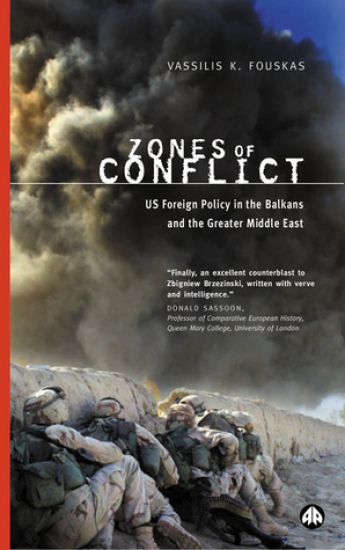
Zones of Conflict

Zones of Conflict

Vassilis K. Fouskas

Pluto Press
2003
sidottu
The US has major interests in the Balkans, the Greater Middle East and the Eurasian zone, which determine its political and military strategies in the region. What are these interests, and what strategies are used to ensure that they are maintained? Examining the balance of power between the US, the EU and key EU states, Vassilis Fouskas offers a critique of US foreign policy and its underlying motivations. Fouskas argues that the major US objectives include control over gas and oil producing zones; safe transportation of energy to Western markets at stable prices; and the elimination, but not destruction, of America's Eurasian competitors. He asserts that US foreign policy is therefore driven by the desire to maintain a strategic partnership with key EU states, while preventing the emergence of an alternative coalition in Eurasia capable of challenging US supremacy. How does the US manage its interests in Eurasia and what are the particular strategies the EU has elaborated so far to deal with America's supremacy? Has US foreign policy undergone a dramatic U-turn after the end of the Cold War or, for that matter, after September 11th? What are the roles of Germany, France, Britain and Turkey, and how do EU-Cyprus relations affect the balance of power? This book tackles these questions and argues that the emergence of a social democratic administration in Eurasia is a feasible alternative to American unilateralism.