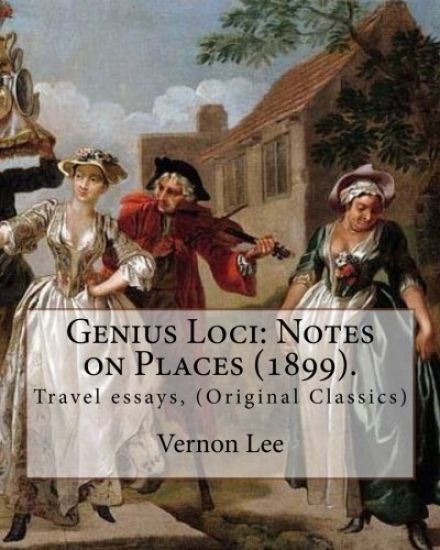
Genius Loci: Notes on Places (1899). By: Vernon Lee: Travel essays, (Original Classics)
Vernon Lee
Createspace Independent Publishing Platform
2017
nidottu
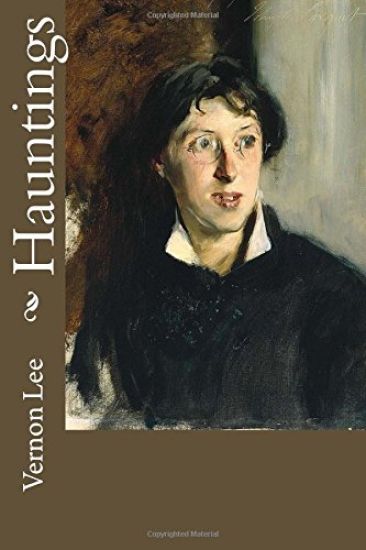
Vernon Lee was the pseudonym of the British writer Violet Paget (14 October 1856 - 13 February 1935). She is remembered today primarily for her supernatural fiction and her work on aesthetics. An early follower of Walter Pater, she wrote over a dozen volumes of essays on art, music, and travel. Biography: Violet Paget was born in France on 14 October1856, at Chateau St Leonard, Boulogne, to British expatriate parents, Henry Ferguson Paget and Matilda Lee-Hamilton (nee Abadam). Violet Paget was the half-sister of Eugene Jacob Lee-Hamilton (1845-1907) 3] by her mother's first marriage, and from whose surname she adapted her own pseudonym. Although she primarily wrote for an English readership and made many visits to London, she spent the majority of her life on the continent, particularly in Italy. Her longest residence was just outside Florence in the Palmerino villa from 1889 until her death at San Gervasio, with a brief interruption during World War I. Her library was left to the British Institute of Florence and can still be inspected by visitors. In Florence she knit lasting friendships with the painter Telemaco Signorini and the learned Mario Praz, and she encouraged his love of learning and English literature. An engaged feminist, she always dressed a la garconne. During the First World War, Lee adopted strong pacifist views, and was a member of the anti-militarist organisation, the Union of Democratic Control. She was also a lesbian, and had long-term passionate friendships with three women, Mary Robinson, Clementina Anstruther-Thomson, and British author Amy Levy. She played the harpsichord and her appreciation of music animates her first major work, Studies of the Eighteenth Century in Italy (1880). In her preface to the second edition of 1907, she recalled her excitement as a girl when she came across a bundle of 18th-century music. She was so nervous that it wouldn't live up to her expectations that she escaped to the garden and listened rapturously through an open window as her mother worked out the music on the piano. citation needed] Along with Pater and John Addington Symonds, she was considered an authority on the Italian Renaissance, and wrote two works that dealt with it explicitly, Euphorion (1884) and Renaissance Fancies and Studies (1895). Her short fiction explored the themes of haunting and possession. The most famous were collected in Hauntings (1890) and her story "Prince Alberic and the Snake Lady" (1895) was first printed in the notorious The Yellow Book. She was instrumental in the introduction of the German concept of 'Einfuhlung', or 'empathy' into the study of aesthetics in the English-speaking world. She developed her own theory of psychological aesthetics in collaboration with her lover, Kit Anstruther-Thomson, based on previous works by William James, Theodor Lipps, and Karl Groos. She claimed that spectators "empathise" with works of art when they call up memories and associations and cause often unconscious bodily changes in posture and breathing. 6] 9] She was known for her numerous essays about travel in Italy, France, Germany, and Switzerland, which attempted to capture the psychological effects of places rather than to convey any particular piece of information. citation needed] Like her friend Henry James, she wrote critically about the relationship between writers and their audience, pioneering the idea of critical assessment among all the arts as relating to an audience's personal response. She was a proponent of the Aesthetic movement, and after a lengthy written correspondence met the movement's effective leader, Walter Pater, in England in 1881, just after encountering one of Pater's most famous disciples, Oscar Wilde. citation needed] Her open resistance against World War I and her work Satan the Waster led to her being ostracized by the younger generation of scholars and writers. Feminist research led to a rediscovery since the 1990s..........