Kirjojen hintavertailu – 12 903 724 kirjaa ja 27 kauppaa

Kirjailija

Vicki Bruce

Kirjat ja teokset yhdessä paikassa: 8 kirjaa, julkaisuja vuosilta 1989–2023, suosituimpiin kuuluu Goaaalllie. Vertaile teosten hintoja ja tarkista saatavuus suomalaisista kirjakaupoista.

8 kirjaa

Kirjojen julkaisuvuodet: 1989–2023.

Face Perception

Face Perception

Andy Young; Vicki Bruce

TAYLOR FRANCIS LTD
2023
sidottu
Human faces are unique biological structures that convey a complex variety of important social messages. Even strangers can tell things from our faces – our feelings, our locus of attention, something of what we are saying, our age, sex, and ethnic group, whether they find us attractive or approachable. Face Perception, second edition, has been thoroughly updated throughout, providing an up-to-date, integrative summary by two authors who have helped to develop and shape the field. The book begins with the foundations of face perception before considering what is known about how we see different things in faces. It concludes with a discussion of how face perception relates to wider questions involving interpersonal perception and re-examines the question of what makes faces ‘special’. The importance of integrating different research perspectives and asking critical theoretical questions is emphasised throughout, to develop a distinctive point of view of the area. Written in a clear and accessible style, this is invaluable reading for all students and researchers interested in studying face perception and social cognition.

Face Perception

Face Perception

Andy Young; Vicki Bruce

TAYLOR FRANCIS LTD
2023
nidottu
Human faces are unique biological structures that convey a complex variety of important social messages. Even strangers can tell things from our faces – our feelings, our locus of attention, something of what we are saying, our age, sex, and ethnic group, whether they find us attractive or approachable. Face Perception, second edition, has been thoroughly updated throughout, providing an up-to-date, integrative summary by two authors who have helped to develop and shape the field. The book begins with the foundations of face perception before considering what is known about how we see different things in faces. It concludes with a discussion of how face perception relates to wider questions involving interpersonal perception and re-examines the question of what makes faces ‘special’. The importance of integrating different research perspectives and asking critical theoretical questions is emphasised throughout, to develop a distinctive point of view of the area. Written in a clear and accessible style, this is invaluable reading for all students and researchers interested in studying face perception and social cognition.

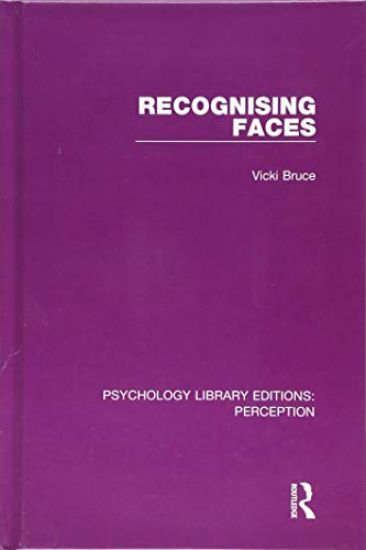
Recognising Faces

Recognising Faces

Vicki Bruce

Routledge
2019
nidottu
Each of us is able to recognise the faces of many hundreds if not thousands of people known to us. We recognise faces despite seeing them in different views and with changing expressions. From these varying patterns we somehow extract the invariant characteristics of an individual’s face, and usually remember why a face seems familiar, recalling where we know the person from and what they are called. In this book, originally published in 1988, the author describes the progress which has been made by psychologists towards understanding these perceptual and cognitive processes, and points to theoretical directions which may prove important in the future. Though emphasising theory, the book also addresses practical problems of eyewitness testimony, and discusses the relationship between recognising faces, and other aspects of face processing such as perceiving expressions and lipreading. The book was aimed primarily at a research audience, but would also interest advanced undergraduate students in vision and cognition.
Recognising Faces

Recognising Faces

Vicki Bruce

Routledge
2017
sidottu
Each of us is able to recognise the faces of many hundreds if not thousands of people known to us. We recognise faces despite seeing them in different views and with changing expressions. From these varying patterns we somehow extract the invariant characteristics of an individual’s face, and usually remember why a face seems familiar, recalling where we know the person from and what they are called. In this book, originally published in 1988, the author describes the progress which has been made by psychologists towards understanding these perceptual and cognitive processes, and points to theoretical directions which may prove important in the future. Though emphasising theory, the book also addresses practical problems of eyewitness testimony, and discusses the relationship between recognising faces, and other aspects of face processing such as perceiving expressions and lipreading. The book was aimed primarily at a research audience, but would also interest advanced undergraduate students in vision and cognition.
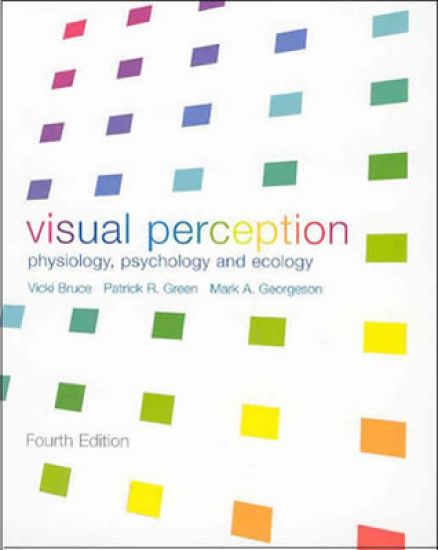
Visual Perception

Visual Perception

Vicki Bruce; Mark A. Georgeson; Patrick R. Green

Psychology Press Ltd
2003
nidottu
This comprehensively updated and expanded revision of the successful second edition continues to provide detailed coverage of the ever-growing range of research topics in vision. In Part I, the treatment of visual physiology has been extensively revised with an updated account of retinal processing, a new section explaining the principles of spatial and temporal filtering which underlie discussions in later chapters, and an up-to-date account of the primate visual pathway. Part II contains four largely new chapters which cover recent psychophysical evidence and computational model of early vision: edge detection, perceptual grouping, depth perception, and motion perception. The models discussed are extensively integrated with physiological evidence. All other chapters in Parts II, III, and IV have also been thoroughly updated.
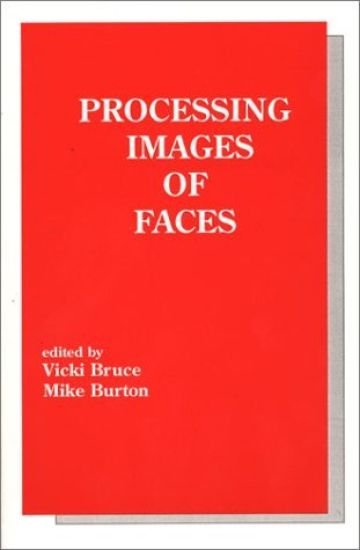
Processing Images of Faces

Processing Images of Faces

Vicki Bruce; Mike Burton

Praeger Publishers Inc
1992
nidottu
The human face poses a challenge to engineers, computer scientists, and psychologists alike. This book integrates different contributions by combining detailed review articles with general overviews of the relationship between different kinds of research on faces and contemporary problems in vision and cognition. Theoretical developments in this area are increasingly dependent on computer technology, both because image-processing techniques allow us to display and manipulate faces for experiments in ways that were not feasible with old photographic technology and because theoretical ideas can be expressed and tested more rigorously using computer simulation. The psychological contributions in this volume illustrate current theoretical developments that are heavily dependent on image processing and computer simulation. As technology improves, so it becomes increasingly feasible to automate many aspects of face processing normally taken for granted to develop new technological aids. Therefore, this volume also includes examples of computing developments for forensic purposes, for the simulation of plastic surgery, and for automatic animation for applications in telecommunications and creative arts.
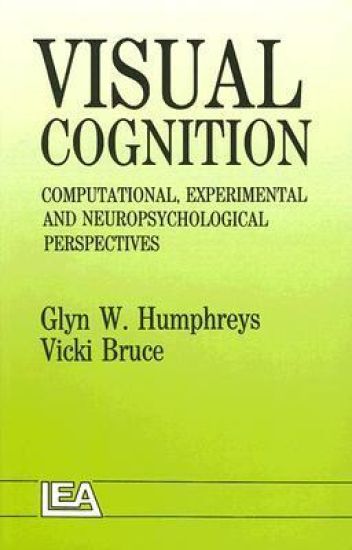
Visual Cognition

Visual Cognition

Glyn W. Humphreys; Vicki Bruce

Psychology Press Ltd
1989
nidottu
Vision allows us to do many things. It enables us to perceive a world composed of meaningful objects and events. It enables us to track those events as they take place in front of our eyes. It enables us to read. It provides accurate spatial information for actions such as reaching for or avoiding objects. It provides colour and texture that can help us to separate objects from their background, and so forth. This book is concerned with understanding the processes that allow us to carry out these various visually driven behaviours. In the past ten years our understanding of visual processing has undergone a rapid change, primarily fostered by the convergence of computational, experimental and neuropsychological work on the topic. Visual Cognition provides the first major attempt to cover all aspects of this work within a single text. It provides a summary of research on visual information processing, relevant to advanced undergraduates, postgraduates and research workers. It covers: seeing static forms, object recognition, dynamic vision (motion perception and visual masking), visual attention, visual memory, visual aspects of reading. For each topic, the relevant computational, experimental and neuropsychological work is integrated to provide a broader coverage than that of other texts.