Kirjojen hintavertailu – 12 903 724 kirjaa ja 27 kauppaa

Kirjailija

Victor A. Canto

Kirjat ja teokset yhdessä paikassa: 5 kirjaa, julkaisuja vuosilta 1986–2018, suosituimpiin kuuluu The Financial Analyst's Guide to Monetary Policy. Vertaile teosten hintoja ja tarkista saatavuus suomalaisista kirjakaupoista.

5 kirjaa

Kirjojen julkaisuvuodet: 1986–2018.

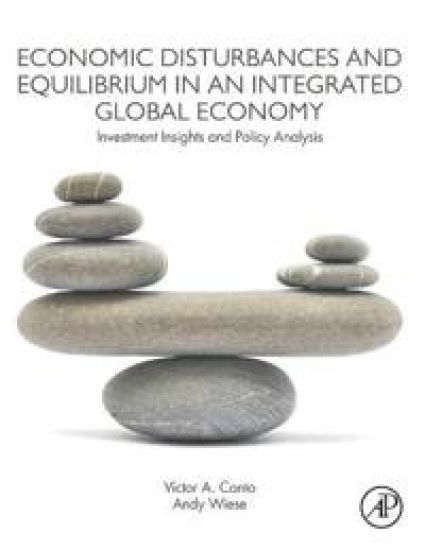
Economic Disturbances and Equilibrium in an Integrated Global Economy
Economic Disturbances and Equilibrium in an Integrated Global Economy: Investment Insights and Policy Analysis helps readers develop a framework for analyzing economic events and make better, more consistent decisions. Victor Canto presents the theoretical building blocks that make up the overall framework, then expands the framework to tackle more complex problems, applying additional considerations to actual policy or investment issues. Drawing upon the most recent trends in monetary policy and international economics, the book offers sustained direct engagement with the main research question and makes innovative use of the simple concepts of supply and demand to illuminate modern finance literature. The book succeeds by highlighting the often-forgotten interconnectedness of different economic processes. How do we respond to a change in policy or an economic shock? Are all the expected changes to the general equilibrium consistent with each other?
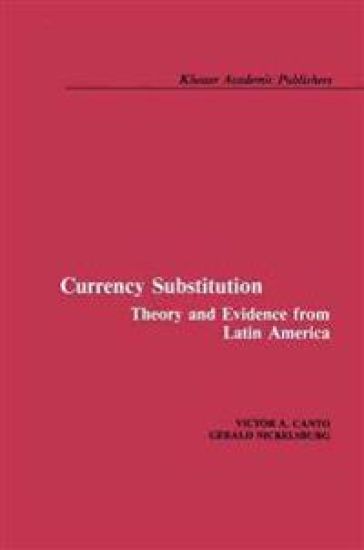
Currency Substitution

Currency Substitution

Victor A. Canto; Gerald Nickelsburg

Springer
2011
nidottu
This work grew out of a series of investigations begun by the authors in 1980 and 1981. Specifically the authors pursued two lines of inquiry. First, to advance the state of the theoretical lit- erature to better explain the crises of liberalization which seemed to be afflicting the third world in general and Latin America in particular. To do this, several different kinds of models were in- vestigated and adapted. These are presented in Chapters 2, 3 and 5. Secondly an analysis of the empirical evidence was conducted in order to gain insight into the processes that were thought to be occurring and the theoretical models that were being developed. Some of this work appears in Chapters 3, 4, 5 and 6. Other work by the authors on these issues has been published elsewhere and is referenced herein. There are a great many people whose work and whose com- ments have influenced this work. We would like to especially thank Guillermo Calvo, Michael Connolly, Sebastian Edwards, Roque Fernandez, Michael Darby, Robert Clower, Neil Wallace, John Kareken, Paul McNelis, Jeffrey Nugent, Jaime Marquez, Lee Ohanian, Leroy Laney, Jorge Braga de Macedo, Dale Henderson, vii Matthew Canzoneiri, Arthur Laffer, Marc Miles, and George Von Furstenberg whose ideas and comments gave rise to much of our work. We would like to thank Suh Lee for his assistance with the computations in Chapter 5.
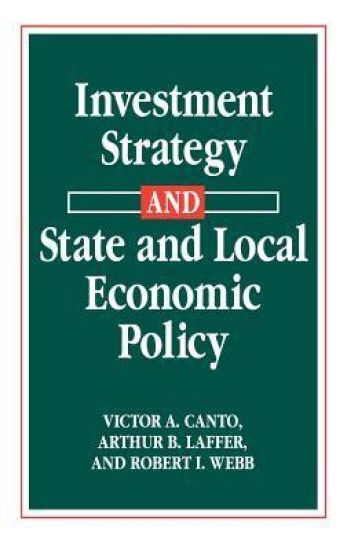
Investment Strategy and State and Local Economic Policy

Investment Strategy and State and Local Economic Policy

Victor A. Canto; Arthur Laffer; Robert I. Webb

Praeger Publishers Inc
1992
sidottu
State governments are ultimately competitors in their economic policies when people, products and capital are free to move across state borders. Nowhere is this competition more apparent than in the United States where individual states compete to promote economic growth by attracting industry with tax holidays, outright grants, subsidized financing and other means. Yet, the arguably greater influence of state fiscal policy on investment decisions has largely been ignored. This book redresses that deficiency by providing a collection of chapters which discuss the theoretical and practical linkage between investment strategy and state economic policy. Specifically, it uses changes in relative state burdens as a measure of state fiscal policy and shows that by altering the incentives to work, save and invest, changes in a state's tax burden relative to other states influence decisions on whether, how much and where to invest. The book is divided into three parts. The first section provides the theoretical framework for the book and discusses application of the basic model to explain the persistent differences in observed real income across states; the level of economic activity; and business starts and failures. The second section discusses, among other things, the implications of changes in state economic policy for investments in real estate; common stocks of small capitalization firms; and state general obligation bonds. The third section of the book, which examines the political dimensions of state economic policy, begins with a discussion of the effect of state economic policy on relative population shifts and reapportionment and ends with a proposal for a flat tax.
Currency Substitution

Currency Substitution

Victor A. Canto; Gerald Nickelsburg

Kluwer Academic Publishers
1987
sidottu
This work grew out of a series of investigations begun by the authors in 1980 and 1981. Specifically the authors pursued two lines of inquiry. First, to advance the state of the theoretical lit- erature to better explain the crises of liberalization which seemed to be afflicting the third world in general and Latin America in particular. To do this, several different kinds of models were in- vestigated and adapted. These are presented in Chapters 2, 3 and 5. Secondly an analysis of the empirical evidence was conducted in order to gain insight into the processes that were thought to be occurring and the theoretical models that were being developed. Some of this work appears in Chapters 3, 4, 5 and 6. Other work by the authors on these issues has been published elsewhere and is referenced herein. There are a great many people whose work and whose com- ments have influenced this work. We would like to especially thank Guillermo Calvo, Michael Connolly, Sebastian Edwards, Roque Fernandez, Michael Darby, Robert Clower, Neil Wallace, John Kareken, Paul McNelis, Jeffrey Nugent, Jaime Marquez, Lee Ohanian, Leroy Laney, Jorge Braga de Macedo, Dale Henderson, vii Matthew Canzoneiri, Arthur Laffer, Marc Miles, and George Von Furstenberg whose ideas and comments gave rise to much of our work. We would like to thank Suh Lee for his assistance with the computations in Chapter 5.
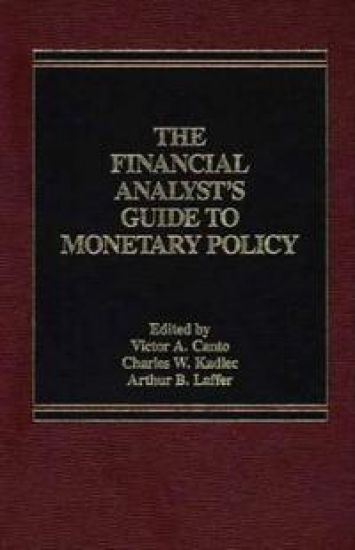
The Financial Analyst's Guide to Monetary Policy

The Financial Analyst's Guide to Monetary Policy

Victor A. Canto

Praeger Publishers Inc
1986
sidottu
The Financial Analyst's Guide to Monetary Policy approaches monetary policy in a straightforward manner. In each chapter, a particular monetary policy problem is addressed and analyzed. Then it considers the practical implications and strategies that are important to the business executives, financial analysts, portfolio managers, and investors in general.