Kirjojen hintavertailu – 12 868 988 kirjaa ja 27 kauppaa

Kirjailija

Victor Robinson

Kirjat ja teokset yhdessä paikassa: 48 kirjaa, julkaisuja vuosilta 2003–2026, suosituimpiin kuuluu 5 of The Most Amazing Things I've Learned About Love. Vertaile teosten hintoja ja tarkista saatavuus suomalaisista kirjakaupoista.

48 kirjaa

Kirjojen julkaisuvuodet: 2003–2026.

Conquest of Bread

Conquest of Bread

Peter Kropotkin; Victor Robinson

READ BOOKS
2020
sidottu

Halvin toimitettuna 35,70 €

"The Conquest of Bread" is an 1892 work by Peter Kropotkin. Kropotkin outlines what he believes are the main problems with both feudalism and capitalism, and explains why they require and encourage poverty and scarcity through the description of a future society based on liberty, equality and fraternity. A must-read for those with an interest in anarchy, communism, or libertarianism. Contents include: "Our Riches", "Well-Being for All", "Anarchist Communism", "Expropriation", "Food", "Dwellings", "Clothing", "Ways and Means", "The Need for Luxury", "Agreeable Work", "Free Agreement", "Objections", "The Collectivist Wages System", "Consumption and Production", "The Division of Labour", etc. Pyotr Alexeyevich Kropotkin (1842-1921) was a Russian writer, activist, revolutionary, economist, scientist, sociologist, essayist, historian, researcher, political scientist, geographer, geographer, biologist, philosopher and advocate of anarcho-communism. He was a prolific writer, producing a large number of pamphlets and articles, the most notable being "The Conquest of Bread and Fields, Factories and Workshops" and "Mutual Aid: A Factor of Evolution". This classic work is being republished now in a new edition complete with an excerpt from "Comrade Kropotkin" by Victor Robinson.
The Conquest of Bread

The Conquest of Bread

Peter Kropotkin; Victor Robinson

Read Co. Books
2020
pokkari
"The Conquest of Bread" is an 1892 work by Peter Kropotkin. Kropotkin outlines what he believes are the main problems with both feudalism and capitalism, and explains why they require and encourage poverty and scarcity through the description of a future society based on liberty, equality and fraternity. A must-read for those with an interest in anarchy, communism, or libertarianism. Contents include: "Our Riches", "Well-Being for All", "Anarchist Communism", "Expropriation", "Food", "Dwellings", "Clothing", "Ways and Means", "The Need for Luxury", "Agreeable Work", "Free Agreement", "Objections", "The Collectivist Wages System", "Consumption and Production", "The Division of Labour", etc. Pyotr Alexeyevich Kropotkin (1842-1921) was a Russian writer, activist, revolutionary, economist, scientist, sociologist, essayist, historian, researcher, political scientist, geographer, geographer, biologist, philosopher and advocate of anarcho-communism. He was a prolific writer, producing a large number of pamphlets and articles, the most notable being "The Conquest of Bread and Fields, Factories and Workshops" and "Mutual Aid: A Factor of Evolution". This classic work is being republished now in a new edition complete with an excerpt from "Comrade Kropotkin" by Victor Robinson.

Pathfinders in medicine

Pathfinders in medicine

Victor Robinson

Alpha Edition
2019
pokkari
This book has been considered by academicians and scholars of great significance and value to literature. This forms a part of the knowledge base for future generations. We have represented this book in the same form as it was first published. Hence any marks seen are left intentionally to preserve its true nature.
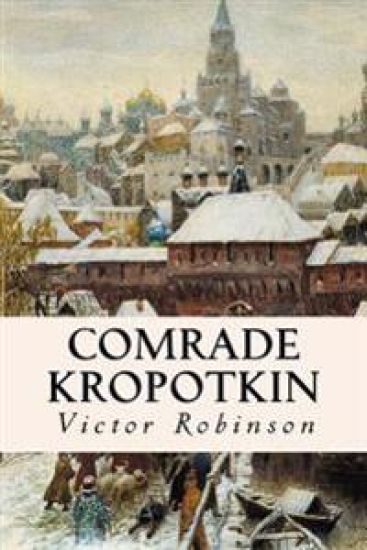
Comrade Kropotkin

Comrade Kropotkin

Victor Robinson

Createspace Independent Publishing Platform
2015
nidottu
Comrade Kropotkin is a classic Russian political biography by Victor Robinson. Bernard Shaw calls us a nation of villagers. To a large extent this appellation holds good. We are so self-sufficient unto ourselves that the most important events in the world leave us cold if they take place outside of the realm of the star-spangled banner. Pyotr Alexeevich Kropotkin (December 9, 1842 - February 8, 1921) was a Russian activist, revolutionary, scientist and philosopher who advocated anarchism. Pyotr Alexeevich Kropotkin was born in Moscow, into the second-highest level of the Russian aristocracy. His mother was the daughter of a Cossack general. 12] His father, Alexei Petrovich Kropotkin, was a prince in Smolensk, 13] of the Rurik dynasty which had ruled Russia before the rise of the Romanovs. Kropotkin's father owned large tracts of land and nearly 1,200 male serfs in three provinces. " U]nder the influence of republican teachings," Kropotkin dropped his princely title at age 12, and "even rebuked his friends, when they so referred to him." In 1857, at age 14, Kropotkin enrolled in the Corps of Pages at St. Petersburg. 15] Only 150 boys - mostly children of nobility belonging to the court - were educated in this privileged corps, which combined the character of a military school endowed with special rights and of a court institution attached to the Imperial Household. Kropotkin's memoirs detail the hazing and other abuse of pages for which the Corps had become notorious. In Moscow, Kropotkin developed what would become a lifelong interest in the condition of the peasantry. Although his work as a page for Tsar Alexander II made Kropotkin skeptical about the tsar's "liberal" reputation, 17] Kropotkin was greatly pleased by the tsar's decision to emancipate the serfs in 1861. 18] In St. Petersburg, he read widely on his own account, and gave special attention to the works of the French encyclop dists and to French history. The years 1857-1861 witnessed a growth in the intellectual forces of Russia, and Kropotkin came under the influence of the new liberal-revolutionary literature, which largely expressed his own aspirations. Born into an aristocratic land-owning family, he attended a military school and later served as an officer in Siberia, where he participated in several geological expeditions. He was imprisoned for his activism in 1874 and managed to escape two years later. He spent the next 41 years in exile in Switzerland, France (where he was imprisoned for almost four years) and in England. He returned to Russia after the Russian Revolution in 1917, but was disappointed by the Bolshevik form of state socialism. Kropotkin was a proponent of a decentralised communist society free from central government and based on voluntary associations of self-governing communities and worker-run enterprises. He wrote many books, pamphlets and articles, the most prominent being The Conquest of Bread and Fields, Factories and Workshops; and his principal scientific offering, Mutual Aid: A Factor of Evolution. He also contributed the article on anarchism to the Encyclop dia Britannica Eleventh Edition 11] and left unfinished a work on anarchist ethical philosophy.
History of Cardiology

History of Cardiology

Louis Faugeres Bishop; John Neilson Jr; Victor Robinson

Literary Licensing, LLC
2013
sidottu
The book ""History of Cardiology"" by Louis Faugeres Bishop is a comprehensive guide that delves into the origins and evolution of cardiology as a medical discipline. The author traces the history of cardiology from ancient times to the modern era, highlighting the major milestones, discoveries, and advancements that have shaped the field. The book covers a wide range of topics related to cardiology, including the anatomy and physiology of the heart, the diagnosis and treatment of cardiovascular diseases, and the development of medical technologies and procedures such as electrocardiography, angiography, and cardiac surgery. In addition to providing a detailed account of the scientific and medical aspects of cardiology, the book also explores the social, cultural, and political factors that have influenced the practice of cardiology throughout history. It examines the role of key figures in the development of cardiology, including William Harvey, Rene Laennec, and Paul Dudley White, and discusses the impact of major events such as World War II on the field of cardiology. Overall, ""History of Cardiology"" is an informative and engaging read that will appeal to anyone with an interest in the history of medicine or the cardiovascular system. This scarce antiquarian book is a facsimile reprint of the old original and may contain some imperfections such as library marks and notations. Because we believe this work is culturally important, we have made it available as part of our commitment for protecting, preserving, and promoting the world's literature in affordable, high quality, modern editions, that are true to their original work.