

Kirjailija
Vikram Rao
Kirjat ja teokset yhdessä paikassa: 5 kirjaa, julkaisuja vuosilta 2012–2023, suosituimpiin kuuluu Shale Gas: The Promise and the Peril. Vertaile teosten hintoja ja tarkista saatavuus suomalaisista kirjakaupoista.
5 kirjaa
Kirjojen julkaisuvuodet: 2012–2023.

A title in the Emerging Issues in Analytical Chemistry series, Particulates Matter: Impact, Measurement, and Remediation of Airborne Pollutants provides the latest technical findings in the study of particulate matter (PM). It links these findings to awareness-raising and actionable schemes for legislated remediation and engineered solutions. Written in an engaging and informative manner, the book begins with a multi-disciplinary overview of the major sources and unique classes of PM, detection techniques, and their impact, including molecular changes resulting in health effects. It then goes one step further by proposing and examining the means to curtail and contain PM generation and ameliorate their impacts. Particulates Matter: Impact, Measurement, and Remediation of Airborne Pollutants offers a high-quality reference guide to PM that will greatly benefit technology leaders in environmental compliance groups, epidemiologists and other public health professionals focused on pollution and health, and researchers and scholars working in pollution, climate change, and urbanization. It may also be useful to advanced undergraduate and early graduate students in environmental sciences.
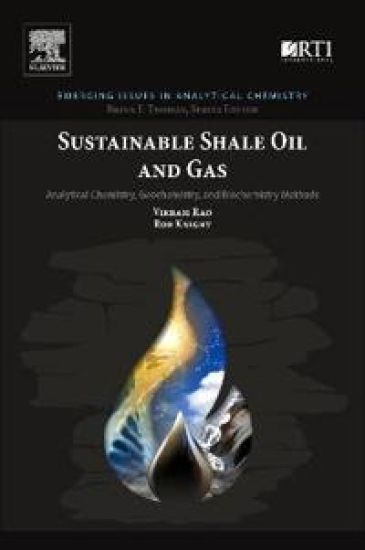
Sustainable Shale Oil and Gas
Vikram Rao; Rob Knight
Elsevier Science Publishing Co Inc
2016
nidottu
Shale oil and gas have altered the energy landscape, possibly permanently. They burst upon the fossil energy scene with a suddenness that initially defied prediction. Even the political balance of the world has changed. But, with the methods employed, the vast majority of the oil and gas remains in the ground. At the same time, serious environmental impact issues have been raised. A new volume in the Emerging Issues in Analytical Chemistry series, Sustainable Shale Oil and Gas: Analytical Chemistry, Geochemistry, and Biochemistry Methods was written on the premise that analytical methods to inform these areas were wanting. While not attempting to be comprehensive, it describes important analytical methods, some still in development. These methods are underpinned primarily by chemistry, but geochemistry and even biochemistry play significant roles. The book has a solutions flavor; problems are posed together with approaches to ameliorate them.
Shale Oil and Gas: The Promise and the Peril, Revised and Updated Second Edition
Vikram Rao
Rti International / Rti Press
2015
nidottu
In the first edition of Shale Gas: The Promise and the Peril, Vikram Rao explained that shale gas has the potential to transform the U. S. energy-based economy in the electricity, transportation, and chemical sectors. Since then, shale oil burst into the national consciousness even more rapidly than did shale gas. In the second edition, Rao does more justice to the shale oil-related issues, including the consequences of unpreparedness of infrastructure to deliver fluids to market. Six new chapters discuss issues such as chemicals disclosure and challenges to the orthodoxy in the production of fuels and chemicals. Both the first and second editions are intended to inform both sides of the fracturing debate, where currently rhetoric is overtaking understanding. Tailored for a nontechnical audience-with technical chemistry and geology information couched in sidebars-the second edition culminates in suggestions for research and guidance for policy making.
Shale gas has the potential to transform the U. S. energy-based economy in the electricity, transportation, and chemical sectors. U. S. success can be expected to translate to Europe and other parts of the world. Shale gas production is uniquely enabled by hydraulic fracturing, a technique that has come under heavy scrutiny for its potential to cause environmental damage. In this book, Vikram Rao addresses the issues surrounding shale gas in a balanced fashion. The book is intended to inform both sides of the fracturing debate, where currently rhetoric is overtaking understanding. Tailored for a nontechnical audience-with technical chemistry and geology information couched in sidebars-the book culminates in suggestions for research and guidance for policymaking.