Kirjojen hintavertailu – 12 903 725 kirjaa ja 27 kauppaa

Kirjailija

Vincent Descombes

Kirjat ja teokset yhdessä paikassa: 5 kirjaa, julkaisuja vuosilta 1981–2016, suosituimpiin kuuluu The Institutions of Meaning. Vertaile teosten hintoja ja tarkista saatavuus suomalaisista kirjakaupoista.

5 kirjaa

Kirjojen julkaisuvuodet: 1981–2016.

Puzzling Identities

Puzzling Identities

Vincent Descombes

Harvard University Press
2016
sidottu
As a logical concept, identity refers to one and the same thing. So why, Vincent Descombes asks, do we routinely use “identity” to describe the feelings associated with membership in a number of different communities, as when we speak of our ethnic identity and religious identity? And how can we ascribe the same “identity” to more than one individual in a group? In Puzzling Identities, one of the leading figures in French philosophy seeks to bridge the abyss between the logical meaning of identity and the psychological sense of “being oneself.” Bringing together an analytic conception of identity derived from Gottlob Frege with a psychosocial understanding stemming from Erik Erikson, Descombes contrasts a rigorously philosophical notion of identity with ideas of collective identity that have become crucial in contemporary cultural and political discourse. He returns to an argument of ancient Greek philosophy about the impossibility of change for a material individual. Distinguishing between reflexive and expressive views of “being oneself,” he shows the connections between subjective identity and one’s life and achievements. We form profound attachments to the particular communities by which we define ourselves. At the same time, becoming oneself as a modern individual requires a process of disembedding oneself from one’s social milieu. This is how undergoing a crisis of identity while coming of age has become for us a normal stage in human life. Puzzling Identities demonstrates why a person has more than one answer to the essential question “Who am I?”

The Institutions of Meaning

The Institutions of Meaning

Vincent Descombes

Harvard University Press
2014
sidottu
Holism grows out of the philosophical position that an object or phenomenon is more than the sum of its parts. And yet analysis--a mental process crucial to human comprehension--involves breaking something down into its components, dismantling the whole in order to grasp it piecemeal and relationally. Wading through such quandaries with grace and precision, The Institutions of Meaning guides readers to a deepened appreciation of the entity that ultimately enables human understanding: the mind itself. This major work from one of France's most innovative philosophers goes against the grain of analytic philosophy in arguing for the view known as anthropological holism. Meaning is not fundamentally a property of mental representations, Vincent Descombes says. Rather, it arises out of thought that is holistic, embedded in social existence, and bound up with the common practices that shape the way we act and talk. To understand what an individual "believes" or "wants"--to apply psychological words to a person--we must take into account the full historical and institutional context of a person's life. But how can two people share the same thought if they do not share the same system of belief? Descombes solves this problem by developing a logic of relations that explains the ability of humans to analyze structures based on their parts. Integrating insights from anthropology, linguistics, and social theory, The Institutions of Meaning pushes philosophy forward in bold new directions.
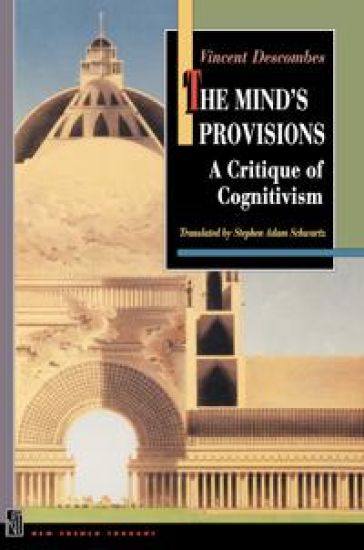
The Mind's Provisions

The Mind's Provisions

Vincent Descombes

Princeton University Press
2010
pokkari
Vincent Descombes brings together an astonishingly large body of philosophical and anthropological thought to present a thoroughgoing critique of contemporary cognitivism and to develop a powerful new philosophy of the mind. Beginning with a critical examination of American cognitivism and French structuralism, Descombes launches a more general critique of all philosophies that view the mind in strictly causal terms and suppose that the brain--and not the person--thinks. Providing a broad historical perspective, Descombes draws surprising links between cognitivism and earlier anthropological projects, such as Levi-Strauss's work on the symbolic status of myths. He identifies as incoherent both the belief that mental states are detached from the world and the idea that states of mind are brain states; these assumptions beg the question of the relation between mind and brain. In place of cognitivism, Descombes offers an anthropologically based theory of mind that emphasizes the mind's collective nature. Drawing on Wittgenstein, he maintains that mental acts are properly attributed to the person, not the brain, and that states of mind, far from being detached from the world, require a historical and cultural context for their very intelligibility. Available in English for the first time, this is the most outstanding work of one of France's finest contemporary philosophers. It provides a much-needed link between the continental and Anglo-American traditions, and its impact will extend beyond philosophy to anthropology, psychology, critical theory, and French studies.
Wittgenstein Reads Freud

Wittgenstein Reads Freud

Jacques Bouveresse; Vincent Descombes

Princeton University Press
1996
pokkari
Did Freud present a scientific hypothesis about the unconscious, as he always maintained and as many of his disciples keep repeating? This question has long prompted debates concerning the legitimacy and usefulness of psychoanalysis, and it is of utmost importance to Lacanian analysts, whose main project has been to stress Freud's scientific grounding. Here Jacques Bouveresse, a noted authority on Ludwig Wittgenstein, contributes to the debate by turning to this Austrian-born philosopher and contemporary of Freud for a candid assessment of the early issues surrounding psychoanalysis. Wittgenstein, who himself had delivered a devastating critique of traditional philosophy, sympathetically pondered Freud's claim to have produced a scientific theory in proposing a new model of the human psyche. What Wittgenstein recognized--and what Bouveresse so eloquently stresses for today's reader--is that psychoanalysis does not aim to produce a change limited to the intellect but rather seeks to provoke an authentic change of human attitudes. The beauty behind the theory of the unconscious for Wittgenstein is that it breaks away from scientific, causal explanations to offer new forms of thinking and speaking, or rather, a new mythology. Offering a critical view of all the texts in which Wittgenstein mentions Freud, Bouveresse immerses us in the intellectual climate of Vienna in the early part of the twentieth century. Although we come to see why Wittgenstein did not view psychoanalysis as a science proper, we are nonetheless made to feel the philosopher's sense of wonder and respect for the cultural task Freud took on as he found new ways meaningfully to discuss human concerns. Intertwined in this story of Wittgenstein's grappling with the theory of the unconscious is the story of how he came to question the authority of science and of philosophy itself. While aiming primarily at the clarification of Wittgenstein's opinion of Freud, Bouveresse's book can be read as a challenge to the French psychoanalytic school of Lacan and as a provocative commentary on cultural authority.
Modern French Philosophy

Modern French Philosophy

Vincent Descombes

Cambridge University Press
1981
pokkari
This is a critical introduction to modern French philosophy, commissioned from one of the liveliest contemporary practitioners and intended for an English-speaking readership. The dominant ‘Anglo-Saxon’ reaction to philosophical development in France has for some decades been one of suspicion, occasionally tempered by curiosity but more often hardening into dismissive rejection. But there are signs now of a more sympathetic interest and an increasing readiness to admit and explore shared concerns, even if these are still expressed in a very different idiom and intellectual context. Vincent Descombes offers here a personal guide to the main movements and figures of the last forty-five years. He traces over this period the evolution of thought from a generation preoccupied with the ‘three H’s’ - Hegel, Husserl and Heidegger, to a generation influenced since about 1960 by the ‘three masters of suspicion’ - Marx, Nietzsche and Freud. In this framework he deals in turn with the thought of Sartre, Merleau-Ponty, the early structuralists, Foucault, Althusser, Serres, Derrida, and finally Deleuze and Lyotard. The ‘internal’ intellectual history of the period is related to its institutional setting and the wider cultural and political context which has given French philosophy so much of its distinctive character.