

Kirjojen hintavertailu – 12 903 725 kirjaa ja 27 kauppaa

Kirjailija

Vincent L. Hutchings

Kirjat ja teokset yhdessä paikassa: 3 kirjaa, julkaisuja vuosilta 2005–2024, suosituimpiin kuuluu Race and Inequality in American Politics. Vertaile teosten hintoja ja tarkista saatavuus suomalaisista kirjakaupoista.

3 kirjaa

Kirjojen julkaisuvuodet: 2005–2024.

Race and Inequality in American Politics

Race and Inequality in American Politics

Zoltan L. Hajnal; Vincent L. Hutchings; Taeku Lee

Cambridge University Press
2024
sidottu
Authored by three of the USA's most well-known scholars on American politics, this undergraduate textbook argues that racial considerations are today-and have always been since the nation's founding-central to understanding America's political system writ large. Drawing on decades of teaching experience and compelling original research, Hajnal, Hutchings, and Lee present an up-to-date and comprehensive survey of race's role in American democracy, spanning topics as wide-ranging as public opinion, voting behavior, media representation, criminal justice, social policy, and protest movements. The reader will examine the perspectives of multiple racial groups, learn how to bring empirical analysis to bear on deeply divided viewpoints, and debate solutions to the many problems of governance in an America that is polarized by party, riven by race, and divided by inequality. Chapters open with a vignette to introduce the core issues and conclude with discussion questions and annotated suggested readings. Full color photos, figures, and boxed features elaborate on and reinforce important themes. Instructor resources are available online.

Race and Inequality in American Politics

Race and Inequality in American Politics

Zoltan L. Hajnal; Vincent L. Hutchings; Taeku Lee

Cambridge University Press
2024
pokkari
Authored by three of the USA's most well-known scholars on American politics, this undergraduate textbook argues that racial considerations are today-and have always been since the nation's founding-central to understanding America's political system writ large. Drawing on decades of teaching experience and compelling original research, Hajnal, Hutchings, and Lee present an up-to-date and comprehensive survey of race's role in American democracy, spanning topics as wide-ranging as public opinion, voting behavior, media representation, criminal justice, social policy, and protest movements. The reader will examine the perspectives of multiple racial groups, learn how to bring empirical analysis to bear on deeply divided viewpoints, and debate solutions to the many problems of governance in an America that is polarized by party, riven by race, and divided by inequality. Chapters open with a vignette to introduce the core issues and conclude with discussion questions and annotated suggested readings. Full color photos, figures, and boxed features elaborate on and reinforce important themes. Instructor resources are available online.
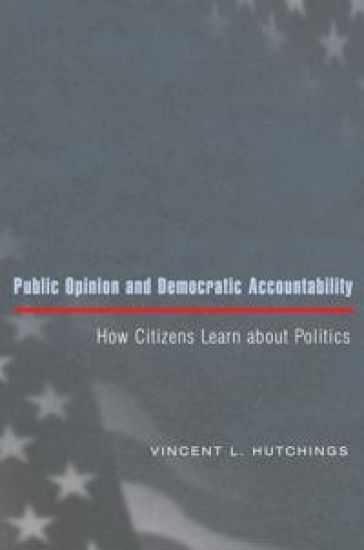
Public Opinion and Democratic Accountability

Public Opinion and Democratic Accountability

Vincent L. Hutchings

Princeton University Press
2005
pokkari
Much of public opinion research over the past several decades suggests that the American voters are woefully uninformed about politics and thus unable to fulfill their democratic obligations. Arguing that this perception is faulty, Vincent Hutchings shows that, under the right political conditions, voters are surprisingly well informed on the issues that they care about and use their knowledge to hold politicians accountable. Though Hutchings is not the first political scientist to contend that the American public is more politically engaged than it is often given credit for, previous scholarship--which has typically examined individual and environmental factors in isolation--has produced only limited evidence of an attentive electorate. Analyzing broad survey data as well as the content of numerous Senate and gubernatorial campaigns involving such issues as race, labor, abortion, and defense, Hutchings demonstrates that voters are politically engaged when politicians and the media discuss the issues that the voters perceive as important. Hutchings finds that the media--while far from ideal--do provide the populace with information regarding the responsiveness of elected representatives and that groups of voters do monitor this information when "their" issues receive attention. Thus, while the electorate may be generally uninformed about and uninterested in public policy, a complex interaction of individual motivation, group identification, and political circumstance leads citizens concerned about particular issues to obtain knowledge about their political leaders and use that information at the ballot box.