Kirjojen hintavertailu – 12 859 824 kirjaa ja 27 kauppaa

Kirjailija

Virginie Lalucq

Kirjat ja teokset yhdessä paikassa: 3 kirjaa, julkaisuja vuosilta 2012–2023, suosituimpiin kuuluu Fortino Samano. Vertaile teosten hintoja ja tarkista saatavuus suomalaisista kirjakaupoista.

3 kirjaa

Kirjojen julkaisuvuodet: 2012–2023.

Cutting the Stems

Cutting the Stems

Virginie Lalucq

Saturnalia Books
2023
nidottu
Translated from the French, Cutting the Stems is a playful, long poem in sections that contains a pastiche of various unlikely influences: manuals on gardening and plant propagation, etymological dictionaries, gemstone and mineral guides, a how-to for florists, and other "un-poetic" texts. Lalucq's poem incorporates word play, linguistic borrowings, and etymological references, and McQuerry and Bourhis's translation captures, and, at times, reinvents, that word play for an English audience. The poem includes the central personas she and he who at times talk past each other in lyrical and often surrealist exchanges. Through these personas, we see gender category, like language, as fluid. She, whose identity merges with the poem's speaker, is a florist and devotes much attention to the tending of words, to " her] sentence," which takes on a life of its own. Cutting the stems of plants becomes akin to cutting away at language so that "the sentences bloom". Lalucq's poetry invites a questioning of poetic convention, foregrounding language's gaps and slippages. In this dual language flip book, the attention to language's instability is all the richer.
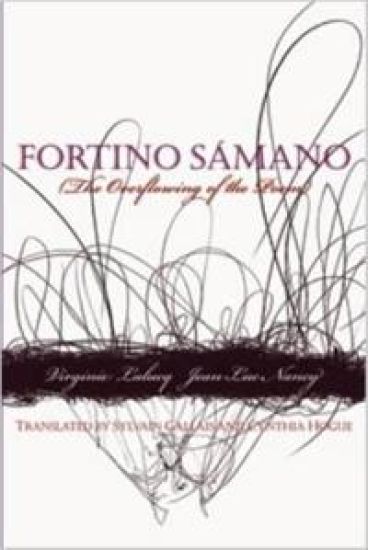
Fortino Samano

Fortino Samano

Jen-Luc Nancy; Virginie Lalucq

Omnidawn Publishing
2012
nidottu
Fortino Sámano (the overflowing of the poem), translated by Cynthia Hogue and Sylvain Gallais, with French on facing pages, is a collaborative work by the emerging French poet, Virginie Lalucq, and the distinguished philosopher, Jean-Luc Nancy. Lalucq wrote the serial poem, Fortino Sámano, after seeing an exhibit of photographs on the Mexican Revolution by Agustin Victor Casasola. Her series is a meditation on the single, extant photograph of Sámano, a Zapatista lieutenant and counterfeiter, which Casasola snapped as Sámano, smoking a last cigar, appeared to stare death nonchalantly in the face moments before his execution by firing squad (it was reported that he himself gave the order to fire). Little is known about Sámano, and Lalucq's poem makes no attempt to be biographical or historical. Rather, she treats the image itself, the fact that the camera caught the image of life just prior to its end. What, then, does the image represent? She asks. Nancy's section, Les débordements du poème (The overflowing of the poem), is a series of poetic commentaries on each of the poems in Lalucq's series. It is a philosophical contemplation of the specific poem, Fortino Sámano, and also, a poetic investigation of the lyric genre, which works hand-in-hand with Lalucq's poems. Fortino Sámano is an exciting poetic dialogue, and a significant work in poetics, which Hogue and Gallais have brought into English.