Kirjojen hintavertailu – 12 903 725 kirjaa ja 27 kauppaa

Kirjailija

Vladik Kreinovich

Kirjat ja teokset yhdessä paikassa: 23 kirjaa, julkaisuja vuosilta 2011–2024, suosituimpiin kuuluu Algorithmic Aspects of Analysis, Prediction, and Control in Science and Engineering. Vertaile teosten hintoja ja tarkista saatavuus suomalaisista kirjakaupoista.

23 kirjaa

Kirjojen julkaisuvuodet: 2011–2024.

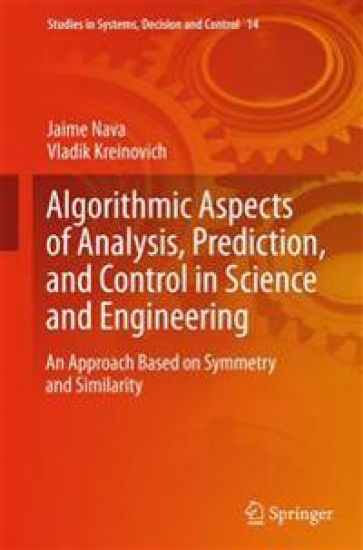
Algorithmic Aspects of Analysis, Prediction, and Control in Science and Engineering

Algorithmic Aspects of Analysis, Prediction, and Control in Science and Engineering

Jaime Nava; Vladik Kreinovich

Springer-Verlag Berlin and Heidelberg GmbH Co. K
2014
sidottu
This book demonstrates how to describe and analyze a system's behavior and extract the desired prediction and control algorithms from this analysis. A typical prediction is based on observing similar situations in the past, knowing the outcomes of these past situations, and expecting that the future outcome of the current situation will be similar to these past observed outcomes. In mathematical terms, similarity corresponds to symmetry, and similarity of outcomes to invariance. This book shows how symmetries can be used in all classes of algorithmic problems of sciences and engineering: from analysis to prediction to control. Applications cover chemistry, geosciences, intelligent control, neural networks, quantum physics, and thermal physics. Specifically, it is shown how the approach based on symmetry and similarity can be used in the analysis of real-life systems, in the algorithms of prediction, and in the algorithms of control.
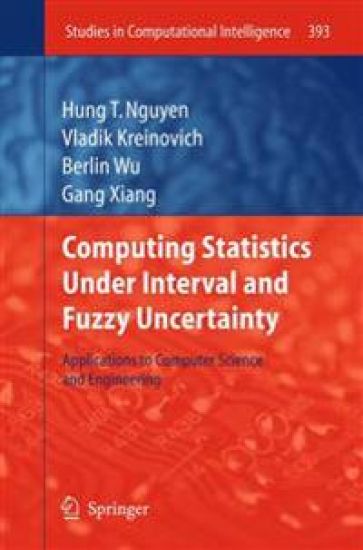
Computing Statistics under Interval and Fuzzy Uncertainty

Computing Statistics under Interval and Fuzzy Uncertainty

Hung T. Nguyen; Vladik Kreinovich; Berlin Wu; Gang Xiang

Springer-Verlag Berlin and Heidelberg GmbH Co. K
2014
nidottu
In many practical situations, we are interested in statistics characterizing a population of objects: e.g. in the mean height of people from a certain area. Most algorithms for estimating such statistics assume that the sample values are exact. In practice, sample values come from measurements, and measurements are never absolutely accurate. Sometimes, we know the exact probability distribution of the measurement inaccuracy, but often, we only know the upper bound on this inaccuracy. In this case, we have interval uncertainty: e.g. if the measured value is 1.0, and inaccuracy is bounded by 0.1, then the actual (unknown) value of the quantity can be anywhere between 1.0 - 0.1 = 0.9 and 1.0 + 0.1 = 1.1. In other cases, the values are expert estimates, and we only have fuzzy information about the estimation inaccuracy. This book shows how to compute statistics under such interval and fuzzy uncertainty. The resulting methods are applied to computer science (optimal scheduling of different processors), to information technology (maintaining privacy), to computer engineering (design of computer chips), and to data processing in geosciences, radar imaging, and structural mechanics.
Computing Statistics under Interval and Fuzzy Uncertainty

Computing Statistics under Interval and Fuzzy Uncertainty

Hung T. Nguyen; Vladik Kreinovich; Berlin Wu; Gang Xiang

Springer-Verlag Berlin and Heidelberg GmbH Co. K
2011
sidottu
In many practical situations, we are interested in statistics characterizing a population of objects: e.g. in the mean height of people from a certain area. Most algorithms for estimating such statistics assume that the sample values are exact. In practice, sample values come from measurements, and measurements are never absolutely accurate. Sometimes, we know the exact probability distribution of the measurement inaccuracy, but often, we only know the upper bound on this inaccuracy. In this case, we have interval uncertainty: e.g. if the measured value is 1.0, and inaccuracy is bounded by 0.1, then the actual (unknown) value of the quantity can be anywhere between 1.0 - 0.1 = 0.9 and 1.0 + 0.1 = 1.1. In other cases, the values are expert estimates, and we only have fuzzy information about the estimation inaccuracy. This book shows how to compute statistics under such interval and fuzzy uncertainty. The resulting methods are applied to computer science (optimal scheduling of different processors), to information technology (maintaining privacy), to computer engineering (design of computer chips), and to data processing in geosciences, radar imaging, and structural mechanics.